Robert Sandifer
Robert "Yummy" Sandifer (March 12, 1983 – September 1, 1994) was an 11-year-old American boy from Chicago, Illinois. Sandifer's murder by fellow gang members in Chicago garnered national attention because of his age,[1][2][3][4] resulting in his appearance on the cover of Time magazine in September 1994.[5] Nicknamed "Yummy" because of his love of cookies,[6] standing 137 cm (4 ft 6 in), Sandifer was a young member of the street gang the Black Disciples (BD).
Robert Sandifer | |
|---|---|
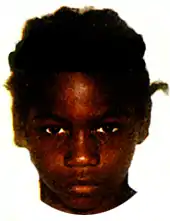 | |
| Born | March 12, 1983 Chicago, Illinois, U.S. |
| Died | September 1, 1994 (aged 11) Chicago, Illinois, U.S. |
| Cause of death | Gunshot wounds |
| Other names | "Yummy" |
| Occupation | Street gang member (Black Disciples) |
| Criminal status | Deceased |
| Parent(s) | Lorina Sandifer Robert Akins |
| Criminal charge | Murder, arson, armed robbery, drug possession |
| Penalty | Probation |
After committing murder, arson and armed robbery, he was murdered by his own fellow gang members who feared he could become an informant, and that he was attracting too much attention towards their activities. Coverage of Sandifer's death and retrospectives on his short, violent life were widely published in the American media. Sandifer became a symbol of the gang problem in American inner cities, the failure of social safety nets, and the shortcomings of the juvenile justice system.
Biography
Early life
Robert Sandifer was born in Chicago, Illinois, on March 12, 1983. Sandifer's mother, Lorina Sandifer, had over 30 arrests while prostituting,[7] many of which were drug-related. Sandifer's father, Robert Akins, was absent throughout Sandifer's life due to incarceration for a felony gun charge. Sandifer was physically abused from the time he was an infant.[6]
Before he was three years old, Sandifer was already known to the Department of Children and Family Services (DCFS). Physical examinations showed that Sandifer was alleged to have had cigarette burns on his arms and neck as well as linear bruising consistent with physical beatings. Lorina initially blamed the abuse on Sandifer's father, although she later recanted.[8]
In 1986, Sandifer and his siblings were removed from his mother's home by DCFS and were sent to live with their grandmother in the Roseland neighborhood of Chicago. His grandmother's residence contained as many as 19 children on some occasions. By most accounts, his grandmother's home was not much better than Sandifer's previous home.[8]
Sandifer, by the age of eight, quit attending school and began to roam the streets stealing cars and breaking into houses. At the age of ten, Sandifer was arrested on charges of armed robbery. A psychological examiner at the time reported that "Robert is a child growing up without any encouragement and support," and that he "has a sense of failure that has infiltrated almost every aspect of his inner self."[8]
In 1993, Sandifer and his siblings were removed from his grandmother's home and were sent to the Lawrence Hall DCFS shelter on Chicago's North Side, from which Sandifer ran away and never returned. From 1993 until his death, Sandifer's whereabouts and living arrangements remain unclear, although he continued to be arrested by the authorities.[2]
Murder of Shavon Dean
On August 28, 1994, Sandifer was ordered to do a favor for his gang. He opened fire several times with a 9-millimeter semiautomatic pistol, striking several youths. Sandifer quickly fled the scene. Among his victims was a 14-year-old girl, Shavon Dean, who was fatally hit by a stray bullet.[9]
Death
On August 31, while standing on a neighbor's porch after asking to call his grandmother (in whom he had the greatest trust),[10] Sandifer was met by brothers Cragg and Derrick Hardaway, ages 16 and 14, who were both members of the Black Disciples street gang. Sandifer was told he was being taken to a safe location and ordered into a waiting car.[9]
Instead, he was taken to a railroad underpass at East 108th Street and South Dauphin Avenue and told to get on his knees. While kneeling, Sandifer was shot twice in the back of the head by the Hardaway brothers.[9] Sandifer's body was discovered by the Chicago Police Department in the early morning of September 1.[11][12]
Around 400 people attended Sandifer's funeral, which was held at the Youth Center Church of God in Christ on Chicago's Northwest Side.[13]
The Hardaway brothers were later convicted of Sandifer's murder.[11][12] Derrick Hardaway, aged 14 at the time of Sandifer's murder, received a sentence of 20 years. He was released in December 2016.[14]
In popular media
- Yummy: the Last Days of a Southside Shorty, a graphic novel
See also
References
- Long, Elizabeth Valk (19 September 1994). "To Our Readers". TIME. Archived from the original on January 22, 2011. Retrieved 30 March 2011.
- Gibbs, Nancy R.; Grace, Julie; Hull, Jon D. (19 September 1994). "Murder in Miniature". TIME. Archived from the original on April 28, 2007. Retrieved 30 March 2011.
- Grace, Julie (12 September 1994). "There Are No Children Here". TIME. Archived from the original on January 22, 2008. Retrieved 30 March 2011.
- Hewitt, Bill (19 September 1994). "Death at an Early Age". People. pp. 52–54. Retrieved 30 March 2011.
- "TIME Magazine Cover: Robert (Yummy) Sandifer". TIME. 19 September 1994. Archived from the original on January 22, 2008. Retrieved 30 March 2011.
- Powers, Mike (Winter 1995). "Stop the Violence". Human Ecology Forum. 23 (1).
- "Too Young to Kill, Too Young to Die - Robert "Yummy" Sandifer • Morbidology". January 19, 2018.
- Papajohn, George (2 September 1994). "Robert: Executed At 11". Chicago Tribune. Retrieved 10 June 2019.
- "Two fellow gang members charged in execution of 11-year-old". Daily Herald. Associated Press. 3 September 1994. p. 6 – via NewspaperArchive.
- Buckley, William Lee, Madeline. "11-year-old 'Yummy' Sandifer was on the run for killing a teenage girl. Then he was killed by his own gang in a Chicago story that shocked the nation 25 years ago". chicagotribune.com.
- Sharon Cohen (18 December 2007). "Locked up at 14 for an infamous murder, living with regrets and dreaming of a future". Star-News. Archived from the original on 14 December 2013. Retrieved 4 January 2016.
- Lee, William; Buckley, Madeline (30 August 2019). "11-year-old 'Yummy' Sandifer was on the run for killing a teenage girl. Then he was killed by his own gang in a Chicago story that shocked the nation 25 years ago". Chicago Tribune. Retrieved 31 August 2019.CS1 maint: uses authors parameter (link)
- Terry, Don (8 September 1994). "In an 11-Year-Old's Funeral, a Grim Lesson". The New York Times. Retrieved 15 September 2013.
- Bogert, Carroll (20 November 2020). "I Wasn't a Superpredator. I Was a Kid Who Made a Terrible Decision". The Marshall Project. Retrieved 6 April 2021.