Roberto María Ortiz
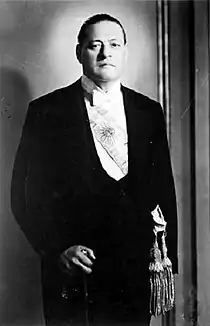
Jaime Gerardo Roberto Marcelino María Ortiz Lizardi (September 24, 1886 – July 15, 1942) was the 19th President of Argentina from February 20, 1938 to June 27, 1942.
Roberto M. Ortiz | |
|---|---|
 | |
| President of Argentina | |
| In office February 20, 1938 – June 26, 1942 | |
| Vice President | Ramón Castillo |
| Preceded by | Agustín P. Justo |
| Succeeded by | Ramón Castillo |
| Personal details | |
| Born | September 24, 1886 Buenos Aires |
| Died | July 15, 1942 (aged 55) Buenos Aires |
| Nationality | Argentine |
| Political party | Radical Civic Union |
| Other political affiliations | Concordancia |
| Spouse(s) | María Luisa Iribarne Daubert |
| Profession | Lawyer |
Ortiz is a little remembered president. He became president in 1937, in one of the most fraudulent elections in our history, but his main management objective was to end fraud. The attempt to normalize the institutions confronted him with his vice president, Ramón Castillo, leader of the conservative sectors of the government coalition. The president and vice president belonged to different political groupings. Ortiz was a radical antipersonnel and Castillo, a conservative in the National Democratic Party. Both were part of the formula of Concordancia, a coalition that had ruled since 1932.[1]
Life
Ortiz was born in Buenos Aires. As a student at the University of Buenos Aires, he participated in an unsuccessful revolution in 1905. In 1909 he graduated from the university and became a lawyer.
He became active in the Radical Civic Union and was elected to the Argentine National Congress in 1920. He served as minister of public works from 1925 to 1928. He supported the Revolution of 1930 and served as minister of the treasury from 1935 to 1937.
Presidency
In the presidential elections of 1937, he was the official government candidate and won, though the opposition accused him of participating in fraud, as irregularities were widespread. Ortiz never denied those charges but once he took office he tried to make Argentine politics more open and truly democratic. Soon after becoming president, Ortiz became seriously ill with diabetes and on July 3, 1940, he delegated his powers to vice-president Ramón Castillo. He was pro-Allies but because of opposition in the army, he did not break relations with the Axis. He resigned a few weeks before his death.


See also
References
- Perochena, Camila (25 April 2021). "Presidentes en la tormenta: Ortiz y Castillo, una puja feroz en el seno del poder". La Nación.
External links
| May Revolution and Independence War Period up to Asamblea del Año XIII (1810–1814) |  Flag of Argentina | |
|---|---|---|
| Supreme directors of the United Provinces of the Río de la Plata (1814–1820) | ||
| Unitarian Republic – First Presidential Government (1826–1827) | ||
| Pacto Federal and Argentine Confederation (1827–1862) | ||
| National Organization – Argentine Republic (1862–1880) | ||
| Generation of '80 – Oligarchic Republic (1880–1916) | ||
| First Radical Civic Union terms, after secret ballot (1916–1930) | ||
| Infamous Decade (1930–1943) | ||
| Revolution of '43 – Military Dictatorships (1943–1946) | ||
| First Peronist terms (1946–1955) | ||
| Revolución Libertadora – Military Dictatorships (1955–1958) | ||
| Fragile Civilian Governments – Proscription of Peronism (1958–1966) | ||
| Revolución Argentina – Military Dictatorships (1966–1973) | ||
| Return of Perón (1973–1976) | ||
| National Reorganization Process – Military Dictatorships (1976–1983) | ||
| Return to Democracy (1983–present) | ||
Authority control  | |
|---|---|
| General | |
| National libraries | |
| Other | |