Robertson screw
A Robertson screw, also known as a square screw[4] or Scrulox,[5] is a type of screw which has a square-shaped socket in the screw head and a square protrusion on the tool. Both the tool and the socket have a slight taper. Originally to make the manufacture of the screws practical using cold forming of the heads,[6]: 79–81 this taper provides two other advantages which have served to popularize the drive: it makes inserting the tool easier, and tends to help keep the screw on the tool tip without the user needing to hold it there.[6] The Robertson screw is specified as ANSI Type III Square Center.
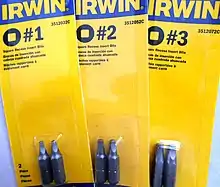
| Color | No | Screw sizes | Fraction | Range | 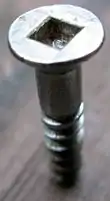 | ||
|---|---|---|---|---|---|---|---|
| in | mm | ||||||
| Orange | #00 | #1, #2 | 1⁄16 in + | 0.05 | 1.3[3] | ||
| Yellow | #0 | #3, #4 | 3⁄32 in − | 0.0696–0.071 | 1.77–1.80 | ||
| Green | #1 | #5, #6, #7 | 7⁄64 in + | 0.090–0.091 | 2.3–2.3 | ||
| Red | #2 | # 8, #9, #10 | 1⁄8 in + | 0.111–0.1126 | 2.82–2.86 | ||
| Black | #3 | #12, 1/4 | 3⁄16 in + | 0.1315–0.133 | 3.34–3.38 | ||
| Brown | #4 | 5/16, 3/8 | 3⁄16 in + | 0.1895–0.191 | 4.81–4.85 | ||
Usage and design
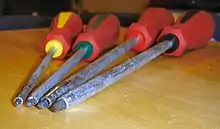
Robertson screws are commonplace in Canada, though they have been used elsewhere[6]: 85–86 and have become much more common in other countries. As patents expired and awareness of their advantages spread, Robertson fasteners have become popular in woodworking and in general construction. Combination Robertson/Phillips drives are often used in the electrical trade, particularly for device and circuit breaker terminals, as well as clamp connectors.
Robertson screwdrivers are easy to use one-handed, because the tapered socket tends to retain the screw, even if it is shaken.[6]: 85–86 They also allow for the use of angled screw drivers and trim head screws. The socket-headed Robertson screws are self-centering, reduce cam out, stop a power tool when set, and can be removed if painted over or old and rusty.[6]: 85–86 In industry, they speed up production and reduce product damage.[6]: 85–86
History


Background
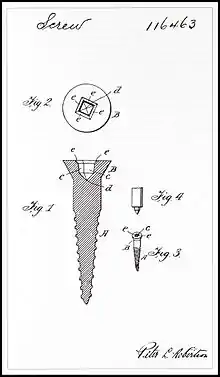
The internal-wrenching square socket drive for screws (as well as the corresponding triangular socket drive) had already been conceived several decades before the invention of the Robertson screw and driver. An earlier patent covering both square-socket- and triangle-socket-drive wood screws, U.S. Patent 161,390, was issued to one Allan Cummings of New York City on March 30, 1875. However, as with other clever drive types conceived and patented in the 1860s through 1890s, it was not manufactured widely (if at all) during its patent lifespan due to the difficulty and expense of doing so at the time.[6]: 79–81
Invention
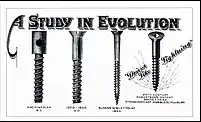
P. L. Robertson invented the Robertson screw and screwdriver in 1906 and received the Canadian patent in 1907 (CA103387, U.S. Patent CA103387A) and US patent 1911 (U.S. Patent 1,003,657) for a manufacturing machine. Robertson's breakthrough in 1908 was to design the socket's taper and proportions in such a combination that the heads could be easily and successfully cold formed,[6]: 79–81 which is what made such screws a valuable commercial proposition. Today, cold forming (by stamping in a die) is still the common method used for most screws sold, although rotary broaching is also common now. Linear broaching to cut corners into a drilled hole (similar to the action of a mortising machine for woodworking) has also been used (less commonly) over the decades.
Licensing
Robertson had licensed the screw design to a maker in England, but the party that he was dealing with intentionally drove the licensee company into bankruptcy and purchased the rights at a reduced price from the trustee, thus circumventing the original agreement. Robertson spent a small fortune buying back the rights, and subsequently refused to allow anyone else to make the screws under license.
When Henry Ford tried out the Robertson screws, he found that they saved considerable time in Model T production, but when Robertson refused to license the screw design, Ford realized that the supply of screws would not be guaranteed and chose to limit their use in production to Ford's Canadian division.[7][8][9]
Robertson's refusal to license his screws prevented their widespread adoption in the United States, where the more widely licensed Phillips head gained wider acceptance. The restriction of licensing of Robertson's internal-wrenching square may have sped the development of the internal-wrenching hexagon or hex key.
"Nüvo" drive system
A new variation of the Robertson drive is the "Nüvo" drive system, in which the screws are compatible with Robertson drive tools, but the screws have rounded lobes that, when used with Nüvo drivers, "dramatically reduce wobbling and stripping out, enabling single-handed operation".[10]
References
- "McFeely's Square Drive Screws". Archived from the original on 2008-11-22. Retrieved 2010-06-03.
- "American Fastener". Archived from the original on 2010-06-12. Retrieved 2010-06-03.
- Wera Catalog, 2011/2012, P. 371
- Kelsey, John; Kirby, Ian J. (2004). Furniture Projects for the Deck and Lawn. ISBN 9781892836175. Retrieved 2012-03-12.
- Robertson Inc. "Robertson Inc. – The Original Robertson Fastening System". Robertson Inc. main site. Retrieved 28 September 2011.
- Rybczynski, Witold (2000). One good turn : a natural history of the screwdriver and the screw. New York [u.a.]: Scribner. ISBN 0-684-86729-X.
- "Robertson Screws".
- "History of Screws and Screwdrivers".
- Martindale, Barbara (1996-03-01). Caledonia: Along the Grand River. ISBN 978-0-920474-81-5.
- "NUVO Screws 2016" (PDF).