Rogers–Ramanujan continued fraction
The Rogers–Ramanujan continued fraction is a continued fraction discovered by Rogers (1894) and independently by Srinivasa Ramanujan, and closely related to the Rogers–Ramanujan identities. It can be evaluated explicitly for a broad class of values of its argument.
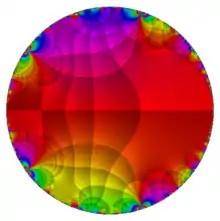



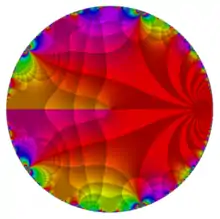
Definition

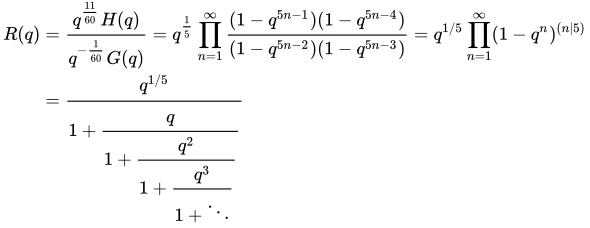
Given the functions and appearing in the Rogers–Ramanujan identities,


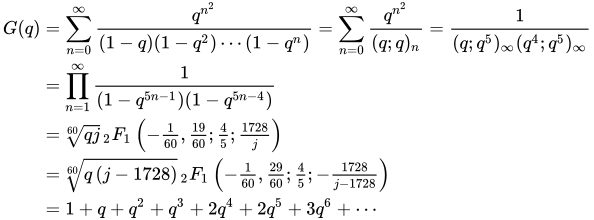
and,
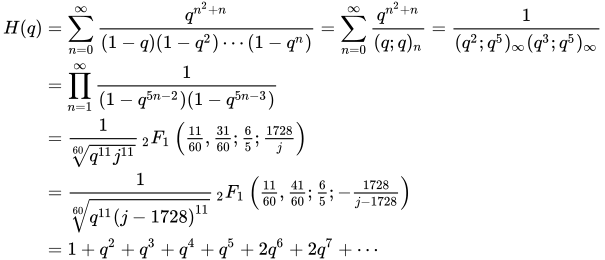
OEIS: A003114 and OEIS: A003106, respectively, where denotes the infinite q-Pochhammer symbol, j is the j-function, and 2F1 is the hypergeometric function, then the Rogers–Ramanujan continued fraction is,

- denotes the Jacobi symbol.

Modular functions
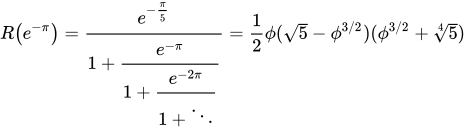
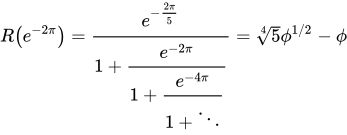
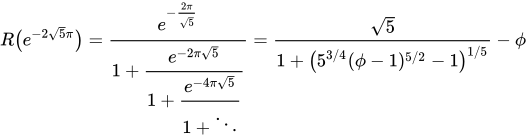
If , then and , as well as their quotient , are modular functions of . Since they have integral coefficients, the theory of complex multiplication implies that their values for an imaginary quadratic irrational are algebraic numbers that can be evaluated explicitly.



Relation to modular forms
can be related to the Dedekind eta function, a modular form of weight 1/2, as,[1]
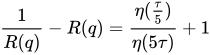
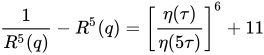
Therefore the Rogers-Ramanujan continued fraction can be expressed in terms of Jacobi theta function this way:



Definition of the nome function:

The small letter k describes the elliptic modulus and the big letter K describes the complete elliptic integral of the first kind.
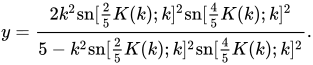
The continued fraction is related to the Jacobi elliptic functions as follows:

with
Relation to j-function
One formula involving the j-function and the Dedekind eta function is this:
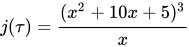
where
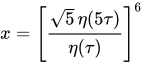
Eliminating the eta quotient , one can then express j(τ) in terms of as,


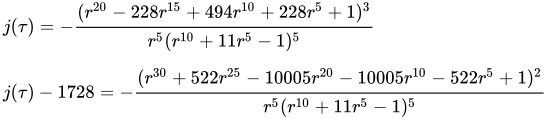
where the numerator and denominator are polynomial invariants of the icosahedron. Using the modular equation between and , one finds that,


let , then

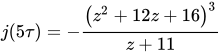
where
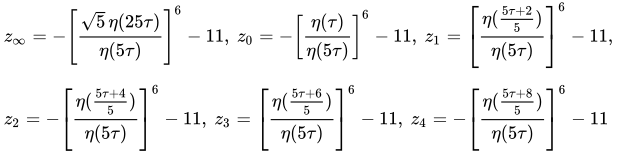
which in fact is the j-invariant of the elliptic curve,

parameterized by the non-cusp points of the modular curve .

Functional equation
For convenience, one can also use the notation when q = e2πiτ. While other modular functions like the j-invariant satisfies,

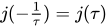
and the Dedekind eta function has,

the functional equation of the Rogers–Ramanujan continued fraction involves[2] the golden ratio ,

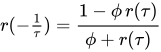
Incidentally,

Modular equations
There are modular equations between and . Elegant ones for small prime n are as follows.[3]

For , let and , then



For , let and , then



For , let and , then



For , let and , then



Regarding , note that

Derivatives
For , the first order derivative of given in terms of the Euler function is [4]

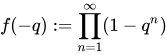

Setting , where , the function is related with the Dedekind eta function
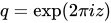



Ramanujan has stated that, for real , with , we have [5]


By taking the logarithmic derivative of the above relation and applying analytic continuation we get
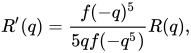
with validity to all complex with .
Evaluations
Assume , and is the root of the equation , (here is the elliptic singular modulus associated with the nome (mathematics) and is the complete elliptic integral of the first kind also see [6],[7],[8]). Then if



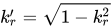


- we get [9]
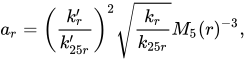

where is root of


Also

Examples of evaluations of and , can be found in tables in the literature. For instance, if we set , then , , and [8] pg.334: , [8] pg.331: , where is the Euler gamma function.






Other results
Ramanujan found many other interesting results regarding .[10] Let , , , and as the golden ratio.


- If , then


- If , then


The powers of also can be expressed in unusual ways. For its cube,

where,


For its fifth power, let , then,


Quintic equations
The general quintic equation in Bring-Jerrard Form can be solved in terms of Rogers-Ramanujan continued fraction. For every real value a > 1 this equation can be solved with the function R(q) and the elliptic nome q(k):

To solve this equation, the elliptic modulus must be determined according to the following pattern:

Then this is the real solution of this quintic equation:

For example, the following equation has the following real solution:



This constant is roughly 1.1673 and it can not be represented by elementary root expressions.
References
- Duke, W. "Continued Fractions and Modular Functions", https://www.math.ucla.edu/~wdduke/preprints/bams4.pdf
- Duke, W. "Continued Fractions and Modular Functions" (p.9)
- Berndt, B. et al. "The Rogers–Ramanujan Continued Fraction", http://www.math.uiuc.edu/~berndt/articles/rrcf.pdf
- N.Bagis, L.Glasser. (2009). "Integrals related with Rogers Ramanujan continued fraction and q-products". arXiv:0904.1641. https://arxiv.org/ftp/arxiv/papers/0904/0904.1641.pdf
- G.Andrews. (1979). Amer. Math. Monthly.Vol 86. pg 89-108.
- J.M. Borwein and P.B. Borwein. (1987). "Pi and the AGM: A Study in Analytic Number Theory and Computational Complexity", Wiley, New York.
- D. Broadhurst. (2008). 'Solutions by Radicals at Singular Values from New Class Invariants for '. arXiv:0807.2976 (math-phy).
- J.M. Borwein, M.L. Glasser, R.C. McPhedran, J.G. Wan, I.J. Zucker. (2013). 'Lattice Sums Then and Now'. Cambridge University Press. New York.
- Nikos Bagis. (2014)."The complete evaluation of Rogers-Ramanujan and other continued fractions with elliptic functions". arXiv:1008.1304v2[math.GM] https://arxiv.org/pdf/1008.1304.pdf
- Berndt, B. et al. "The Rogers–Ramanujan Continued Fraction"


- Rogers, L. J. (1894), "Second Memoir on the Expansion of certain Infinite Products", Proc. London Math. Soc., s1-25 (1): 318–343, doi:10.1112/plms/s1-25.1.318
- Berndt, B. C.; Chan, H. H.; Huang, S. S.; Kang, S. Y.; Sohn, J.; Son, S. H. (1999), "The Rogers–Ramanujan continued fraction" (PDF), Journal of Computational and Applied Mathematics, 105 (1–2): 9–24, doi:10.1016/S0377-0427(99)00033-3