Roman dodecahedron
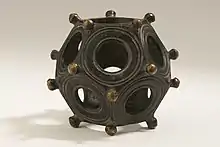
A Roman dodecahedron or Gallo-Roman dodecahedron[2][3] is a small hollow object made of copper alloy which has been cast into a regular dodecahedral shape: twelve flat pentagonal faces, each face having a circular hole of varying diameter in the middle, the holes connecting to the hollow center.[2] Roman dodecahedra date from the 2nd to 4th centuries AD.[2]

History
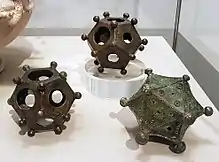
The first dodecahedron was found in 1739. Since then, at least 116 similar objects have been found[2] from Wales to Hungary and Spain and to the east of Italy, with most found in Germany and France. Ranging from 4 to 11 centimetres (1.6 to 4.3 in) in size. A Roman icosahedron has also come to light after having long been misclassified as a dodecahedron. This icosahedron was excavated near Arloff in Germany and is currently on display in the Rheinisches Landesmuseum in Bonn.[4]
Purpose
No mention of dodecahedrons has been found in contemporary accounts or pictures of the time.
Speculative uses include as a candlestick holder (wax was found inside two examples); dice; survey instruments for estimating distances to (or sizes of) distant objects;[5] devices for determining the optimal sowing date for winter grain;[6] gauges to calibrate water pipes, legionary standard bases,[7] or a coin measuring device for counterfeit detection. Several dodecahedra were found in coin hoards, providing evidence that their owners either considered them valuable objects, or believed their only use was connected with coins.[8]
Use as a measuring instrument of any kind seems improbable since the dodecahedra were not standardized: They come in many sizes and arrangements of their openings.
It has also been suggested that they may have been religious artifacts, or even fortune-telling devices. This latter speculation is based on the fact that most of the examples have been found in Gallo-Roman sites.[9][10]
Smaller dodecahedra with the same features (holes and knobs) and made from gold have been found in South-East Asia along the Maritime Silk Road. They have been used for decorative purposes and the earliest items appear to be from the Roman epoch.[11][12] Examples include those uncovered in Óc Eo by Louis Malleret, who concluded that the objects represented Mediterranean influence on Funan by trade.[13] Similar decorative gold dodecahedrons have been found in the Pyu city-states and Khao Sam Kaeo.[11]
Several individuals have suggested that the dodecahedra are knitting aids, specifically for knitting gloves, with different sized holes intended for the different sizes of fingers, and the pegs serving as a lattice to hold the yarn.[14][15]
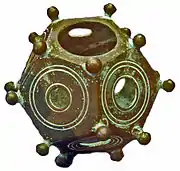 Roman dodecahedron, Schwarzenacker Roman Museum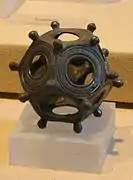
References
- Hunt Museum (2002). The Hunt Museum : essential guide. Scala Publishers in association with the Hunt Museum. ISBN 1-85759-287-5. OCLC 50433650.
- Guggenberger, Michael (2013-10-03). "The Gallo-Roman Dodecahedron". The Mathematical Intelligencer. Springer Science and Business Media LLC. 35 (4): 56–60. doi:10.1007/s00283-013-9403-7. ISSN 0343-6993. S2CID 122337773.
- Hill, Christopher (1994). "Gallo-Roman Dodecahedra: A Progress Report". The Antiquaries Journal. Cambridge University Press (CUP). 74: 289–292. doi:10.1017/s0003581500024458. ISSN 0003-5815.
- Benno Artmann (2012), Euclid – The Creation of Mathematics, pp. 307–308
- Sparavigna, A. (2012). "Roman dodecahedron as dioptron: Analysis of freely available data". arXiv:1206.0946.
- Wagemans, G.M.C. (c. 2015). "Hypothesis: The Roman pentagon dodecahedron [is] an astronomic measuring instrument for determining the optimal sowing date for winter grain" (in English and Dutch). Retrieved 2021-11-08. — This webpage also has a map of the dodecahedron find sites.
-
Lieder, Nancy (2021-08-30). "Use or function of Roman dodecahedrons". Earth Changes and the Pole Shift. Retrieved 2021-08-30.
They were designed to hold standard poles, of various sizes.
- Greiner, Bernhard A. (1996). "Römische Dodekaeder: Untersuchungen zur Typologie, Herstellung, Verbreitung, und Funktion". Carnuntum Jahrbuch 1995 (in German). pp. 9–44.
- Henig, Martin (1984). Religion in Roman Britain. Routledge. p. 128. ISBN 0-7134-6047-4.
- Kilford, L.J.P. (December 2004). "A mathematical tourist in Germany". Mathematics Today. Vol. 40 no. 6. p. 204.
- Bennett, Anna T.N. (2009-12-31). "Gold in early Southeast Asia". ArchéoSciences. OpenEdition (33): 99–107. doi:10.4000/archeosciences.2072. ISSN 1960-1360.
- Xiong, Zhaoming (2014). "The Hepu Han tombs and the maritime Silk Road of the Han Dynasty". Antiquity. Cambridge University Press (CUP). 88 (342): 1229–1243. doi:10.1017/s0003598x0011542x. ISSN 0003-598X.
- Malleret, Louis (1961). "Les dodecaedres d'or du site d'Oc-eo" [The gold dodecohedrons from the Oc-eo site]. Artibus Asiae (in French). JSTOR. 24 (3–4): 343. doi:10.2307/3249235. ISSN 0004-3648. JSTOR 3249235.
- Knitting with a Roman dodecahedron (craft demo video). ChertineP (YouTube user). 1 July 2014 – via YouTube.
-
Roman dodecahedron: Knitting setup (craft demo video). makecraftdo (YouTube channel). 4 July 2020 – via YouTube;
Roman dodecahedron: Knitting a finger (craft demo video). makecraftdo (YouTube channel). 4 July 2020 – via YouTube;
Roman dodecahedron: Thumb placement (craft demo video). makecraftdo (YouTube channel). 27 July 2020 – via YouTube;
Roman dodecahedron: Bind-off (craft demo video). makecraftdo (YouTube channel). 27 July 2020 – via YouTube.CS1 maint: postscript (link)
External links
 Media related to Roman dodecahedron at Wikimedia Commons
- "History Mystery: Ancient Dodecahedron's Purpose Remains Secret" by Alexandria Hein, Fox News, June 10, 2011