Romanian Air Force
The Romanian Air Force (RoAF) (Romanian: Forțele Aeriene Române) is the air force branch of the Romanian Armed Forces. It has an air force headquarters, an operational command, four airbases and an air defense brigade. Reserve forces include two air bases and three airfields.
| Romanian Air Force | |
|---|---|
| Forțele Aeriene Române | |
 Emblem of the Romanian Air Force | |
| Founded |
|
| Country |  Romania Romania |
| Type | Air force |
| Role | Aerial warfare |
| Size | 10,700 personnel[2] |
| Part of | Romanian Armed Forces |
| Headquarters | Bucharest |
| Anniversaries | 20 July[3] |
| Commanders | |
| Chief of the Air Force Staff | Lieutenant general Viorel Pană[4] |
| Insignia | |
| Roundel |  |
| Flag of the General Staff | .svg.png.webp) |
| Aircraft flown | |
| Attack | IAR-330 SOCAT |
| Fighter | MiG-21 LanceR C, F-16AM MLU |
| Reconnaissance | Antonov An-30, RQ-7 Shadow |
| Trainer | MiG-21 LanceR B, F-16BM, IAR-99, Iak-52, IAR 316 |
| Transport | Antonov An-26, C-130 Hercules, C-27J Spartan, IAR-330L/M Puma |
In 2019, the Romanian Air Force employed 15,000 personnel.
Current state
The Romanian Air Force modernized 110 MiG 21 LanceRs, in cooperation with Israel between 1993 and 2002. Today, 23-28 of these MiG 21 LanceRs are operational.[5][6] The Romanian Air Force also operates C-130 Hercules, C-27J Spartan and An-26 transport airplanes and IAR-330 Puma helicopters. IAR-330 PUMA SOCAT helicopters have been modernized by the Romanian Aviation Industry in cooperation with Elbit Systems (Israel) for attack missions. The Romanian Air Force also includes locally built IAR-99 Șoim jet planes, in general only used for training of the young pilots. The remaining MiG-29s have been withdrawn since 2003.
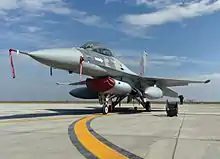
Due to the old age of the MiGs, the Romanian Air Force is in the process of procurement of new fighters or possibly used fighters from partner states. Romania has signed a contract in 2013 with Portugal for 12 F-16 A/B Block 15 MLU fighters.[7] The first six fighters have entered service with the Romanian Air Force in October 2016, another three have been delivered in December and the last three have entered service in 2017.
Also, Romania has signed a contract in 2019 with Portugal for another 5 F-16 A/B Block 15 MLU fighters, which have been delivered up to March 2021.
In the spring of 2009, the Romanian government decided to purchase VSHORAD/SHORAD systems from France.[8] The deal included Mistral MANPADS and MICA VL surface-to-air missiles.[9] However, after preliminary talks with MBDA in August, the deal was put on hold and canceled afterwards because of the defense cuts.[10]
In February 2010, the Supreme Council of National Defense signed an agreement with the United States for missile defence under whose terms land-based SM-3 systems would be installed in Romania. On 3 May 2011, the president of Romania Traian Băsescu announced the location for the SM-3 systems: former Air Force base Deveselu in Olt County.[11] The system includes 3 batteries with 24 SM-3 Block I rockets, manned by approximately 200 US soldiers (with a maximum of 500) under Romanian Air Force overall command. The Deveselu Aegis Ashore site has been declared operational on the 13th of May 2016.[12]
The current chief of the Romanian Air Force Staff, succeeding Major General Fănică Cârnu on 19 December 2013, is Major General Laurian Anastasof.[13]
History
Beginnings
In 1818, during the reign of John Caradja, the prince of Wallachia, an unmanned hot air balloon was flown off Dealul Spirii in Bucharest.[14] On 2 July [O.S. 20 June] 1874, Marius Willemot, the owner of the hydrogen balloon named "Mihai Bravul" flew together with Majors Iacob Lahovary, Constantin Poenaru and Dumitrescu over Bucharest. The last flight took place on 19 [O.S. 7 July] 1874, Willemot flying together with Colonel Nicolae Haralambie, Ion Ghica and a third person. The balloon had made its first flight at Paris on 27 March of the same year.[15]
On 20 November 1909 the Chitila Piloting School was formed as a joint venture by Mihail Cerchez. The school, conducted by French flight instructors, had five hangars, bleachers for spectators and workshops where the Farman airplanes were built under license. The school opened on 9 July 1910, when the chief flight instructor and director of the school René Guillemin crashed a Farman III biplane from a height of 40 metres (130 ft) during a demonstration flight and broke his leg.
Guillemin was succeeded by Michel-Paul Molla who made the first flight across Bucharest on 7 September 1910. Molla was succeeded by two others before the school closed in late 1912 due to financial difficulties, having trained six officers, but only licensed two.[16]
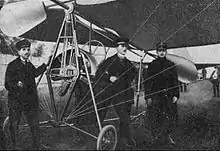
In November 1909, the Romanian Minister of War commissioned Aurel Vlaicu to build the A. Vlaicu I airplane at the Bucharest Army Arsenal which first flew on 17 June 1910. On 28 September during the Fall military exercise, Vlaicu flew his airplane from Slatina to Piatra Olt carrying a message, Romania thus becoming one of the first countries to use airplanes for military purposes.[17] Along with other Romanian pilots, Vlaicu flew reconnaissance missions during the Second Balkan War.[18][19][20] Vlaicu III, the first metal aircraft in the world, was completed after his death, in May 1914.[21]
World War I
On the eve of Romania's entrance in the war in August 1916, only 24 out of the 44 aircraft that had been imported and assembled at RGA were available. Another 20 aircraft were provided by the flight schools. The total of 44 aircraft included: 10 Bristol T.B.8, 7 Bristol Coanda Monoplanes, 5 Blériot XI, 4 Farman HF.20, 8 Farman MF.7 and MF.11, 4 Voisin III, 4 Morane-Saulnier monoplanes, 1 Caudron G.3 and 1 Aviatik C.I.[22][23][24][lower-alpha 1][lower-alpha 2]. Added to these were two native-made monoplanes designed by Aurel Vlaicu.[25] One of the Vlaicu monoplanes, A Vlaicu II, crashed in 1913, leaving A Vlaicu I as the sole Romanian-made aircraft in the Romanian Air Corps.
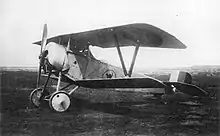
During World War I, Romania acquired 322 aircraft from France and ex-RNAS aircraft from Great Britain including Nieuport 11 and 17 single seat fighters and Morane-Saulnier LA and Nieuport 12 two seat fighters, Caudron G.3, Henry Farman HF.20, Farman MF.11, and Farman F.40 & 46 artillery observation and reconnaissance aircraft, Caudron G.4, Breguet-Michelin BLM and Voisin LA bombers.[26] On 16 September 1916, a Romanian Farman F.40 downed an Imperial German Air Force aircraft near Slobozia; this was the first Romanian aerial victory. By the end of World War I, Romanian pilots had flown about 11,000 hours and 750 missions; however, it was unable to prevent the December 1916 Romanian offensive at the Battle of the Argeș from being defeated, which resulted in the occupation of southern Romania, and the armistice on 6 December 1917 following the Russian revolution.[27]
World War II
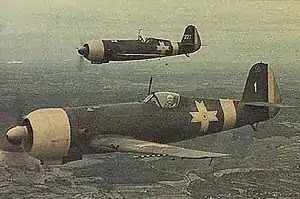
When Romania, allied with Nazi Germany, went to war against the Soviet Union on 22 June 1941, the Romanian Air Force had 621 airplanes, including its locally made fighter IAR 80/81. The air force accomplished hundreds of missions, contributing to Romania's recapture of Northern Bucovina and Bessarabia, which had been occupied by the Soviet Union a year earlier. Until the Odessa episode, the Romanian military fighters gained 661 air victories. Romanian Military Aviation fought on the Eastern Front until 22 August 1944, bringing an important contribution to the great battles at Stalingrad, in Crimea, and the Ukrainian fronts. Between 1941 and 1944, Romanian aircraft won 2,000 air victories. The most famous flying aces were Captain Prince Constantin Cantacuzino, who gained 69 certified victories, Captain Horia Agarici, and Captain Alexandru Șerbănescu, who shot down 60 enemy airplanes.
In the aftermath of King Michael's Coup of 23 August 1944, Romania turned against Germany and joined the Allies.
Cold War
.jpg.webp)
Starting with 1948, Romania tailored its military to Soviet concepts and doctrine. On 15 February 1949, the Aviation Command was established based on the Soviet model (regiments instead of flotillas). New Soviet aircraft, such as Yakovlev Yak-18, Polikarpov Po-2, Lavochkin La-9, Tupolev Tu-2, and Ilyushin Il-10 entered service. A year later, 9 Yakovlev Yak-17s and Yak-23s entered the air force, and in 1952, other 88 aircraft: MiG-15 and MiG-17. In 1958, the first supersonic fighter MiG-19 entered the inventory. Three years later, in February 1962, a new fighter was added to the inventory, MiG-21, which represented one of the most effective fighters of that time.
Starting with 1974, Romanian-made aircraft supplemented the already existing jets. The Romanian IAR-93 attack aircraft flew its first flight on 31 October 1974. It represented a great step forward taking into account that it was the only jet fighter not made by the Soviets, the only one ever manufactured and operated by a Warsaw Pact country.
In 1962, the first helicopter subunits were established and followed later on, in 1965, by the first Soviet Mi-2 and Mi-4 helicopters. Renewing the aircraft fleet process went on, the first 12 MiG-23s entering the service between July–September 1979.
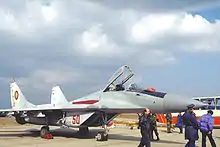
On 14 May 1981, at 20:16, Soviet spaceship Soyuz-40 was launched from Baikonur to perform a common Romanian-Soviet flight, with Lieutenant Dumitru Prunariu and Colonel Leonid Popov as commander on board. During the early 1980s, 67th Fighter-Bomber Regiment and 49th Fighter-Bomber Regiment from Craiova and Ianca were equipped with new IAR-93s, which replaced old MiG-15s and MiG-17s. In December 1989, just a few days before the Romanian revolution against communism began, MiG-29 aircraft entered the Air Force inventory.
2007 Baltic Air Policing
Four MiG-21 LanceR Cs were deployed from August–November 2007 at Šiauliai, in Lithuania for Baltic Air Policing. The Romanian detachment succeeded the French Air Force Mirage 2000Cs of Escadron de Chasse 01.012 from Cambrai, which fulfilled the Baltic Air Policing since May 2007. Once the RoAF finished its three-month stint, a Portuguese Air Force detachment took over the mission.[28]
The four aircraft and most of the staff came from the 71st Air Base. A total of 67 personnel, among them nine pilots, were part of the detachment: 63 served at Šiauliai, while other four served at the air traffic control centre in Kaunas, to ensure smooth cooperation with local authorities. The Romanian detachment attracted attention from the local media, not least from the fact that it was only the second time a fighter from the Soviet era deployed to Šiauliai – Polish Air Force MiG-29s had also been deployed there in 2006.[29]
Structure
Air Force General Staff
The Romanian Air Force General Staff represents the military concept-developing, command and executive structure providing Air Forces peacetime, crisis and wartime leadership in order to reach, maintain and increase, as required, the operational level of the military subordinated structures so that to be able to operate under authorized commands responsible for military operations planning and conduct.
Generate, mobilize, structure, equip, operationalize and regenerate the required forces, provide the logistic support necessary to conduct military operations and based on higher orders, take over both the Joint Operation Air Component and independent air operations command and control, through the Main Air Operational Center. Starting with July 1, 2010, the Romanian Air Force bases were renamed to Air Flotillas.[30]
Units
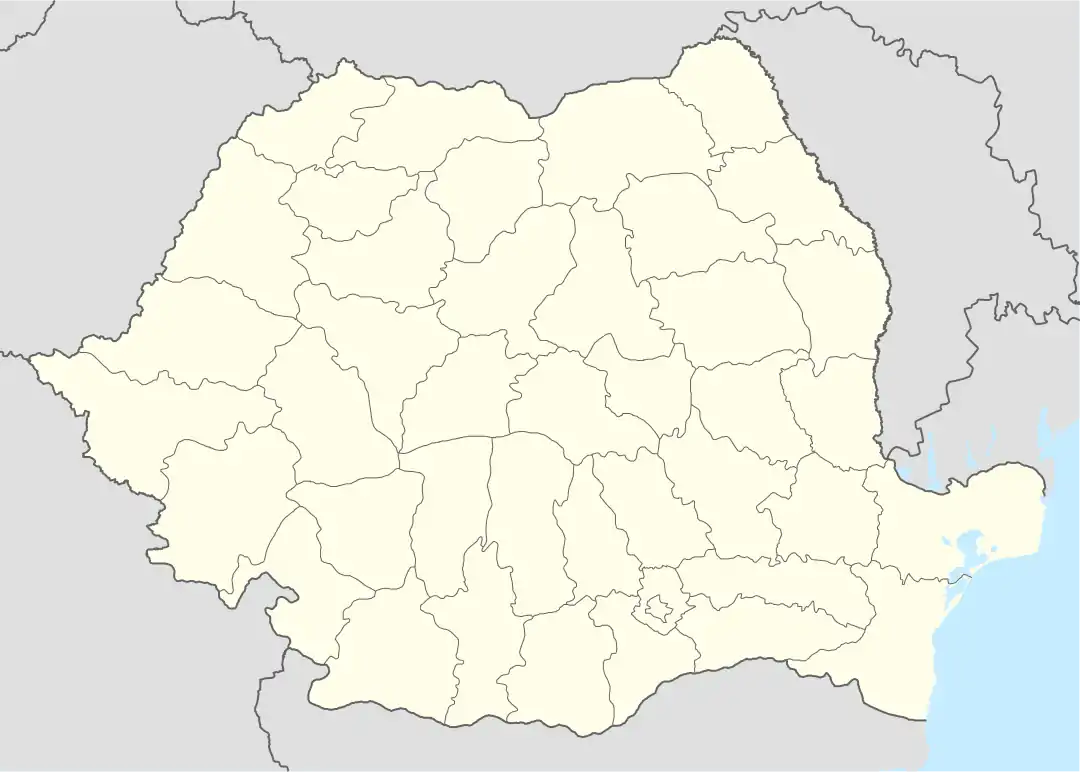


 Fighter base
  Helicopters
  Other flying units AN/FPS-117(V) Radar station Control and Reporting Centre
  Air Signals and IT Centre
The structure current structure of the Romanian Air Force is as follows:[31]
 71st Air Base "General Emanoil Ionescu"
- 71st Air Base, Câmpia Turzii military airfield
- 711th Combat Aviation Squadron, with MiG-21 LanceR C/B
- 713th Combat Helicopter Squadron, with IAR-330 SOCAT
- 71st Air Base annex, at Timișoara – Giarmata IAP
- 712th Helicopter Squadron, with IAR-330L/M (MEDEVAC)
- 71st Air Base, Câmpia Turzii military airfield
 86th Air Base "Locotenent Aviator Gheorghe Mociorniță"
- 86th Air Base, in Fetești – Borcea military airfield
- 86th Air Base annex, at Constanța – Mihail Kogălniceanu IAP (former 57th Air Base)
- 861st Combat Aviation Squadron, with MiG-21 LanceR C/B
- 862nd Helicopter Squadron, with IAR-330M (MEDEVAC)
 90th Airlift Base "Comandor Aviator Gheorghe Bănciulescu"
- 90th Airlift Base, at Bucharest – Otopeni IAP
- 901st Tactical Air Transport Squadron, with C-130B/H Hercules
- 902nd Operational Air Transport and Aerophotogrametric Squadron, with C-27J Spartan and An-30
- 903rd Transport Helicopter Squadron, with IAR-330L/M
- 90th Airlift Base, at Bucharest – Otopeni IAP
 95th Air Base "Erou Căpitan Aviator Alexandru Șerbănescu"
- 95th Air Base, at Bacău IAP
- 951st Advanced Air Training Squadron, with IAR-99 Șoim
- 952nd Combat Helicopter Squadron, with IAR-330 SOCAT
- 95th Air Base, at Bacău IAP
- 142nd Reconnaissance Squadron, with Shadow 600 UAVs, at Timișoara – Giarmata IAP
- Air Operations Centre, in Bucharest
- 2nd Airspace Surveillance Centre "North", at 71st Air Base, in Câmpia Turzii
- Radar Station, in Ovidiu, with AN/FPS-117(V)
- Radar Station, at Giarmata Airport with AN/FPS-117(V)
- Radar Station, in Suceava, with AN/FPS-117(V)
- Radar Station, in Craiova, with AN/FPS-117(V)
- Radar Station, on Muntele Mare, with AN/FPS-117(V)
- Civil/Military Radar Station, in Bârnova, with AN/FPS-117(V)
 1st Surface-to-air Missile Brigade "General Nicolae Dăscălescu", in Bucharest


- 70th Engineering Centre, in Bucharest
- 85th Air Signals and IT Centre "General Doroftei Ghermănescu", in Curtea de Argeș
 91st Logistic Base "General Aviator Andrei Popovici", in Bucharest
 Air Force Academy "Henri Coandă", in Brașov
- Air Force Personnel Training and Formation Air Base
 Air Force Application School "Aurel Vlaicu", Boboc military airfield
- 1st Air Training Squadron AI-A Phase, with IAK-52 and IAR 316B
- 2nd Air Training Squadron AII-A Phase, with IAR 99 Standard
- Air Force NCO and Specialists School "Traian Vuia", Boboc military airfield
- Capu Midia Surface-to-air Training and Air-to-Surface Shooting Range
Reserve air bases
Capu Midia Training Range
The Capu Midia Surface-to-air Training and Air-to-Surface Shooting Range provides firing training, execution and evaluation facilities. It is located in Constanța County, 20 kilometres (12 mi) north of the city of, Constanța.
Aircraft
Current inventory
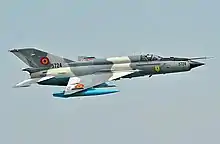
.jpg.webp)
| Aircraft | Origin | Type | Variant | In service | Notes | |
|---|---|---|---|---|---|---|
| Combat Aircraft | ||||||
| MiG-21 | Soviet Union | fighter | LanceR[32] | 23-28[5][6][2] | ||
| F-16 Fighting Falcon | United States | multirole | F-16AM | 14[33] | ex-Portuguese 32 more on order from Norway[34] | |
| Reconnaissance | ||||||
| Antonov An-30 | Ukraine | surveillance | 2[35] | |||
| Transport | ||||||
| Antonov An-26 | Ukraine | transport | 1[35] | |||
| C-27J Spartan | Italy | transport | 7[35] | |||
| C-130 Hercules | United States | transport | C-130B/H | 4/2[36] | ||
| Helicopters | ||||||
| IAR 330L/M | Romania | transpot / utility | 35[37] | licensed built SA330 | ||
| IAR 330L SOCAT | Romania | attack / gunship | 22[2] | |||
| Trainer Aircraft | ||||||
| IAR 99 | Romania | jet trainer | 19[35] | |||
| IAR 316 | Romania | trainer / utility | 7[35] | licensed built SA316B | ||
| Yakovlev Yak-52 | Romania | trainer | Iak-52W/TW | 14[35] | ||
| F-16 Fighting Falcon | United States | conversion trainer | F-16BM | 3[35] | ||
| UAV | ||||||
| RQ-7 Shadow | United States | surveillance | Shadow 600 | 6[38] | ||
- Three C-17 Globemaster III are available through the Heavy Airlift Wing based at Pápa Air Base, Hungary.[39]
- Five RQ-4D Phoenix are shared within NATO's Alliance Ground Surveillance based at Sigonella Air Base, Italy.[40]
Air Defense
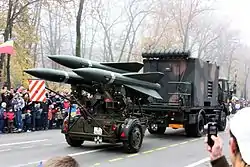
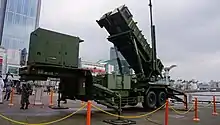
.gif)
The Romanian Air Force also has several anti-aircraft systems:[41]
| Name | Origin | Type | In service | Notes | ||
|---|---|---|---|---|---|---|
| SAM | ||||||
| MIM-104 Patriot | United States | SAM system | 1 battery | A total of 7 batteries (28 launchers) on order, of which 4 will be for the Air Force.[42] | ||
| MIM-23 Hawk | United States | SAM system | 8 batteries[41][43] | |||
| S-75M3 Volhov | Soviet Union | SAM system | 6 batteries | Will be replaced with the Patriot system.[41] | ||
| Air Defence Artillery | ||||||
| S-60 57mm | Soviet Union | Mobile anti-aircraft | Unknown amount | towed gun[44] | ||
| KS-19 100 mm | Soviet Union | Mobile anti-aircraft | 30 units | towed gun | ||
| Radars | ||||||
| AN/TPS-79(R) Gap Filler | Romania United States |
Radar | 17 | Medium range 3D radar.[45][46] | ||
| AN/FPS-117 | United States | 3D radar | 5 FPS-117[47] 4 TPS-77[48][49] |
Long-range 3D radar | ||
| P-37 (radar) | Soviet Union | Radar | Unknown amount | E band/F band 2D radar[50] | ||
| P-18 | Soviet Union | Radar | Unknown amount | 2-dimensional air search radar[51] | ||
| P-14 | Soviet Union | Radar | Unknown amount | 2D VHF radar[52] | ||
| PRV-13 | Soviet Union | Radar | Unknown amount | Radar altimeter[53] | ||
Aircraft markings
The Romanian roundel uses the colours of the Romanian flag. It is used on Romanian Armed Forces vehicles and Romanian Air Force aircraft.
- Roundel used for aircraft and vehicles from 1912 to 1941, 1944 to 1950 and since 1984
 Roundel used during WWI. French markings were overpainted with yellow to match the Romanian national colors.
 Roundel seen in 1916, appearing on some aircraft.
 Marking used by Romanian Royal Air Force, and Romanian Royal Army from 1 May 1941 to 3 September 1944
.svg.png.webp) Romanian Roundel used from 1950 to 1984 while under Communist rule
Romanian Roundel used from 1950 to 1984 while under Communist rule
Ranks and insignia
- Officers
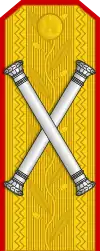
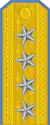
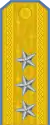
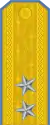
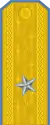
| NATO code | OF-10 | OF-9 | OF-8 | OF-7 | OF-6 | OF-5 | OF-4 | OF-3 | OF-2 | OF-1 | OF(D) | Student officer | ||||||||||||||||||||||||
|---|---|---|---|---|---|---|---|---|---|---|---|---|---|---|---|---|---|---|---|---|---|---|---|---|---|---|---|---|---|---|---|---|---|---|---|---|
| Romanian Air Force[54] |
 |
 |
 |
 |
 |
 |
 |
 |
 |
 |
 |
|||||||||||||||||||||||||
| Mareșal | General | General-locotenent | General-maior | General de flotilă aeriană | Comandor | Căpitan-comandor | Locotenent-comandor | Căpitan | Locotenent | Sublocotenent | ||||||||||||||||||||||||||
- Enlisted
| NATO code | OR-9 | OR-8 | OR-7 | OR-6 | OR-5 | OR-4 | OR-3 | OR-2 | OR-1 | |||||||||||||||||||||||||||
|---|---|---|---|---|---|---|---|---|---|---|---|---|---|---|---|---|---|---|---|---|---|---|---|---|---|---|---|---|---|---|---|---|---|---|---|---|
| Romanian Air Force[54] |
 |
 |
 |
 |
 |
 |
 |
 |
 |
 |
 | |||||||||||||||||||||||||
| Plutonier adjutant principal | Plutonier adjutant | Plutonier-major | Plutonier | Sergent-major | Sergent | Caporal clasa I | Caporal clasa a II-a | Caporal clasa a III-a | Fruntaş | Soldat | ||||||||||||||||||||||||||
See also
References
Notes
- Using the numbers and airplane types from the 3 sources gives that the 20 aircraft from the flight schools were the 10 Bristol TB 8, the 7 Bristol Coanda and 3 Farman HF 20.
- The Morane-Saulnier types were not specified.
Footnotes
- "Anul 1920". RoAF (in Romanian).
- International Institute for Strategic Studies (February 2021). The Military Balance 2021. Routledge. pp. 137–139. ISBN 978-1032012278.
- "Ziua Aviației Române și a Forțelor Aeriene. 100 de ani de aviație militară". Stiriletvr.ro. 24 December 2014. Archived from the original on 25 December 2014. Retrieved 24 December 2014.
- "General locotenent doctor Viorel PANĂ". RoAF (in Romanian).
- "Câte MiG-21 LanceR mai are România. Armata trece numărul bătrânelor avioane la "informații confidențiale"". Defense Romania (in Romanian). 21 April 2021.
- "Câte avioane MiG-21 LanceR mai are România?". Aviatia Magazin (in Romanian). 1 July 2021.
- Cristian Fierbinteanu (11 October 2013). "România şi Portugalia au semnat contractul de achiziţie a 12 avioane F-16. Primele avioane vor ajunge în ţară în 2016". Mediafax (in Romanian).
- "Defense & Security Intelligence & Analysis: IHS Jane's – IHS". Archived from the original on 26 April 2012. Retrieved 24 December 2014.
- "Cer Senin Magazine, nr. 3/2009, page 10" (PDF). Archived (PDF) from the original on 2011-08-12. Retrieved 2011-06-29.
- "Defense under external pressure". Archived from the original on 25 December 2014. Retrieved 24 December 2014.
- "Băsescu anunță locul unde vor fi amplasate în România rachetele americanilor. Ce spune primarul din Deveselu, chemat luni seară la Cotroceni să-și dea acordul". Gandul.info. Archived from the original on 28 July 2012. Retrieved 24 December 2014.
- "Scutul american antirachetă din România a devenit operațional. Vezi imagini de afara și din interiorul bazei de la Deveselu". HotNews. Archived from the original on 2016-10-26. Retrieved 2016-10-26.
- "Generalul Laurian Anastasof, noul șef al Forțelor Aeriene". Archived from the original on 25 December 2014. Retrieved 24 December 2014.
- Horia Salca. "Dr. Horia Salca". Archived from the original on 28 December 2014. Retrieved 24 December 2014.
- Ioan Vasile Buiu (2007). "1874: Balonul "Mihai-Bravul" şi Ascensiunile Sale" (PDF) (in Romanian).
- Ralph S. Cooper, D.V.M. "Gheorghe Negrescu". Archived from the original on 3 March 2016. Retrieved 24 December 2014.
- Gheorghiu, 1960, p.101
- "Aviația Magazin – Blog Archive Momente din istoria aviației militare române (II) – Aviația Magazin". Aviația Magazin. 13 January 2013. Archived from the original on 25 December 2014. Retrieved 24 December 2014.
- "Aviația Magazin Blog – Archive Momente din istoria aviației române (III) – Aviația Magazin". Aviația Magazin. 18 January 2013. Archived from the original on 25 December 2014. Retrieved 24 December 2014.
- "503 Service Unavailable". 5 January 2013. Archived from the original on 25 December 2014. Retrieved 24 December 2014.
- Jozef Wilczynski, Technology in Comecon: Acceleration of Technological Progress Through Economic Planning and the Market, p. 243
- Keith Hitchins, Clarendon Press, 1994, Rumania 1866–1947, p. 262
- Ronald L. Tarnstrom, Trogen Books, 1998, Balkan Battles, p. 326
- Alexandru Armă, Valeriu Avram (2017). Aeronautica română în Războiul de Întregire naţională 1916-1919 (in Romanian). Editura Vremea. p. 5.CS1 maint: uses authors parameter (link)
- William Green, John Fricker, MacDonald, 1958, The Air Forces of the World: Their History, Development, and Present Strength, p. 234
- Green, 1971, p.25-26
- Green, 1971, p.26
- Air Forces Monthly, November 2007 issue, p.36.
- Air Forces Monthly, November 2007 issue, p.37.
- "Romania's Air Force Staff to be overhauled starting July 1, 2010". Archived from the original on 25 December 2014. Retrieved 24 December 2014.
- "Romania - Air Force". Scramble (NL).
- "PAF Super Mushak Jets participate in Bucharest International Airshow 2015". 20 June 2015. Retrieved 2021-11-30.
- Bjorn Claes (25 March 2021). "Romania's last F-16 delivered". f-16.net.
- Tudor Curtifan (10 December 2021). "Oficial: România cumpără 32 de avioane F-16 din Norvegia pentru 354 milioane de euro". defense.ro (in Romanian).
- "World Air Forces 2021". Flightglobal Insight. 2021. p. 27. Retrieved 4 September 2021.
- "Guvernul SUA a donat o aeronavă C-130 Hercules Forţelor Aeriene Române". Adevărul (in Romanian). December 14, 2021. Retrieved December 14, 2021.
- International Institute for Strategic Studies (2010-02-03). Hackett, James (ed.). The Military Balance 2010. London: Routledge. p. 158. ISBN 978-1-85743-557-3.
- "Romania gets Shadow 600". flightglobal.com. Retrieved 1 June 2015.
- "Heavy Airlift Wing". Strategic Airlift Capability Program. Retrieved 17 April 2020.
- "Alliance Ground Surveillance (AGS)". NATO. 23 February 2021.
- Victor Cozmei (2 May 2019). "Care sunt rachetele și sistemele de artilerie din arsenalul militarilor români". HotNews (in Romanian).
- "Romania receives first Patriot missile system". romania-insider.com. 17 September 2020.
- Tudor, Radu (9 March 2005). "Romania to get Dutch HAWK missiles". IHS Jane's Defence Weekly.
- "Tunul antiaerian S-60". RoAF (in Romanian).
- Radu Tudor (19 March 2008). ""Romania orders more AN/TPS-79s to fill radar gap", un articol apărut în Jane's Defence Weekly, 18 martie 2008". UTI.
- Christian Wolff. "AN/TPS-79 (MMSR)". Radartutorial.
- "Upgrades for the Romanian AN/FPS-117 long-range Radars". DefenceTalk. 15 February 2007.
- Marius Constantin (24 February 2016). "Lockheed Martin va livra Romaniei doua radare TPS-77" (in Romanian).
- David Victor (8 February 2018). "MApN achizitioneaza 2 radare TPS-77 si lansatoare portabile de rachete antitanc Spike" (in Romanian).
- "Radarul P-37". RoAF (in Romanian).
- "Radarul P-18". RoAF (in Romanian).
- "Radarul O/P-14". RoAF (in Romanian).
- "Radiometrul PRV-13". RoAF (in Romanian).
- "Grade militare (Military ranks)". defense.ro (in Romanian). Romanian Defence Staff. Retrieved 1 February 2021.
Bibliography
- Bernád, Dénes (2003). Rumanian Aces of World War 2 (Aircraft of the Aces 54). Botley, Oxford, UK: Osprey Publishing. pp. #–##. ISBN 184176535-X.
- Bernád, Dénes (1999). Rumanian Air Force: The Prime Decade, 1938–1947. Carrollton, TX: Squadron/Signal Publications Inc. ISBN 0897474023.
- Craciunoiu, Cristian (February 2002). "Deux des Savoia..." [Two of Savoia...]. Avions: Toute l'Aéronautique et son histoire (in French) (107): 7–16. ISSN 1243-8650.
- Crăciunoiu, Cristian; Roba, Jean-Louis (2003). Romanian Aeronautics in the Second World War, 1941–1945. București, Romania: Editura Modelism International. ISBN 973-8101182. (bilingual Romanian/English)
- Green, W.; Swanborough, G., eds. (June 1971). "Oil Well Top Cover – Sixty Years of Rumanian Military Aviation". Air Enthusiast. 1 (1): 25–26.
External links
 |
Wikimedia Commons has media related to Air force of Romania. |
- Official site of the Romanian Air Force
- Official site of the Romanian Ministry of National Defense (MoND)
- Order of Battle of the RoAF
.svg.png.webp)
.svg.png.webp)

.svg.png.webp)

.svg.png.webp)