Romualdas Giedraitis
Romualdas Giedraitis (French: Romuald Gedroitze; Polish: Romuald Tadeusz Giedroyć/Gedroić/Giedrojć; 7 February 1750 – 15 October 1824) was a Polish-Lithuanian prince from the Lithuanian princely Giedraičiai family,[2] who fought in the Bar Confederation, War of 1792 and the Kościuszko Uprising as part of the Grand Ducal Lithuanian Army. From mid-1812 to early 1813, Giedraitis was also the commander of the Lithuanian regiments raised during the French invasion of Russia.[3][4] In early 1813, he was captured by the Russians and exiled to Arkhangelsk. In 1815, Alexander I of Russia amnestied Giedraitis and made him a Lieutenant general of the Army of Congress Poland.
Romualdas Giedraitis | |
|---|---|
.jpg.webp) Portrait of Romualdas Giedraitis in the uniform of a Grand Ducal Lithuanian General of the artillery[1] 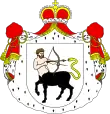 Coat of arms: Hipocentaur | |
| Born | 7 February 1750 Babtinas, Grand Duchy of Lithuania |
| Died | 15 October 1824 (aged 74) Warsaw, Congress Poland |
| Allegiance |
|
| Service/ | |
| Years of service | 1765–1794, 1812–1813 |
| Rank |
|
| Unit |
|
| Battles/wars | Bar Confederation
War of 1792
Kościuszko Uprising
|
| Awards | Order of Saint Stanislaus (1790)[2] |
Grand Duchy of Lithuania
From 1765, he was in the Corps of Cadets in Warsaw.[2]
Bar Confederation
Giedraitis began his military career in 1765 as a cadet in the 2nd Foot Regiment of the Grand Ducal Lithuanian Army, part of the Polish-Lithuanian Army.[5] The regiment in which he served followed Casimir Pulaski.[4] In it, Giedraitis reached the rank of major.[4] In 1771, he served in the unit led by Michał Kazimierz Ogiński.[4] At the battle of Stalavičiai in 1771, Giedraitis was distinguished by his valour and was wounded eight times.[4][5]
In 1784, we has a member of the Sejm of Gardinas.[3][4] After a long recovery, Romualdas Giedraitis was made the vice-commander of the 1st Lithuanian National Cavalry Brigade.[5]
War of 1792
Giedraitis fought in the War of 1792.[2][5] During this war, he was elevated to the rank of Major general.[3][4][5] When Stanisław August Poniatowski signed the Targowica Confederation, Giedraitis wrote a report to him, demanding that he would be released from military service.[5]
Uprising of 1794
In 1794, he was one of the organizers of the Kościuszko Uprising in the Grand Duchy of Lithuania.[2] On April 16, in Šiauliai, he, together with Niesiolovskis, A. Prozoras and P. Zaviša, announced the first act of uprising in Lithuania.[2][3] On April 18, Giedraitis and 200 cavalrymen advanced to Šatės, where he fought with Kossakowski's regiment which supported the Russians.[3] From April 24, he was a member of the Lithuanian National Supreme Council.[2] From northeastern Lithuania, he went to Vilnius, which he reached on April 30.[3]
From June to August, he commanded the Samogitian Division's right wing.[2] Together with Tomasz Wawrzecki, they took over Liepoja.[3] In July, Giedraitis took over Salistrovski's command of a corps, and on July 3, fought with the Imperial Russian Army near Pušalotas.[3] A week later, on July 10, the Russians attacked him once more.[3] After a fortnight and a few more days, on July 28, Giedraitis won a battle near Vaiškai.[3][5] On July 29, he won the Battle of Saločiai (Sałaty).[2][4] In the battle, he dealt a heavy defeat to the stronger Russian unit of Lieutenant General Sergei Fedorovich Golitsyn.[6] Thanks to this victory, southern Courland came under the control of the insurrectionary forces.[6] Tadeusz Kościuszko promoted him to the rank of Lieutenant general.[4] Moreover, Kościuszko gave Giedraitis the permission to raise a regiment named Sałaty.[4] Following the victorious fight on July 29, he went towards Joniškėlis.[3]
On 8 September 1794, he took over the command of the Armed Forces of the Grand Duchy of Lithuania in the Kościuszko Uprising from Antoni Chlewiński.[3] At the time, he marched to Varėna.[3] From there, he retreated towards the Kingdom of Poland.[3] On November 3, near Stara Wieś, he joined Jan Henryk Dąbrowski.[3] At the time, Romualdas Giedraitis had 2,000 infantrymen, 700 cavalrymen and 17 cannons under his command.[3] On November 4, already after the Battle of Praga, he was recalled to Warsaw.[3] However, on November 5, he stopped near Tarczyn, and received Wawrzecki on November 10, who was retreating from Warsaw.[3] After his soldiers began dispersing, Giedraitis and others surrendered to the Russians at Radoszyce, being the last of the rebels to surrender.[3]
From 1795 to 1812
After the uprising's defeat, he emigrated to Paris, then in French First Republic.[3][4] He went together with Tadeusz Mostowski, both being part of a committee that sought the support of the French government.[4] In Paris, Giedraitis acquainted with Josephine Beauharnais.[3] Quickly thereafter, he came back to Lithuania.[3] In February 1796, he was sent by the aforementioned committee to Lithuania in order to encourage the insurrectionary spirit.[4] He first stopped in Dresden, but, seeing no way of being useful to the cause of independence, he retired to his lands, where he lived until 1812.[4] Nevertheless, In 1797, he was involved in the Ciecierski conspiracy.[3] In fact, he was a founder of a secret patriotic organization in Lithuania in 1797.[7]
Napoleonic Wars
Napoleon's Invasion of Russia
During French invasion of Russia in 1812, the day after Napoleon entered Vilnius, on 29 June 1812, an act of renewal of the Polish-Lithuanian Union was proclaimed at Vilnius Cathedral on the initiative of university students. In the following days, this act was signed by several thousand people, and the signatures were collected at the home of Romualdas Giedraitis.[8] Later he was made Chairman of the Military Committee of the Lithuanian Provisional Governing Commission.[2] He was also the Inspector General of the Lithuanian regiments and Pospolite ruszenie formed for Napoleon's army.[2][3][7][9]
On 31 August 1812, General Van Hogendorp appointed him commander of the emerging Lithuanian military units.
War of the Sixth Coalition
During Napoleon's retreat, Giedraitis crossed the Nemunas and the Vistula.[3] On 12–13 February 1813, the Lithuanian cavalry division, which included the 17th Lithuanian Uhlan Regiment, led by him was surprised and defeated by Russian vanguard of Cossacks under general Chernyshev near Sieraków.[2][10] He was wounded during his capture.[10] He was captured by the Russians and imprisoned in Arkhangelsk until 1815.[2][3][4] He was amnestied by Alexander I of Russia.[3]
Concert of Europe
He was part of the Army of Congress Poland with the rank of the Imperial Russian Divisional General.[2][3] He was a member of the military committee charged with the army's organisation.[3][4]
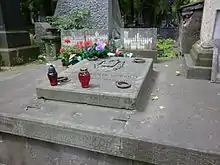
Family
Romualdas Giedraitis married Karolina Anna Borzymowska (1766-1858). Children:[11]
- Ludwik Jerzy (born 1785)
- Stefan Józef Franciszek Ksawery Giedroyć (1787-1855), Colonel of the French Army (1808-1815), fought in the Battle of Waterloo. He received French citizenship in 1835, as Joseph Étienne François Xavier, prince Giedroyc.[12] He married Franciszka Szymańska in 1821.
- Kunegunda Franciszka Róża Giedroyć (1793-1883), Lady-in-waiting of Empress Joséphine and the Russian Empress Elizabeth Alexeievna. She married Jerzy Białopiotrowicz (1785-1871) in 1825.
- Barbara Łucja Giedroyć (1798-1886), wife of general Józef Rautenstrauch (1773-1842) from 1828
- Aleksander Konstanty Julian Giedroyć (1805-1844), Kammerherr of the Imperial Russian palaces. He married Alina Aleksandra Podoska in 1841
Commemoration
On 30 April 2004, the General Romualdas Giedraitis Artillery Battalion of the Lithuanian Armed Forces was given the name of General Romualdas Giedraitis.
References
- Gureckienė, Virginija. LIETUVOS DIDŽIOSIOS KUNIGAIKŠTYSTĖS laikotarpio GRAFIKOS DARBAI Vytauto Didžiojo karo muziejaus rinkiniuose (PDF) (in Lithuanian). Kaunas: Vytautas the Great War Museum. p. 40. ISBN 978-609-412-056-5.
- Jasas 2021.
- Ivinskis & Biržiška 1956, p. 218.
- Michaud 1838, p. 322.
- Daugirdas 2021.
- "Powstanie kościuszkowskie (12.03.1794 - 16.11.1794)". www.muzeumwp.pl (in Polish). Polish Army Museum.
- Judycki & Judycki 2021, p. 23.
- Nawrot 2008, p. 265.
- Jasas 2004, p. 639.
- "Epoka napoleońska lata 1796-1815". www.muzeumwp.pl (in Polish). Polish Army Museum.
- Romuald Tadeusz ks. Giedrojć h. wł. in M.J. Minakowski: Wielka Genealogia Minakowskiego
- Stefan Józef Franciszek h. wł. in M.J. Minakowski: Wielka Genealogia Minakowskiego
Sources
- Ivinskis, Zenonas; Biržiška, Vaclovas (1956). "Romualdas Giedraitis". Lietuvių Enciklopedija (in Lithuanian). 7. United States of America.
- Daugirdas, A. (2021). "Divizijos Generolas Kunigaikštis Romualdas Gedraitis" (in Lithuanian). Archived from the original on 9 October 2021.
- Jasas, Rimantas (2004). "Romualdas Giedraitis (1750)". Visuotinė lietuvių enciklopedija (in Lithuanian). VI (Fau-Goris). Vilnius: Mokslo ir enciklopedijų leidybos institutas.
- Jasas, Rimantas (2021). "Romualdas Giedraitis". Vle.lt (in Lithuanian). Mokslo ir enciklopedijų leidybos centras. Archived from the original on 8 October 2021.
- Michaud, Louis Gabriel (1838). "Giedroyc". Biographie universelle, ancienne et moderne (in French). 65. Paris: Imprimerie de Paul Dupont et Cie. p. 322.
- Judycki, Zbigniew; Judycki, Maksymilian (2021). Polacy w Armii Napoleona - Słownik Biograficzny Dowódców (PDF). Warsaw. ISBN 978-83-66640-51-1.
- Nawrot, Dariusz (2008). Litwa i Napoleon w 1812 roku. Katowice. ISBN 9788322617489.