Roy MacLeod
Roy Malcolm MacLeod OAM FSA FRHistS FAHA FASSA FRSN is an American-born historian who has spent his career working in the United Kingdom and Australia. He is a leading specialist on the history and social studies of science and knowledge.
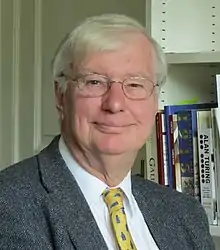
Emeritus Professor Roy MacLeod OAM FSA FRHistS FAHA FASSA FRSN | |
|---|---|
 | |
| Born | Roy Malcolm MacLeod 1941 (79–80 years old) United States of America |
| Nationality | USA/Australian |
| Occupation | Historian |
| Title | Emeritus Professor |
| Spouse(s) |
|
| Children | 1 (m) |
| Awards | Medal of the Order of Australia (2020) Humboldt Prize (2001) Centenary Medal (2001) |
| Academic background | |
| Alma mater | University of Cambridge Harvard University |
| Academic work | |
| Discipline | History History and Philosophy of Science |
| Sub-discipline | Social History of Science, Technology and Medicine |
| Institutions | University of Sydney University of London University of Sussex |
| Website | https://sydney.edu.au/arts/sophi/staff/profiles/roy.macleod.php?apcode=ACADPROFILE300808 |
Early life
Roy MacLeod studied history and biochemistry at Harvard University and was awarded the AB degree summa cum laude.[1]
From 1963 to 1966 he studied the history of science at Cambridge University as a Fulbright Fellow, and was awarded the PhD in history in 1967.[2]
Career
MacLeod was appointed to the first junior research fellowship in History at Churchill College, Cambridge in 1966, a position he held until 1970. Whilst at Cambridge, he was invited to a visiting chair in Victorian Studies at Indiana University in Bloomington, where he introduced students to Darwinian studies and the history of the scientific movement in 19th century England.[3] In 1966, following an invitation from Asa Briggs, he was appointed a Research Fellow in Social Sciences at the new University of Sussex, where he soon became a founding Fellow of the new Science Policy Research Unit (SPRU).[1] In 1970, he was appointed foundation Reader in the History and Philosophy of Science at Sussex, where he established a new subject group in the History and Social Studies of Science (HSSS).[4]
In 1971, MacLeod launched at HSSS one of the first graduate degrees in 'Science Studies' in England, which, by 1979, had graduated over 100 students [5] - and co-founded the academic journal Social Studies of Science, focused on the history, politics and sociology of science and technology.[1] Today among the most cited journals in the field, MacLeod served as co-editor, with David Edge of Edinburgh, for the next 21 years, standing down in 1992.[6]
Also in 1971, with Gerard Lemaine, Clemens Heller, and the Maison des Sciences de l'Homme in Paris, he co-founded Project PAREX (Paris-Sussex) for the collaborative study of the history and sociology of science in Europe.[7] In 1973-74, he served as a visiting professor of Science and Society at the Free University in Amsterdam, and established a network of scholars that, by the 1980s, helped form the European Association for the Study of Science and Technology.[8] MacLeod was a visiting fellow at the Charles Warren Centre for studies in American History at Harvard University in 1976-77, where he wrote on the relation between science, the “research ideal”, and the social role of the American University.[9]
In 1978 MacLeod moved from the University of Sussex to the foundation chair of Science Education at the Institute of Education in the University of London where he introduced the history of science, and higher degrees in Health Education and Environmental Education, and oversaw the introduction of classroom computers in secondary schools across London and the Southeast of England. In 1980, he was appointed a Fellow at the Woodrow Wilson Center in Washington, DC, where he wrote on military history and modern statecraft.
In 1982, MacLeod was invited to Australia as Professor of History at the University of Sydney,[1][2] where he remained for the next 21 years. There he began new courses in imperial history and museum studies, established a Centre for Human Aspects of Science and Technology (CHAST), and contributed to the establishment of the University’s Centre for Peace and Conflict Studies (CPAC) and its Research Institute on Asia and the Pacific.
Whilst at Sydney, MacLeod also taught undergraduate, honours and Master’s courses in social, economic, and cultural history; Australian and Commonwealth history; medical history; military history; nuclear history; the history of higher education; and the history of science and technology in Europe, India, Asia, Australia, and the Pacific.[2]
In 1985, with Philip Rehbock, he co-founded the Pacific Circle, a Scientific Commission of the International Union of the History and Philosophy of Science, and launched the Pacific Circle Bulletin, based in Honolulu, as a means of encouraging research in the history of the natural and social sciences across the Ocean and around the Rim.[10]
In 2000 working from Sydney, MacLeod became Editor-in-Chief of the academic journal Minerva: A Review of Science, Learning and Policy, and served in that position until 2008. In this role, he broadened the scope and compass of the journal to embrace the new field of ‘Science and Technology Studies’ (STS) and to reach a global readership.[11]
In 2003, following his formal retirement from the University of Sydney, he was appointed Emeritus Professor of History,[12] where he has remained in the School of Philosophical and Historical Inquiry (SOPHI). He is also an Honorary Professor at the University's Centre for International Security Studies, an Honorary Associate in the School of History and Philosophy of Science, and an Honorary Member of the Sydney Nano Institute.[1][2]
MacLeod has held a number of visiting and honorary positions, including the Charles A. Lindbergh Chair in Aerospace History at the National Air and Space Museum in Washington D.C. (part of the Smithsonian Institution) in 2010.[2] In 2011 and again in 2012, he was a Fellow of the Lichtenberg Kolleg of the University of Göttingen.[13] He held the Keeley Visiting Fellowship at Wadham College, Oxford in 2013,[14] and a Wellcome Trust Fellowship at the London School of Hygiene and Tropical Medicine in 2017.[2] He has also been a Visiting Senior Fellow at Magdalen College, Oxford and St John's College, Oxford, and a Fowler Hamilton Fellow, Christ Church, Oxford. In 2001, he was awarded a Research Prize [1] by the Alexander von Humboldt Foundation, which took him to the University of Heidelberg, and in 2017 he was a Humboldt Alumni Fellow at the University of Hamberg and the University of Karlsruhe.
In 2021, under the auspices of the Academy of the Social Sciences in Australia, MacLeod co-convened and presented a nine-part webinar series on 'Australia's Future in Space: Making SPACE for the Social Sciences'.[15]
Distinctions and Awards
Roy MacLeod is a Fellow of the Society of Antiquaries of London,[16] the Royal Historical Society,[17] the Academy of the Social Sciences in Australia,[18] the Australian Academy of the Humanities,[2][19] and of the Royal Society of New South Wales.[20] He has twice been a Fellow at the Chemical Heritage Foundation in the United States (now the Science History Institute).[21]
In 2001 he was awarded the Doctor of Letters degree by Cambridge University.[2] In the same year he was awarded a Centenary Medal for services to History by the Australian government.[22]
In 2005, he received a doctorate of letters, honoris causa from the University of Bologna.[23]
MacLeod received the Sarton Medal as Sarton Chair of History of Science, Faculty of Political and Social Sciences, Ghent University, Belgium between 2014 and 2015 [24] In 2017, he received the History of Philosophy and Science Medal from the Royal Society of New South Wales.[20]
In the 2020 Queen's Birthday Honours he was awarded the Medal of the Order of Australia for service to education, particularly to history.[25]
Select Bibliography
Some of his books and more than 140 articles include:[26]
Authored
- Treasury Control and Social Administration: Establishment Growth and the Local Government Board, 1871-1905 (1968)
- John Tyndall, natural philosopher, 1820-1893: a catalogue of correspondence/journals and collected papers (1974)
- The Wellsprings of English Science: The Corresponding Societies of the British Association for the Advancement of Science, 1880-1920 (1974)
- Public Science and Public Policy in Victorian England (1996)
- The Creed of Science in Victorian England (2000)
- Archibald Liverside, FRS: Imperial Science under the Southern Cross (2009)
- Chapter on Discovery and Exploration in The Cambridge History of Science (2009)
- Chapter on Scientists in The Cambridge History of World War 1 (2014)
Co-authored
- Archives of British Men of Science (with Friday, J.) (1973)
- Perspectives on the Emergence of Scientific Disciplines (with Lemaine, G., Mulkay, M., Weingart, P.) (1976)
- Natural knowledge in social context: the journals of Thomas Archer Hirst FRS (with Brock, W.) (1980)
Edited or co-edited
- Perspectives on the Emergence of Scientific Disciplines (1976)
- The Parliament of Science: the British Association for the Advancement of Science 1831-1981 (1981)
- Days of Judgement: Science, Examinations, and the Organization of Knowledge in Late Victorian England (1982)
- The Government of Victorian London, 1855-1889: The Metropolitan Board of Works, the Vestries, and the City Corporation (1982)
- Technology and the Human Prospect (1986)
- Disease, Medicine and Empire: Perspectives on Western Medicine and the Experience of European Expansion (1988)
- Government and Expertise: Specialists, Administrators and Professionals, 1860-1919 (1988)
- The Commonwealth Of Science: ANZAAS and the Scientific Enterprise in Australasia, 1888-1988 (1988)
- University and Community in Nineteenth Century Sydney: Professor John Smith and Science in the Colonial Metropolis, 1821-1885 (1988)
- Nature in its Greatest Extent: Western Science in the Pacific (1988)
- Health and Healing in Tropical Australia and Papua New Guinea (1991)
- Darwin's Laboratory: Evolutionary Theory and Natural History in the Pacific (1994)
- The Library of Alexandria: Centre of Learning in the Ancient World (1999)
- Science and the Pacific War: Science and Survival in the Pacific, 1939-1945 (2000)
- Frontline and Factory: Comparative Perspectives on the Chemical Industry at War, 1914-1924 (2006)
- For Science, King & Country: The Life and Legacy of Henry Moseley (2018)
References
- Who's Who in Australia 53rd Edition. East Melbourne: AAP Directories. 2017. p. 1068. ISBN 9781740952149.
- "Professor Roy MacLeod - School of Philosophical and Historical Inquiry". The University of Sydney. Retrieved 2019-04-25.
- "Indiana University Department of History Chair's records,1940-1991, bulk 1964-1973". Indiana University Archives. Retrieved 11 October 2021.
- "Fifty Years Fifty Voices: Roy MacLeod". University of Sussex. Retrieved 1 October 2018.
- "Fifty Years Fifty Voices: Roy MacLeod". University of Sussex. Retrieved 1 October 2018.
- "Journals Ranked by Impact: History of Philosophy and Science". 2014 Journal Citation Reports. Web of Science (Social Sciences ed.). Thomson Reuters. 2015.
- PAREX: Report to the Social Science Research Council (Report). London. 1972.
- Alzinga, Aant (June 1997). "Some Notes from the Past by Aant Alzinga". EASST Review. 16 (2): 17–23. Retrieved 15 November 2020.
- "Former Fellows". Harvard University. Retrieved 29 October 2021.
- The Pacific Circle: Report to the Division of History of Science and Technology (DHST), of the International Union of History and Philosophy of Science and Technology (IUHPS) (Report). Manchester. 2013.MacLeod, Roy (n.d.). "The Pacific Circle: Some Historical Notes". The Pacific Circle. Retrieved 2020-11-15.
- "Minerva: A Review of Science, Learning and Policy". Springer Publishing. Retrieved 27 April 2019.
- "Emeritus Professors". The University of Sydney. Retrieved 2019-04-25.
- "Fellows". Georg-August-Universität Göttingen. Retrieved 27 October 2021.
- "Visiting Fellowships". Wadham College, Oxford. Retrieved 27 November 2020.
- "Making Space for the Social Sciences: Webinar Series". Academy of the Social Sciences in Australia Inc. Retrieved 29 October 2021.
- "Fellows Directory". Society of Antiquaries. Retrieved 28 September 2018.
- "Current Fellows and Members". Royal Historical Society. Retrieved 21 October 2018.
- "Fellows Detail: Emeritus Professor Roy MacLeod". Academy of the Social Sciences in Australia. Retrieved 28 September 2018.
- "Emeritus Professor Roy MacLeod FASSA FrHistS FSA FRSN FAHA". Australian Academy of the Humanities. Retrieved 27 March 2018.
- "News 2017". Royal Society of New South Wales. Retrieved 1 October 2018.
- "Roy MacLeod". Science History Institute. Retrieved 27 March 2018.
- "Australian Honours Search Facility". The Commonwealth of Australia. Retrieved 26 April 2019.
- Georg-August-Universität Göttingen - Öffentlichkeitsarbeit (2015-01-16). "Georg-August-Universität Göttingen - Roy M. MacLeod". Uni-goettingen.de. Retrieved 2017-06-30.
- "Sarton Chair Past Chair Holders". The University of Ghent. Retrieved 14 December 2020.
- Government House, Canberra (2020-06-08). "Queen's Birthday 2020 Honours List" (PDF). Government House, Canberra. Retrieved 2020-06-09.
- "Roy MacLeod (Author of The Library of Alexandria)". Goodreads.com. 2015-05-25. Retrieved 2017-06-30."Publications for Roy MacLeod" (PDF). The University of Sydney. Retrieved 26 April 2019.
External links
Authority control  | |
|---|---|
| General | |
| National libraries | |
| Other | |