Rub el Hizb
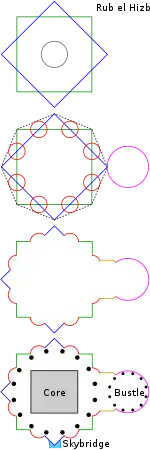
The Rub-el-Hizb (۞) (Arabic: ربع الحزب rubʿ al-ḥizb), also known as the Islamic Star, is an Islamic symbol. It is in the shape of an octagram, represented as two overlapping squares. It is has been found on a number of emblems and flags. The main purpose of this dividing system is to facilitate the recitation of the Quran.
| ۞ | |
|---|---|
Rub el Hizb | |
| In Unicode | U+06DE ۞ ARABIC START OF RUB EL HIZB (HTML ۞) |
Etymology
In Arabic, Rubʻ means "one-fourth" or "quarter," while Hizb translates to "a group." Initially, it was used in the Quran, which is divided into 60 Hizbs (groups of roughly equal length); Rub el Hizb further divides each Hizb in four. A Hizb is one half of a juz'.
History
Islamic archeologists investigations have shown that the Rub el Hizb symbol possibly originated from ancient petroglyphs in the Arabian desert. The symbol in question, consisting of two concentric circles with a defined punctual center, connected by eight radial sectors, is similar to the Islamic symbol when the two lines of the East-West orientation are combined, thus resulting in a hexagon with a circular symmetry.[1]
Contemporary use
National flags
The first country to use the Rub-el-Hizb was Merinid in 1258.
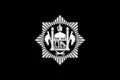 Emirate of Afghanistan
See also
References
- Majeed Khan (13 December 2013). "Rock Art of Saudi Arabia". Arts 2013, 2, 447-475 (Figure 28); doi:10.3390/arts2040447. Retrieved 11 May 2021.
- Galal Abada (2004). "Petronas Office Towers" (PDF). Kuala Lumpur, Malaysia. Archived from the original on 2012-10-01.CS1 maint: unfit URL (link)