Rudi Dutschke
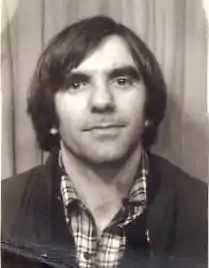
Rudi [Alfred Willi Rudolf] Dutschke (German: [ˈʁuːdi ˈdʊtʃkə]; 7 March 1940 – 24 December 1979) was a German student activist who, until severely injured by an assassin in 1968, was the leading charismatic figure within the West German extra-parliamentary opposition (APO).
Rudi Dutschke | |
|---|---|
 | |
| Born | Alfred Willi Rudolf Dutschke 7 March 1940 |
| Died | 24 December 1979 (aged 39) Århus, Denmark |
| Alma mater | Freie Universität Berlin |
| Known for | Spokesperson of the German student movement |
| Spouse(s) | Gretchen Klotz (m. 1966) |
| Children | 3 |
Dutschke claimed both Christian and Marxist inspiration for a socialism that rejected both the Leninist model of party dictatorship, which he had experienced as a youth in East Germany, and the compromises of West German Social Democracy. He advocated the creation of alternative or parallel social, economic and political institutions structured on the principles of direct democracy.
Shortly before his death in 1979 from complications arising from his wounds in 1968, Dutschke was elected as a delegate to the founding congress of the environmentalist and social-justice Greens, a project then understood as the creation of an "anti-party party", engaging with parliamentary politics but remaining a grass-roots movement.
Christian youth in East Germany
Dutschke was born in Schönefeld (present-day Nuthe-Urstromtal) near Luckenwalde, Brandenburg, the fourth son of a postal clerk. He was raised and educated in East Germany (the German Democratic Republic — GDR), obtaining his high-school diploma (Gymnasium Abitur) in 1958, and apprenticed as an industrial saleman.
In 1956 he had joined the regime-directed Free German Youth aiming at a sporting career as a decathlete.[1] But he was also to engage in the barely tolerated youth organisation of the East German Evangelical Church. Dutschke allowed that religion played an "important role" in his life: that he "incorporated" its "fantastical explanation of the nature of man and his possibilities" into his later political work.[2]
For me, the decisive question, from a real historical point of view, was always: What was Jesus actually doing there? How did he want to change his society and what means did he use? That has always been the crucial question for me. For me, the question of transcendence is also a question of real history, how is the existing society to be transcended, a new design for a future society, that is perhaps materialistic transcendence.[2]
In Easter 1963, he was to write: "Jesus is risen. The decisive revolution in world history has happened – a revolution of all-conquering love. If people would fully receive this revealed love into their own existence, into the reality of the 'now', then the logic of insanity could no longer continue."[3]
It was in this religious milieu outside of approved party and state structures, that Dutschke developed the courage (at the cost of any of any prospect of further education) to refuse compulsory service in National People's Army and to encourage others to likewise resist conscription.[2] Dutschke also cited the impact of the Hungarian Uprising of 1956. Its mobilisation in workers' councils suggested to him a democratic socialism beyond the official line of the GDR’s governing Socialist Unity Party.[4][5][6] In August 1961, Dutschke fled to the Marienfelde transit camp in West Berlin, just three days before the restrictions of Barbed Wire Sunday (that culminated in the building of the Berlin Wall) were introduced to prevent such movement from East Germany to West Germany.[7]
Radical socialist, student leader
SDS, the strategy of confrontation
Dutschke enrolled at the Free University in West Berlin. Formed in 1948 by students abandoning the Communist Party controlled Humboldt University in the East Berlin, the constitution of the new school incorporated a degree of student representation unknown elsewhere in Germany. But the "democratic" faculty and city officials appeared to Dutschke and his classmates to have broken faith with the model of student co-determination. At senate meetings they confronted students delegates with common position decided in advance.[8]
Dutschke's scepticism with regard to the democratic credentials of the new institutions in the west would have been reinforced by his studies: sociology, ethnology, philosophy and history under Richard Löwenthal and Klaus Meschkat.[9] He was introduced to the existentialist theories of Martin Heidegger and Jean-Paul Sartre,[10][11] and to the critical sociology of the Frankfurt School which provided a link to the pre-Hitler left and to alternative interpretations of Marxism and of the history of the labour movement.[12]
In 1965, with a small libertarian-socialist grouping, Subversive Action (Subversiven Aktion), Dutschke joined the German Socialist Students Union (Sozialistischer Deutscher Studentenbund), the former the collegiate wing of the Social Democrats (SPD). The SDS had been expelled from the liberalising party for its unreconstructed leftism, although this had amounted to little more than organising lectures on Marxism.[13]
Dutschke and his faction argued for confrontations in the university and on the streets.[14] The theory as expounded by Dutschke in relation to protests against Vietnam War, which soon dominated the agenda, was that "systematic, limited and controlled confrontations with the power structure" would "force the representative 'democracy' to show openly its class character, its authoritarian, ... to expose itself as a 'dictatorship of force'". The awareness produced by such provocations, would free people to think democratic theory and practice anew.[15]
Revolutionary "voluntarist"
In June 1967, SDS member Benno Ohnesorg was shot and killed by a policeman in West Berlin. Heeding Ulrike Meinhof's call in the journal konkret, he had been among students protesting a visit by the Shah of Iran. Dutschke directed the outrage not at the police, but also at the conservative Axel Springer press whom many were to accuse of incitement[16] (the response of Springer's Bild Zeitung to the death was “Students threaten, We shoot back”).[17][18] Dutschke called for Springer's expropriation.[19] A general wave of student protest shook the universities and major cities. Springer offices were attacked and print and distribution operations disrupted.
In the midst of the disorder the sociologist and philosopher Jürgen Habermas accused Dutschke of “voluntarism”. He argued that Dutschke’s notion of calculated disturbance to unmask the veiled force of the state was mistaken. There was not a revolutionary situation in Germany. Dutschke, he said, was putting the lives of other students at risk.[13]
Dutschke responded that he was honoured by the accusation of voluntarism; Habermas's “objectivity” served only to hold back a rising movement. In his diary Dutschke cited Che Guevara: “Revolutionaries must not just wait for the objective conditions for a revolution. By creating a popular ‘armed focus’ they can create the objective conditions for a revolution by subjective initiative”.[13] After Che's guerrilla death Bolivia in October 1967, Dutschke and the Chilean Gaston Salvatore, translated, and wrote an introduction to, Che's last public statement, Message to the Tricontinental, with its famous appeal for "two, three, many Vietnams."[20]
Within a month, however, Dutschke recognised that the campaign against Springer, against which there was a strong public reaction, could not "mobilise the masses" and called for a halt. The new focus was to be German complicity in the escalating American war in Vietnam.[21]
The Vietnam Congress, February 1968
Already in 1966, Dutschke and the SDS had staged the "Vietnam - Analysis of an Example" congress at the University of Frankfurt, with Herbert Marcuse as the main speaker and around 2,200 students and trade unionists attending. At the beginning of 1968 they decided to organise an even larger event, an international conference.As the "intersection" of the rival Cold War blocs and as a "provocation" to the city's American military presence, Berlin would be the venue. After a rejection by the Free University of Berlin, and despite a concerted campaign in the Springer Press and opposition in the Berlin Senate, the Technical University of Berlin accommodated the two-day event .[22]
Forty-four socialist-youth delegations from fourteen countries (including the FDJ from East Germany) attended. In addition to Dutschke, who appeared to direct much of the discussion, they were addressed by Alain Krivine and Daniel Bensaïd (both Jeunesse Communiste Révolutionnaire, JCR) as well as Daniel Cohn-Bendit (Liaison d'Etudiants Anarchistes) from France, Tariq Ali and Robin Blackburn (New Left Review and Vietnam Solidarity Campaign ) from the United Kingdom, Bahman Nirumand (of the international Confederation of Iranian Students) and Bernardine Dohrn (Students for a Democratic Society) from USA. The floor was also given to Dutschke's friend, the veteran Belgian Trotskyist, Ernest Mandel.[22] Characterising the national liberation struggle of the Vietnamese people as an active front in a worldwide socialist revolution, the final declaration charged "US imperialism" with "trying to incorporate the Western European metropolises into its policy of colonial counterrevolution via NATO".[22]
Under the slogan "Smash NATO" and with an invitation to American soldiers stationed in West Berlin to desert en masse Dutschke wanted to lead the closing demonstration of more than 15,000 people ("above a sea of red flags rose huge portraits of Rosa Luxemburg, Karl Liebknecht, Che Guevara, and Ho Chi Minh")[23] in a march on the U.S. Army McNair Barracks in Berlin-Lichterfelde. But once the U.S. Command cautioned that it would use force to defend the barracks, and following discussions with the novelist Günter Grass, Bishop Kurt Scharf and the former West Berlin mayor Heinrich Albertz, Dutschke was persuaded that this was a provocation from which it would be best to desist.[22]
Rejects cadre, and party, model
From the summer of 1967, Ernest Mandel had been trying persuade Dutschke to transform the Marxist wing of the SDS into a revolutionary socialist youth organisation on the model of the French JCR; to "select the best comrades to create an organisation within the SDS . . . to form a cadre . . . and to build a vanguard from inside the social-democratic union." Klaus Meschkat, who had founded the rival Republikanischer Club in response to what he saw as the anarchist tendency within the SDS,[24] did not believe it possible. He advised Mandel that Dutschke maintained his position only by virtue of his flexibility.[23]
In a televised interview with Gunther Gaus in October 1967, Dutschke was unequivocal: "we are not a Leninist cadre party, we are a completely decentralised organisation". It was something he claimed was a "great advantage". Because the SDS was "set up in a decentralised manner" it was "in a position to set the movement in motion at any time, that is, people are always ready to participate, we don't need to force them, it is a voluntary matter". They know that there is no "apparatus" giving precedence to the interests of office holders, or of professional politicians.[25]
At the same time, Dutschke asserted that, while it might be otherwise for the right, "in organised late capitalism" there could be "no victory for left minorities". The SDS was but a small grouping. In West Berlin, he suggested it might have "90 very active people and maybe 300, 400 active people", and in the wider movement, four to five thousand people ready to take part in its "awareness-raising events" and in the campaigns.[25]
Call for German unity
The interview on Gaus's SWR programme Zur Person, gave Dutschke an exposure reserved for the Federal Republic's leading statesmen and intellectuals.[26] Gaus's first question to Dutschke was why he wished to upend the republic's social order. Dutschke replied first with a classic socialist observation:
[In 1918] the German workers 'and soldiers' councils fought for the eight-hour day. In 1967 our workers worked a measly four or five hours less a week. And that with a tremendous development of the productive forces, the technical achievements, which could really bring about a very, very great reduction in working hours. Instead, in the interests of the ruling order, working-time reduction is resisted so as to maintain the lack of consciousness that the [long] hours induce.[25]
Then, as an illustration of this system-induced lack of political consciousness, Dutschke offered not the mendacity of the mass-circulation Springer Press, the shooting of Ohnesorg, complicity in the Vietnam war or other contemporary issues that might have been anticipated from his billing as a generational spokesman, but the lack of progress on German re-unifcation.
For example: after the Second World War, governments talked incessantly of reunification. But in twenty years and more instead of reunification we have had a succession of governments that we can describe as institutional instruments for lying, for half-truths, for distortions. The people are not being told the truth. There is no dialogue with the masses, no critical dialogue that could explain what is going on in this society: why the economic miracle [Wirtschaftswunder] suddenly came to an end; why no progress has been made on the question of reunification?[25]
Dutscke believed that, even after Hitler, Germans had the right to decide for themselves whether they to live in one state more. Perversely no prominent West German stood closer to Dutschke on this point than his arch nemesis, Axel Springer.[27][28] In what he described as the "central political event of my life",[29] in 1958 Springer had gone to Moscow to personally press the case for an "Austrian solution": national unity in return for permanent neutrality.[30] The difference was that German neutrality for Dutschke was a condition not only for national unity but for social transformation.
We criticise the GDR and we have the task of overthrowing capitalist rule in the Federal Republic in order to make a whole Germany possible, which is not identical with the GDR, which really has nothing in common with today's Federal Republic, but a whole Germany, where producers, students, workers and housewives, the different strata of the people, can really represent their interests.[31]
Extra-parliamentary opposition, APO
Dutschke did not in share the reform euphoria surrounding Willy Brandt, the former anti-Nazi resister and West Berlin mayor who, as junior partners of the ruling Christian Democrats, had led the Social Democrats for the first time into federal government. The SDS formed party of a broader extra-parliamentary opposition,(Außerparlamentarische Opposition, APO), a loose grouping of students, left trade unionists, writers and others who believed that with the formation in December 1966 of the Grand Coalition there was no longer even the semblance in the Federal Republic of a democratic counterweight to vested interests. "We have to say no", declared Dutschke, to a parliament in which "we are no longer represented! We have to say no to a grand coalition ... created to maintain the rule of the government clique, the bureaucratic oligarchy".[32]
At the same time, Dutschke was concerned that student protests and the APO not be instrumentalised by Soviet and East German propaganda. He travelled to Czechoslavakia to express solidarity with the Prague Spring that was then challenging the Soviet-imposed party hegemony.[32]
On 11 April 1968, shortly after his return from the east, Dutschke was shot on a West Berlin street by a young right-wing extremist. Again, Springer was accused of complicity ("Bild schoss mit!"). Serious unrest followed. Demonstrators tried to storm the Springer offices in Berlin and set fire to Bild delivery vans. The Hamburg print shop was besieged to prevent the paper leaving the presses, and in Munich a demonstrator and a policeman were killed after students ransacked the Bild editorial offices. There were over a thousand arrests.[33]
Attempted assassination and its aftermath
The shooting and protest reaction
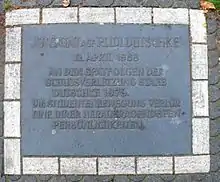
On 11 April 1968, shortly after returning from the Czechoslovakia, Dutschke was shot outside the SDS offices on KurfürstendammJosef Bachmann, his assailant, a builder's labourer and petty criminal, had left East Germany as a child. In 1961, aged 17, he made contact with a Neonazi cell in Peine with whom he handled weapons.[34] Bachman suggested that immediate inspiration for his attack was the assassination the week before of Martin Luther King Jr..[35]
Bachman had waited for Dutschke outside the SDS offices on Kurfürstendamm. When the student leader stepped into the street to collect a prescription for his young son Hosea Che, Bachmann approached him and shouting "you dirty, communist pig", and fired three shots striking him twice in the head and once in the shoulder. Bachmann fled to a nearby basement, where, after a shootout with the police, he was arrested.[36]
Springer once again was accused of complicity ("Bild schoss mit!"). Demonstrators tried to storm the Springer house in Berlin and set fire to Bild delivery vans. The Hamburg print shop was besieged to prevent the paper leaving the presses, and in Munich a demonstrator and a policeman were killed after students ransacked the Bild editorial offices. There were over a thousand arrests.[37]
The Federal Chancellor, Kurt Kiesinger, cut short his Easter holiday, and claiming on his return to Bonn that a planned political action was in progress which had revolutionary character. He appealed to all those who felt responsible for the maintenance of democracy to show vigilance and calm.[38]
England, Ireland, Denmark.
Dutschke survived, but struggled to recover memory and speech and to manage recurring epileptic seizures. The Dutschkes began his convalescence in Italy, guest of the composer Hans-Werner Henze, but, when the press found them, they left for England. Clare Hall at the University of Cambridge had offered Dutschke the opportunity to complete his doctoral thesis (an analysis of the early Commintern). Denied a student visa by the Conservative government, the journalist Neal Ascherson secured them refuge in Ireland.[39]
Between January and March 1969, the Dutschkes were guests, outside Dublin, of Dr Conor Cruise O'Brien who had been distinguished since his UN service during the Congo Crisis by his criticism of U.S. policy both in Vietnam and at home in the repression of the Black Panthers. During their stay, Rudi and Gretchen Dutschke were visited by their lawyer Horst Mahler who tried to persuade them to join him underground in the group that was to become the Red Army Faction.[39] (After serving a ten-year sentence for his RAF activity, Mahler drifted to the far right and was twice imprisoned in the 2000s for Holocaust denial).[40]
As the student movement back home splintered and radicalised, the Dutschkes considered staying in Ireland but returned to the UK in mid-March 1969[39] accepting the condition that he not engage in political activity. At the beginning of 1971 it was a condition the UK Home Office believed he had breached, ruling that his meetings with visitors from Germany, Israel, Jordan, Chile and the United States had "far exceeded normal social activities".[41] A position teaching sociology was offered at the University of Aarhus and the Dutschkes moved to Denmark.[42][43]
View of political violence
Dutschke visited the Federal Republic in May 1972. He sought talks with trade unionists and social democrats, including former president Gustav Heinemann, whose vision of a non-aligned, demilitarised Germany as a whole he shared.[44] In July 1972 he visited East Berlin several times meeting Wolf Biermann with whom he remained friends. He later made contact with Robert Havemann and Rudolf Bahro and other East-Bloc dissidents: Milan Horáček, Adam Michnik and others.[45][46][47]
While Dutschke was touring West Germany, the Red Army Faction (the "Baader Meinhof Gang") launched their "May offensive", a series of bombings directed at the police and judiciary, the U.S. army presence and the Springer Press that together killed 4 people and injured 41.[48] In November 1974, one of the three RAF members detained and convicted in the wake of these outrages, Holger Meins died on hunger strike. Dutschke created a furore when, at the graveside, he declared "Holger, the struggle continues!".[49]
The direct actions and provocations that Dutschke defended as a means of "unmasking the authoritarian structures" of capitalist society,[50] may not in principle excluded armed violence. Gretchen Dutschke admits that early in 1968 the young parents had transported explosives (provided by the Milan publisher Giangiacomo Feltrinelli)[51] through Berlin in their baby's pram. Rudi Dutschke and his friends were considering using the explosive to carry out attacks on ships carrying war materiel, railroad tracks or overhead lines as a protest against the Vietnam War. But realising that people would have endangered, they thought better of it,[52] and had the dynamite quietly dropped into the sea.[51] As the RAF, who showed no such scruples, continued their attacks, according to his wife Dutschke concluded that they "would destroy the achievements the '68 movement had fought for."[49] "We fight", he had told Gaus, "so that it need never come to the point of having to reach for arms."[25]
Revolution as a "march through institutions"
"Revolution", Dutschke had argued in 1967, "is a long complicated process in which people have to change", and such change is effected only by a "long march through the institutions'".[52] By this he intended, not the pushing aside aside Nazi holdovers and conservative careerists in the attempt to promote reform from within, but creation of institutions anew that are irredeemable in their present state.[53][54] The place of universities in this schema is unclear. On the one hand, Dutschke dismissed them as "factories" geared to the production of Fachidioten (people incapable of critical thought beyond their narrowly-defined field of training).[50] On the other, he cast them in the role “safety zones" and "social bases" from which march of change was being initiated.[13]
Returning from Denmark, in 1979 Dutschke joined the Bremen Green List and took part in their election campaign. After they moved into the city parliament in October, he was elected as a delegate for the founding congress of the Green Party planned for mid-January 1980.[55][56] The Greens then were promising an "anti-party party"; a party which, true to their origins in environmentalist, feminist, and anti-war/anti-nuclear protest would remain a grass-roots democratic (basisdemokratische) movement.[57]
Death and memorials
Dutschke had continued to suffer health problems due to the brain injuries sustained in the assassination attempt. On 24 December 1979, he died aged 39 in Aarhus. He had had an epileptic seizure in the bathtub and drowned.[58][59]
In what was reported as a symbolic laying to rest of their "hopes of the 1960s for social change", thousands attended Dutschke's funeral service at St Anne's Parish Church (St. Annen Dorfkirche) in Dahlem, Berlin. The service was conducted by Rev. Helmut Gollwitzer, a Protestant theologian renowned as a member, under the Nazis, of the dissident Confessing Church movement. Gollwitzer praised Dutschke as a man who had "fought passionately, but not fanatically, for a more humane world", and had sought "a unity of socialism and Christianity". In a party statement, West Berlin's governing Social Democrats described Dutscke's early death as "the terrible price he had to pay for his attempts to change a society whose politicians and new media showed a lack of understanding, maturity and tolerance".[60]
In 2018, it emerged that Rudolf Augstein, publisher of Der Spiegel, provided financial support to Dutschke so he could continue to work on his dissertations. Between 1970 and 1973, he paid 1,000 German Marks per year. At the same time they started an exchange of letters in which they also discussed the student revolts.[61]
Family and legacy
Dutschke was survived by his American wife Gretchen Dutschke/Dutschke-Klotz who he had married in 1966 and by their two children Hosea-Che Dutschke (named after the Old Testament minor prophet Hosea and Che Guevara), and sister Polly-Nicole Dutschke, both born in 1968. They had a third child, Rudi-Marek Dutschke (named after a Bulgarian Communist), born in 1980 after his father's death.[62][7][10]
In her 2018 memoir, 1968: Worauf wir stolz sein dürfen (“What we can be proud of”),[63] Gretchen Dutschke argues that her husband helped advance an anti-authoritarian revolution in the German Federal Republic that has helped protect it against the right-wing extremism and nationalist populism infecting many neighbours. She believes that Germany has "held out pretty well so far against the extreme right-wing, and that has to do with the democratisation process and culture revolution which the 68ers [Rudie Dutschke amoung them] carried out. It’s still having an effect.”[39]
Works
- Dutschke, Rudi (1980), Mein langer Marsch: Reden, Schriften und Tagebücher aus zwanzig Jahren (in German), Hamburg, DE: Rowohlt.
- Dutschke, Rudi (2003), Dutschke, Gretchen (ed.), Jeder hat sein Leben ganz zu leben (diaries) (in German), Köln, DE: Kiepenheuer & Witsch, ISBN 3-462-03224-0 (1963–1979).
- Dutschke, Rudi (Summer 1982), "It Is Not Easy to Walk Upright", Telos, New York: Telos Press, 1982 (52): 171–177, doi:10.3817/0682052171, S2CID 147179235.
Bibliography
- Dutschke, Gretchen (1996), Wir hatten ein barbarisches, schönes Leben (biography) (in German), Köln, DE: Kiepenheuer & Witsch, ISBN 3-462-02573-2.
- Dutschke, Gretchen (2018). 1968: Worauf wir stolz sein dürfen. Hamburg: Kursbuch Kulturstiftung, ISBN 9783961960064.
- Karl, Michaela (2003), Rudi Dutschke – Revolutionär ohne Revolution. Neue Kritik, Frankfurt am Main, ISBN 3-8015-0364-X.
- Rabehl, Bernd (2002), Rudi Dutschke – Revolutionär im geteilten Deutschland. Edition Antaios, Dresden, ISBN 3-935063-06-7.
- Dutschke, Rudi-Marek (2001): Spuren meines Vaters. Kiepenheuer und Witsch, Köln, ISBN 3-462-03038-8.
- Ditfurth, Jutta (2008): Rudi und Ulrike: Geschichte einer Freundschaft. Droemer Knaur, München, ISBN 3-426-27456-6.
- Fichter, Tilman, Siegward Lönnendonker (2011), Dutschkes Deutschland. Der Sozialistische Deutsche Studentenbund, die nationale Frage und die DDR-Kritik von links. Klartext, Essen, ISBN 978-3-8375-0481-1.
- Baer, Willi, Karl-Heinz Dellwo (2012), Rudi Dutschke – Aufrecht Gehen. 1968 und der libertäre Kommunismus, Laika, Hamburg, ISBN 978-3-942281-81-2.
- Prien, Carsten (2015), Dutschkismus - die politische Theorie Rudi Dutschkes, Ousia Lesekreis Verlag, Seedorf, ISBN 978-3-944570-58-7.
References
- Miermeister, Jürgen (1986). Rudi Dutschke: mit Selbstzeugnissen und Bilddokumenten (in German). Rowohlt. ISBN 9783499503498.
- "Günter Gaus im Gespräch mit Rudi Dutschke". www.rbb-online.de (in German). 3 December 1967. Retrieved 18 April 2021.
- Frank, Helmut (16–20 April 2003), "Ich liebte diesen naiven Christen", Sonntagsblatt (in German), Bayern, DE, archived from the original on 18 July 2011.
- "Wie Dutschkes Weltbild entstand". www.rbb-online.de (in German). Retrieved 9 April 2018.
- "Mythos Rudi Dutschke: Der verhinderte Stadtguerillero". Spiegel Online. 7 April 2008. Retrieved 9 April 2018.
- WELT (28 May 2009). "Studentenbewegung: Dutschke schrieb über seine Angst vor der Stasi". DIE WELT. Retrieved 9 April 2018.
- Chaussy, Ulrich (26 February 2018). Rudi Dutschke. Die Biographie (in German). Droemer eBook. ISBN 9783426451410.
- Merritt, Richard L. (1969). "The Student Protest Movement in West Berlin". Comparative Politics. 1 (4): 516–533. doi:10.2307/421493. ISSN 0010-4159.
- "Klaus Meschkat", Wikipedia (in German), 3 September 2021, retrieved 14 December 2021
- Dutschke-Klotz, Gretchen (1996). Rudi Dutschke. Köln: Kiepenheuer und Witsch. pp. 38-, 53-, 172, 227, 459. ISBN 978-3-462-02573-6.
- "The Attack on Rudi Dutschke: A Revolutionary Who Shaped a Generation". Spiegel Online. 11 April 2008. Retrieved 9 April 2018.
- Spaling, Michael; Boyle, Michael Shane (30 September 2014). "Hans-Jürgen Krahl: From Critical to Revolutionary Theory". Viewpoint Magazine. Retrieved 11 December 2021.
- "Rudi Dutschke and the German student movement in 1968". Socialist Worker (Britain). Retrieved 13 December 2021.
- Deutschland, Stiftung Deutsches Historisches Museum, Stiftung Haus der Geschichte der Bundesrepublik. "Gerade auf LeMO gesehen: LeMO Biografie: Rudi Dutschke". www.hdg.de (in German). Retrieved 13 December 2021.
- Merritt (1969), p. 521
- "Zum Tod des Studenten Benno Ohnesorg" in Vaterland, Muttersprache: Deutsche Schriftsteller und ihr Staat von 1945 bis heute, eds. Klaus Wagenbach, Winfried Stephan and Michael Krüger. Klaus Wagenbach Berlin, 1980, ISBN 380310100X. p. 247
- "- Presse-Cäsar mit "Bild"-Zeitung". Deutschlandfunk Kultur (in German). Retrieved 4 March 2021.
- "Studenten drohen: Wir schießen zurück", "Hier hören der Spaß und der Kompromiss und die demokratische Toleranz auf. Wir haben etwas gegen SA-Methoden." Kai Herrmann: Die Polizeischlacht von Berlin. In: Die Zeit, Nr. 23/1967
- Sedlmaier, Alexander (2014). Consumption and Violence: Radical Protest in Cold-War West Germany. Ann Arbor: University of Michigan Press. pp. 168–204. JSTOR j.ctv3znzm0.8. Retrieved 13 February 2021.
- "Gaston Salvatore & Rudi Dutschke Einleitung zu CHE GUEVARA". www.infopartisan.net. Retrieved 14 December 2021.
- Sedlmaier, Alexander (2014). Consumption and Violence: Radical Protest in Cold-War West Germany. Ann Arbor: University of Michigan Press. pp. 168–204. JSTOR j.ctv3znzm0.8. Retrieved 13 February 2021.
- "International Vietnam Congress". International Vietnam Congress. 28 April 2010. Retrieved 15 December 2021.
- Stutje, Willem (2018). "Just Short of the "Conscious Leap": Ernest Mandel in 1968". Versobooks.com. Retrieved 15 December 2021.
- Tilman Fichter, Siegward Lönnendonker: Kleine Geschichte des SDS. Rotbuch–Verlag 1977, ISBN 3-88022-174-X, S. 92, 102, 178
- "Günter Gaus im Gespräch mit Rudi Dutschke. Sendung vom 03.12.1967". www.rbb-online.de (in German). Retrieved 12 December 2021.
- Hintermeier, Hannes. "Das Interview als Handwerk: Ehret den Gaus!". FAZ.NET (in German). ISSN 0174-4909. Retrieved 12 December 2021.
- Tilman Fichter und Siegward Lönnendonker (2011), Dutschkes Deutschland. Der Sozialistische Deutsche Studentenbund, die nationale Frage und die DDR-Kritik von links, Klartext Verlag, ISBN 9783837504811
- Buttkereit, Helge (2011). "Dutschkes deutschlandpolitische Position". Deutschlandfunk (in German). Retrieved 13 December 2021.
- Muller, Hans Dieter (1969). Press power: A study of Axel Springer. London: Macdonald & Co. pp. 143–148. ISBN 9780356026893.
- Goshko, John (22 April 1973). "Axel Springer: Germany's Luce" (PDF). Washington Post. Retrieved 15 February 2021.
- quoted in Butterkereit (2011)
- Staunton, Denis (14 April 1998). "Three shots that sparked off a revolution". The Irish Times. Retrieved 11 December 2021.
- "'Gefáhr für uns alle', Studenten gegen Springer", Der Spiegel, 6 May 1968, p. 42
- Kellerhoff, Sven Felix (6 December 2009). "Neonazi-Verbindung: Die undurchsichtige Tat des Dutschke-Schützen". Retrieved 22 February 2019.
- Dehn, Peter (21 November 2012). "Bachmann vor Gericht". Die Zeit (in German). ISSN 0044-2070. Retrieved 22 February 2019.
- Aust, Stefan (2009). Baader-Meinhof: The Inside Story of the R.A.F. Oxford University Press. ISBN 9780195372755.
- Sedlmaier, Alexander (2014). Consumption and Violence: Radical Protest in Cold-War West Germany. Ann Arbor: University of Michigan Press. pp. 168–204. JSTOR j.ctv3znzm0.8. Retrieved 13 February 2021.
- Crossland, Norman (13 April 1968). "Riots after shooting in Berlin". the Guardian. Retrieved 15 December 2021.
- Berlin, Derek Scally In (26 May 2018). "Hiding in Howth: When the 1968 revolution came to Ireland". The Irish Times. Retrieved 11 December 2021.
- Charter, David (15 May 2017). "Hungary denies asylum to neo-Nazi on the run". The Times. London. Retrieved 11 December 2021.
- Lewis, Anthony (9 January 1971). "British Panel Upholds Expulsion of Rudi Dutschke as Security Risk". New York Times.
- Halter, Hans (19 August 1996). "Herz der Revolte". Der Spiegel. 34. Retrieved 9 April 2018.
- 6112@au.dk (15 February 2018). "Rudi Dutschke (1940–1979)". www.au.dk (in Danish). Retrieved 9 April 2018.
- Gretchen Dutschke: Rudi Dutschke. Köln 1996, p. 278 f.
- Mayer, Margit; Ely, John (1998). The German Greens: Paradox Between Movement and Party. Temple University Press. p. 35. ISBN 978-1-56639-516-8.
- Engelmann, Roger; Kowalczuk, Ilko-Sascha (2005). Volkserhebung gegen den SED-Staat: eine Bestandsaufnahme zum 17. Juni 1953. Vandenhoeck & Ruprecht. p. 364. ISBN 978-3-525-35004-1.
- Cornils, Ingo (2016). Writing the Revolution: The Construction of "1968" in Germany. Boydell & Brewer. p. 26. ISBN 978-1-57113-954-2.
- "Red Army Faction: A Chronology of Terror". DW. Deutsche Welle. Retrieved 9 February 2021.
- Welle (www.dw.com), Deutsche. "Rudi Dutschke and the struggle of the 1968 student movement | DW | 05.12.2012". DW.COM. Retrieved 12 December 2021.
- "STUDENTEN / DUTSCHKE: Der lange Marsch". Der Spiegel. 51. 11 December 1967. Retrieved 9 April 2018.
- "Just Short of the "Conscious Leap": Ernest Mandel in 1968". Versobooks.com. Retrieved 14 December 2021.
- Sprengal, Bernhard (2019). "In dieser Partei hätte Rudi Dutschke Karriere gemacht – sagt sein Sohn". watson.de (in German). Retrieved 12 December 2021.
- Huffmann, Richard (March 2004), "The Limits of Violence", Satya, Baader Meinhof, archived from the original on 11 November 2008.
- Davis, Belinda; Mausbach, Wilfried; Klimke, Martin (eds.), Changing the World, Changing Oneself: Political Protest and Collective Identities in West Germany and the U.S. in the 1960s and 1970s.
- Dutschke-Klotz, Gretchen (1996). Wir hatten ein barbarisches, schönes Leben: Rudi Dutschke : eine Biographie. Internet Archive. Cologne : Kiepenheuer & Witsch. pp. 367–370. ISBN 978-3-462-02573-6.
- Gretchen Dutschke-Klotz (1996), Rudi Dutschke. Köln, pp. 467–470.
- Frankland, E. Gene (1989). "Parliamentary Politics and the Development of the Green Party in West Germany". The Review of Politics. 51 (3): 386–411. ISSN 0034-6705.
- Burleigh, Michael (2011). Blood and Rage: History of Terrorism. HarperCollins. p. 230. ISBN 9780062047175.
- Wendland, Johannes (2009). "Erinnerungen: Hosea Dutschke über den Tod seines Vaters vor 30 Jahren" [Memories: Hosea Dutschke on His Father's Death 30 Years Ago]. Spiegel Online (in German). Der Spiegel. Retrieved 27 February 2013.
- Lentz, Ellen (4 January 1980). "Rites for Rudi Dutschke Attract Throngs Mourning a Lost Cause; Drowned in a Bathtub Protest Against the Shah". timesmachine.nytimes.com. Retrieved 20 April 2021.
- "Bislang unbekannte Akten: "Spiegel"-Gründer Augstein unterstützte Dutschke finanziell". FAZ.NET (in German). ISSN 0174-4909. Retrieved 28 July 2018.
- Langenau, Lars. "1968 - 50 Jahre danach erzählen die Dutschkes". Süddeutsche.de (in German). Retrieved 18 April 2021.
- Dutschke, Gretchen (2018). 1968: Worauf wir stolz sein dürfen. Hamburg: Kursbuch Kulturstiftung. ISBN 9783961960064.
External links
 |
Wikimedia Commons has media related to Rudi Dutschke. |
- Rudi Dutschke at IMDb
- Rudi Dutschke in the German National Library catalogue
- Dutschke, Rudi (biography) (in German), DE: German Historic Museum.
- Salvatore, Gaston (2008), "Lost in the Federal Republic, Scenes from Another Era", Dossier 1968, retrieved 11 November 2012.
Authority control  | |
|---|---|
| General | |
| National libraries | |
| Scientific databases | |
| Other | |