Rump state
A rump state is the remnant of a once much larger state, left with a reduced territory in the wake of secession, annexation, occupation, decolonization, or a successful coup d'état or revolution on part of its former territory.[1] In the latter case, a government stops short of going into exile because it controls part of its former territory.
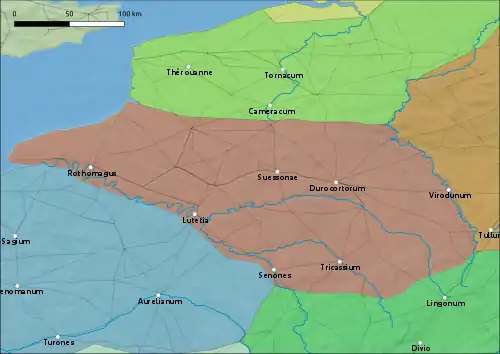
Kingdom of Soissons, a Roman rump state.
Examples
Ancient history
- Seleucid Empire after losing most of its territory to the Parthian Empire.[2]
- After the collapse of the Western Roman Empire in Gaul, the Kingdom of Soissons survived as a rump state under Aegidius and Syagrius until conquered by the Franks under Clovis I in 486.[3]
Post-classical history
- Sultanate of Rum, a rump state to Great Seljuq Empire.[4]
- After the Jin dynasty assumed control over northern China, the Southern Song existed as a rump state of the Northern Song.[5]
- After the 1204 Sack of Constantinople in the Byzantine Empire, three new states emerged: the Empire of Nicaea, the Empire of Trebizond, and the Despotate of Epirus.
- After the 1453 Fall of Constantinople which ended the Byzantine Empire, the reigning Palaiologos dynasty continued to rule the Despotate of the Morea until 1460, when it was conquered by Sultan Mehmed II.
- After the Madurai Sultanate assumed control over most of Pandya Nadu, and which was later captured by Vijayanagara Empire, the Southern Pandyas formed a rump state from 1330 to 1422 ruling over modern day Tirunelveli and Thuthukudi districts along with certain regions of Western Ghats. They further lost their territory and ruled from Tenkasi region as Tenkasi Pandyas formed a rump state there until 1623.[6]
- After the Ming dynasty established control over China proper, the Yuan dynasty retreated to the Mongolian Plateau and survived as a rump state called the Northern Yuan.[7]
- After the Spanish conquest of the Inca Empire in 1532, the Neo-Inca State based at Vilcabamba survived as a rump state until 1572.[8]
- After the Qing dynasty assumed control over most of China proper, the Ming dynasty survived as a rump state called the Southern Ming.[6]
Modern history
 The Polish–Lithuanian Commonwealth was left as a rump state after the First Partition of Poland by Russia, Prussia, and Austria in 1772.[9] The resulting rump state was partitioned again in 1793 and annexed outright in 1795. After Napoleon's victory in the War of the Fourth Coalition in 1807, he created a new Polish rump state, the Duchy of Warsaw.[10] After Napoleon's defeat, the Congress of Vienna created a state, Congress Poland in 1815; it is unclear whether this should be seen as a rump state or a puppet state.[11]
.svg.png.webp) The Hungarian Soviet Republic[12] was proclaimed in March 1919 after the resignation of the government of the First Hungarian Republic when, following their absorption of the Social Democrats, the Communists took control of the country. Though sometimes controlling only around 23% of the territory of the Hungarian state, after some initial military successes, in the end the army was defeated and the government fell in August 1919.
The Hungarian Soviet Republic[12] was proclaimed in March 1919 after the resignation of the government of the First Hungarian Republic when, following their absorption of the Social Democrats, the Communists took control of the country. Though sometimes controlling only around 23% of the territory of the Hungarian state, after some initial military successes, in the end the army was defeated and the government fell in August 1919. The Republic of German-Austria was created in 1918 as the initial rump state for areas with a predominantly German-speaking population within what had been the Austro-Hungarian Empire.[13]
 The rump Republic of Salò (Repubblica Sociale Italiana, 1943–1945), led by Benito Mussolini, claimed to be the legitimate successor of the Kingdom of Italy; it was in fact a puppet state of Nazi Germany.[14][15][16]
 The Republic of China towards the end of the Chinese Civil War retreated to the island of Taiwan.[17]
%253B_Flag_of_Serbia_and_Montenegro_(2003%E2%80%932006).svg.png.webp) The Federal Republic of Yugoslavia, that is, the name the State Union of Serbia and Montenegro used from 1992 to 2003, was often viewed as the rump state left behind by the Socialist Federal Republic of Yugoslavia (1945–1992) when it broke up.[18] This view of it was held not only by its founders,[18] but also by many people antagonistic to them.
The Federal Republic of Yugoslavia, that is, the name the State Union of Serbia and Montenegro used from 1992 to 2003, was often viewed as the rump state left behind by the Socialist Federal Republic of Yugoslavia (1945–1992) when it broke up.[18] This view of it was held not only by its founders,[18] but also by many people antagonistic to them..svg.png.webp) The Islamic Republic of Afghanistan: After the Fall of Kabul 2021, the Taliban forces defeated Afghan military and forced it to relocate to the Panjshir Valley (start of the Panjshir conflict). Despite controlling less than 1% of the territory of Afghanistan, it continued to remain the internationally recognized Government of Afghanistan.[19]
The Islamic Republic of Afghanistan: After the Fall of Kabul 2021, the Taliban forces defeated Afghan military and forced it to relocate to the Panjshir Valley (start of the Panjshir conflict). Despite controlling less than 1% of the territory of Afghanistan, it continued to remain the internationally recognized Government of Afghanistan.[19]
See also
References
Citations
- Tir, Jaroslav (Feb 22, 2005). Keeping the Peace After Secessions: Territorial Conflicts Between Rump and Secessionist States. Annual Meeting of the International Studies Association. Hilton Hawaiian Village, Honolulu: Hawaii Online. Retrieved Oct 26, 2014.
- Fattah, Hala Mundhir; Caso, Frank (2009). A Brief History of Iraq. p. 277.
- Dodd, Leslie (25 November 2016). "Kinship Conflict and Unity among Roman Elites in Post-Roman Gaul". Official Power and Local Elites in the Roman Provinces. Routledge. p. 170. ISBN 9781317086147.
- Richard Todd (2014), The Sufi Doctrine of Man: Ṣadr al-Dīn al-Qūnawī's Metaphysical Anthropology, p. 6
- Des Forges, Roger V. (2003). Cultural centrality and political change in Chinese history : northeast Henan in the fall of the Ming. Stanford University Press. p. 6. ISBN 9780804740449.
- Struve, Lynn A. (1998). "The Ming-Qing Conflict, 1619-1683: A Historiography and Source Guide": 110–111. Cite journal requires
|journal=(help) - Seth, Michael J. (2010). A History of Korea: From Antiquity to the Present. Rowman & Littlefield Publishers. p. 115.
- Bauer, Brian S.; Fonseca Santa Cruz, Javier; Araoz Silva, Miriam (2015). Vilcabamba and the Archaeology of Inca Resistance. Los Angeles. pp. 1–2. ISBN 9781938770623.
- Fazal, Tanisha M. (2011). State Death: The Politics and Geography of Conquest, Occupation, and Annexation. Princeton University Press. p. 110. ISBN 9781400841448.
- Lerski, George J. (1996). Historical dictionary of Poland, 966-1945. Greenwood Press. p. 121. ISBN 9780313260070.
- Marcus, Joseph (2011). Social and political history of the Jews in Poland, 1919-1939. Mouton Publishers. p. 73. ISBN 9783110838688.
- John C. Swanson (2017). Tangible Belonging: Negotiating Germanness in Twentieth-Century Hungary. University of Pittsburgh Press. p. 80. ISBN 9780822981992.
- Magocsi, Paul Robert (2018). Historical atlas of Central Europe: Third Revised and Expanded Edition. University of Toronto Press. p. 128. ISBN 9781487523312.
- James Hartfield, Unpatriotic History of the Second World War, ISBN 178099379X, 2012, p. 424
- Eric Morris, Circles of Hell: The War in Italy 1943-1945, ISBN 0091744741, 1993, p. 140
- Neville, Peter (2014). Mussolini (2nd ed.). Routledge. p. 199. ISBN 9781317613046.
- Williams, Jack; Chang, Ch'ang-yi David (25 February 2008). Taiwan's Environmental Struggle: Toward a Green Silicon Island. ISBN 9781134062836.
- Sudetic, Chuck (1991-10-24), "Top Serb Leaders Back Proposal To Form Separate Yugoslav State", New York Times, retrieved 2018-03-07.
- "The War in Afghanistan Isn't Quite Over Yet". The National Interest. 23 August 2021.
Sources
- Shaughnessy, Edward L. (1999). "Western Zhou History". In Michael Loewe; Edward L. Shaughnessy (eds.). The Cambridge History of ancient China - From the Origins of Civilization to 221 B.C. Cambridge, England: Cambridge University Press. pp. 292–351. ISBN 9780521470308.
This article is issued from Wikipedia. The text is licensed under Creative Commons - Attribution - Sharealike. Additional terms may apply for the media files.