Russ George
Russ George has worked his whole life in eco-restoration. His companies have restored hundreds of millions of trees. For 7 years he has been working to create public private partnership ocean pasture restoration companies with nations in 5 of the world’s seven seas with his slogan “Bring Back The Fish”. In 2007 he provided testimony to the House Select Committee on Energy Independence and Global Warming.[1] In 2021 George was introduced to the Alaska State Senate by Ted Crookston, a fifth generation fishing family head, and George provided testimony to the Alaska State Senate Resources Committee on the effects of Ocean Pasture Restoration (OPR) and its potential impact on the fishing industry.[2]
Russ George | |
|---|---|
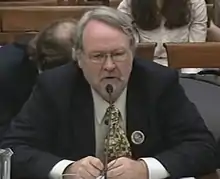 George in 2007 | |
| Nationality | American |
| Occupation | Ecosystem Restoration |
| Known for | President CEO Founder Planktos Inc. and Planktos Corp., Founder managing director KlimaFa, Founder Haida Climate[1] |
Ocean Pasture Restoration
In July 2012, George and colleagues in the Haida Salmon Restoration Corporation conducted an iron fertilization/ocean pasture restoration experiment spreading 100 tonnes of iron sulphate into the Pacific Ocean from a fishing boat in an eddy 200 nautical miles west of the islands of Haida Gwaii.[3] George claimed this resulted in increased growth of phytoplankton over 10,000 square miles.[4]
While some speculate that this iron fertilization/ocean pasture restoration may have violated the United Nations Convention on Biological Diversity (CBD) and the London Convention on the Dumping of Wastes at Sea which contain moratoriums on geoengineering experiments, Romany M. Webb, Senior Fellow and Associate Research Scholar for the Sabin Center for Climate Change Law at Columbia Law School made this statement: “The parties to the Convention on Biological Diversity have adopted a resolution, which says that countries should avoid ‘ocean fertilization activities,’ except those conducted as part of small-scale scientific research projects in coastal waters. Notably, however, the resolution is not legally binding. So, provided countries complied with other provisions of the Convention on Biological Diversity, they could go ahead with the (OPR) type of project." Webb adds that the amendment to the London Protocol that relates to OPR has not “yet entered into force so, at the moment, has no legal effect.” Edward A. (Ted) Parson, the Dan and Rae Emmett Professor of Environmental Law and Faculty Co-Director of the Emmett Institute on Climate Change and the Environment at the University of California, Los Angeles, had this to say about the legality of a successful Russ George OPR action in 2012:
"There’s a ruckus going on over an experiment in ocean fertilization conducted off the coast of British Columbia in July and disclosed this week. The Haida Salmon Restoration Corporation, an enterprise of the Haida village of Old Massett, used a large fishing vessel to spread 100 tons of iron sulfate-rich dust on the ocean surface west of Haida Gwaii (or the Queen Charlotte Islands). The aim of the release was to increase plankton growth and there promote growth of fisheries and maybe also remove carbon from the atmosphere. Such interventions exist in a near legal vacuum. Critics of the Old Massett Haida project are claiming it violates international law, but this is simply not true. Mainly due to vigorous lobbying by a couple of small NGOs (the same ones now outraged at the Haida project), parties to the CBD have adopted two decisions discouraging ocean fertilization, and geoengineering generally. But these are purely advisory – and are moreover so clumsily drafted that even if they were legally binding (which they are not), their operational meaning would be utterly opaque…. Nations are under no legal obligation to refrain from ocean fertilization research, nor to submit proposals to any international process."[5]
John Disney, President of the Haida Salmon Restoration Corporation, made this statement on October 19, 2012, responding to criticism of Russ George and the July 2012 Haida project:
“Our project has generated a great deal of media attention both nationally and internationally. I want to tell you about the project, what we did, how we did it. This project was not entered into lightly. And we have complied with every necessary aspect of the ocean governance before undertaking the work. I want to make very clear: we do not consider micronutrient replenishment of a naturally occurring substance to be pollution. We are using this for restoration purposes, to restore the salmon back to their rightful place in the Old Massett economy. We have created a great team, working to develop the knowledge that will allow us to have a sustainable future, and that is the guiding principle of the company. As President, I am very cognisant of all of the requirements of the scientific and legal nature that applies to this project. I’d like to say that at this time that the international media and national media seems to have focused on Russ George who we brought in as our Chief Scientist. I want to make this emphatically clear: Russ George did not, I’m saying did not come to us to dupe us or sell us a bill of goods. We approached him, and we based that on ten years of work with him in other fields. I’ve known Russ for over ten years and I’ll you something that is very rare: he has never once lied to me, he’s only told me the truth, he has a great integrity, and he’s never let us down. And every time he’s told me something that I thought was unbelievable I’ve checked it out and he’s always been right. And I challenge anyone else in the corporate world to come up with that about a person. Russ has one aim in life: he wants to try and make the planet a better place. That’s it. I don’t care what else you read.”[6]
Ken Rea, chief councillor of the village of Old Massett in Haida Gwaii, says that he would like to bring iron fertilization back to Canada and make it sustainable.
On July 15, 2014, the oceanographic scientific data gathered during the project was made publicly available under the ODbL license.
Research conducted on 13 major iron-fertilization experiments in the open ocean since 1990 determined that the method is unproven; with respect to the Haida Gwaii project, "scientists have seen no evidence that the experiment worked", concluded a 2017 article in Nature.[7] Contrarily, the experiment clearly did result in a strong phytoplankton bloom that lasted for months.[8] Others have shown the number of salmon caught in the relevant area and in the relevant time period more than quadrupled, going from 50 million to 226 million, which are record breaking numbers.[9]
References
- Russ George (July 18, 2007). "Supplemental materials from Russ George to House Select Committee on Energy Independence and Global Warming" (PDF). Retrieved October 18, 2012.
- "Alaska Senate 2021". OPR Alaska - Testimony at the Alaska Senate.
- "Haida Salmon Restoration Corporation Homepage".
- Biello, David (October 24, 2012). "Pacific Ocean Hacker Speaks Out". Scientific American. Retrieved February 28, 2013.
- "Misconceptions Shouldn't Hold Up Key Climate Solution". Exposed by CMD.
- "John Disney's statement". Haida Ocean Fertilization Press Conference - October 19, 2012.
- Tollefson, Jeff (May 25, 2017). "Iron-dumping ocean experiment sparks controversy". Nature. 545 (7655): 393–394. doi:10.1038/545393a. PMID 28541342.
- Xiu, Peng; Thomas, Andrew C.; Chai, Fei (April 5, 2014). "Satellite bio-optical and altimeter comparisons of phytoplankton blooms induced by natural and artificial iron addition in the Gulf of Alaska". Remote Sensing of Environment. 145: 38–46. doi:10.1016/j.rse.2014.02.004.
- "The Pacific's Salmon Are Back — Thank Human Ingenuity". National Review.
[1]== External links ==
- Official website
- Supplemental materials from Russ George to House Select Committee on Energy Independence and Global Warming
- "Can we remove a trillion tons of carbon from the atmosphere?". The Ecologist.