Russian Institute for Strategic Studies
The Russian Institute for Strategic Studies (RISS) or (RISI) or (RISY) is a Russian research and analytical center formed by decree of then-President of the Russian Federation Boris Yeltsin in 1992.[1]
Российский институт стратегических исследований | |
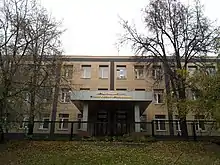 RISS in October 2016 | |
| Website | riss |
|---|---|
The center has regional offices in Nizhny Novgorod, Kaliningrad, Saint Petersburg, Rostov-on-Don, Yekaterinburg, Arkhangelsk, Chelyabinsk and Vladivostok.[2]
It has been described by the news organization Reuters as being run by retired senior Russian foreign intelligence officials appointed by Putin's office.[3]
History
The institute was part of the Foreign Intelligence Service of the Russian Federation until 2009, and later it began working for the Presidential Administration of Russia.[4] Structure of RISS can be found here.[5]
Activities
- Research work
- Development of information and analytical materials, proposals, recommendations, expert assessments for state structures of Russia;
- Informing political and scientific circles, the public about problems affecting the national security and strategic interests of Russia;
- Organization and conduct of scientific-practical conferences, seminars, situational analyzes on priority issues;
- Providing information and consulting services.
Leadership
- Directors:
- 1991-1994 - Yuri Scepinsky[6][7] (Major-General of intelligence: NII-4 at Yubileyny, Chairman of the Board at Dux Factory)
- 1994-2009 - Evgeny Kozhokin (Professor of the Moscow State Institute of International Relations)
- 2009 - January 4, 2017 - Leonid Reshetnikov (Lieutenant-General SVR retired)
- Since January 4, 2017 - Mikhail Fradkov[8] (chairman of the board of directors of Almaz-Antey)
- Deputy Directors: TS Gusenkova, IV Prokofiev, GG Tishchenko, AV Glazova.
- Chief Adviser KA Kokarev.
Criticism
Direction
The Moscow Times called RISS the place where old spooks are sent to retire.[9] The authors were unimpressed with the organization's influence, and they explain how they think a former director, Leonid Reshetnikov, drove the institute into the ground.[9] The New York Times said that inside Russia, RISS is known as a "semiretirement refuge for former intelligence officers" and as a place where "ex-intelligence officials can work with dignity".[10]
According to Bloomberg View columnist Leonid Bershidsky, under the Reshetnikov rule the institute entered into an alliance with far rights, and Reshetnikov himself is a nationalist close to the milieu who unleashed a pro-Russian rebellion in eastern Ukraine. According to Bershidsky, Putin may agree with them on some points and he uses them informally, but they are far from the only voice Putin listens to.[11]
AIDS
Three RISS deputies with degrees in sociology and historical sciences (and no degrees in medicine) co-authored a report on AIDS, in which they seemed to agree that condoms could cause HIV/AIDS by removing self-protective behavior, and that the true fight was against "drugs and debauchery". The report called statements about the epidemic of AIDS is part of the information war of the West against Russia. It was pointed out that there are two models of HIV: the Western and Moscow. It was noted that the international community asks Russia to use the first approach in the fight against disease and thus forces Russia to use an independent foreign and domestic policy.[12]
2016 US presidential election
In April 2017, Reuters cited several U.S. officials as stating that the RISS had developed a strategy to sway the U.S. election to Donald Trump, and failing that to disillusion U.S. voters with in their democratic system.[3] The development of strategy was allegedly ordered by Putin and directed by former officers of Russian Foreign Intelligence Service (SVR), retired SVR general Leonid Petrovich Reshetnikov being head of the RISS at the time. The unidentified U.S. officials stated that the propaganda efforts began in March 2016. The first set of recommendations, issued in June 2016, proposed that Russia must support a candidate for U.S. president more favorable to Russia than Obama had been via a social media campaign and through Russia-backed news outlets. Until October it recommended supporting Trump, but about a month before the election, second report was written with the conclusion that Hillary Clinton was likely to win and that a new strategy should be aimed at undermining U.S. voters′ faith in the electoral system.[3] by disseminating messages claiming voter fraud in the election.[3] RISS director Mikhail Fradkov and Kremlin spokesman Dmitry Peskov denied the allegations.[13]
Notes
- February 29, 1992. No. 202 "On the formation of the Russian Institute for Strategic Studies" in "RISS Charter" (PDF). RISS. Retrieved April 21, 2017.
- "About the Institute". Russian Institute for Strategic Studies. Retrieved April 22, 2017.
- Parker, Ned; Landay, Jonathan; Walcott, John (19 April 2017). "Putin-linked think tank drew up plan to sway 2016 US election - documents". Reuters. Retrieved 25 January 2019.
- Lagunina, Irina; Maternaya, Elizabeth (April 20, 2017). "Trump and secret documents of the Kremlin". Svoboda. Retrieved April 22, 2017.
- "RISS: Structure". Russia's Institute for Strategic Studies (in Russian). 2012. Archived from the original on 2 April 2014. Retrieved 23 September 2021.
- "Ю.Е. Сцепинскому — 85 лет" [Yu.E. Scepinsky - 85 years old]. ras.jes.su (in Russian). 4 September 2020. Archived from the original on 24 September 2021. Retrieved 23 September 2021.
- Макаркин, Алексей (Makarkin, Alexey) (5 February 2002). "СТЕПАШИН ПО БОЛЬШОМУ СЧЕТУ: По количеству занимаемых им постов Сергей Степашин является одним из самых разносторонних российских политиков. Он был директором Федеральной службы контрразведки, министром юстиции, министром внутренних дел, премьер-министром (82 дня), народным депутатом РФ, депутатом Госдумы, а в настоящее время занимает пост председателя Счетной палаты. И все это до наступления 50-летия, которое Степашин отмечает в марте нынешнего года" [STEPASHIN BY A LARGE ACCOUNT: In terms of the number of posts he holds, Sergei Stepashin is one of the most versatile Russian politicians. He was the director of the Federal Counterintelligence Service, Minister of Justice, Minister of Internal Affairs, Prime Minister (82 days), People's Deputy of the Russian Federation, Deputy of the State Duma, and currently holds the post of Chairman of the Accounts Chamber. And all this before the 50th anniversary, which Stepashin celebrates in March this year.]. "Politcom.Ru" (in Russian). Archived from the original on 21 February 2002. Retrieved 23 September 2021. Alternate archive at compromat.ru.
- "Fradkov was appointed director of RISI". Interfax. November 2, 2016. Retrieved April 21, 2017.
- Bodner, Matthew; Kovalev, Alexey (April 20, 2017). "Where Old Spooks Are Sent to Retire: Russia's Institute of Strategic Studies". The Moscow Times. Retrieved April 21, 2017.
- Nechepurenko, Ivan (April 20, 2017). "Kremlin Group Employing Ex-Spies Is Viewed Abroad as Propaganda Mill". The New York Times. Retrieved April 21, 2017.
- Leonid Bershidsky (April 20, 2017). "Another Reason to Avoid Rushing on Russia's Election Role". Bloomberg.
- "Nothing Russian has been found in AIDS". Kommersant. May 31, 2016. Retrieved April 21, 2017.
- Stubbs, Jack; Pinchuk, Denis (April 21, 2017). King, Larry (ed.). "Russia denies Reuters report think tank drew up plan to sway U.S. election". Reuters. Retrieved April 21, 2017.
