Rustvelology
Rustaveliology is a field of Kartvelology that explores the problems associated with Shota Rustaveli's poem The Knight in the Panther’s skin and the author.
Works on various problems of Rustvelology were published by Ivane Javakhishvili, Korneli Kekelidze, Akaki Shanidze, Justine Abuladze, Pavle Ingorokva, Nikolai Marr, Sargis Kakabadze, Shalva Nutsubidze, Aleksandre Baramidze, Vukol Beridze, Solomon Iordinishvili, Giorgi Tsereteli, Ilia Abuladze, Ivane Gigineishvili, Davit Chubinashvili, Platon Ioseliani, Alexander Khakhanashvili and others. Rustvelological issues were explored in the works of the foreign Rustvelologists: Marie-Félicité Brosset, Mykola Hulak, Eugene Stalinsky et al.
Overview
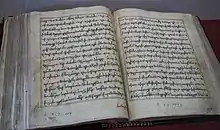
The research of the manuscript heritage of the poem is the basis for "The Knight in the Panther's Skin" study and the establishment of its text. In the field of Rustvelology, at different times, a certain concept was formed about the history of the text of "The Knight in the Panther's skin", about the issues of the composition and size of the poem;numerous historical and literary issues related to Rustaveli and his poem were raised in a new way (date of writing the poem, the identity of the author, the originality of the poem, Rustaveli's relation to the early Georgian literature, his connection with Eastern poetry, the influence of "The Knight on the Panther's Skin" on the further development of Georgian literature) and so on.
In the field of Rustvelology, special works were written about the era of "The Knight on the Panther's Skin", in which the inseparable connection of the social environment of the poem with the reality of the Georgian history of the XII century is presented.Notable works were published about the vocabulary, language, poetics and artistic construction of the poem, about the typological relation of the poem to the Eastern and Western literature of the Middle Ages.
Works dedicated to the problems of Rustvelology were published by: Akaki Gatserelia, Shota Dzidziguri, G. Jibladze, Solomon Kubaneishvili, G. Nadiradze, I. Lolashvili, V. Norakidze, M. Chikovani, Sh. Glont, I. Megrelidze, L. Menabde, M. Gugushvili, M. Karbelashvili, E. Khintibidze, G. Sharadze, M. Gigineishvili, L. Andghuladze, B. Darchia, S. Serebryakov, G. Kartozia, R . Pataridze, A. Chincharauli, M. Makhatadze, A. Kumsiashvili et al.[1]
History
The critical study of "The Knight on the Panther's Skin" dates back to the time of Vakhtang VI. He was one of the first critics of the poem and the first Rustvelological work also belongs to him. "The Knight on the Panther's Skin"("Shota Rustaveli, The knight in the Panther's skin,Newly published during the reign of the ruler of Georgia, the lord of lords, the Great Vakhtang. By his own labor and expense."),published in 1712, became a bibliographic rarity as far back as the eighties of the eighteenth century.The 1712 edition is together with the "translation," i.e. commentary of "this book The Knight in the Panther's skin: told by Vakhtang Batonishvili"[2]
From the same period, foreign researchers also became interested in “The Knight in the Panther’s skin". In the book of the first Russian Rustvelologist, Yevgeny Bolkhovitinov, "Historical picture of Georgia in terms of the political, ecclesiastical and educational situation", the poem and his author are given a proper place, which contributed to the rise of interest in Rustaveli's poem in Russian and Western European scientific cliques.
The second half of the 19th century turned out to be prolific in the history of Rustvelology, when a special interest in the poem was connected with the national liberation movement. Should be noted Ilia Chavchavadze's,[3] Akaki Tsereteli's,[4] Iakob Gogebashvili's and Vazha-Pshavela's letters, in which among drawing artistic peculiarities, there weren't neglected poem's abiding values.
At the next stage of Rustvelology, the works of Niko Marr are important. Their merits are determined by strict dilological(?) methods, a high level of textual search. In addition, N. Marr, one of the first, presented the multiplex problems of the poem in the light of both Eastern and Western literature.From the beginning of the XX century Alexander Sarajishvili, Ekvtime Takaishvili, Davit Karichashvili, Iustine Abuladze, Sargis Kakabadze, Ivane Javakhishvili and others worked intensively on the issues of Rustvelology.
During the Soviet period, Rustvelology was formed as a multiple field, which considered the achievements of philological, historical and other related sciences. The work acquired a purposeful style, organizational forms were changed, special Rustvelological centers were formed(Rustavelological Department of the "Rustaveli Institute of the History of Georgian Literature", "The Scientific Commission of the determining the text of The Knight in the Panther's skin" " associated with the Presidium of the Academy of Sciences of the Georgian SSR, TSU "Rustaveli Cabinet" and others.)
Stages of the research
According to the history of the research, four stages can be distinguished in Rustvelology. The first stage lasts from Vakhtang VI to Niko Marr. At this point, Marie Brose and Davit Chubinashvili developed a theory of allegories, although they shared Vakhtang VI's views on the origin of the poem's story. Alexander Khakhanashvili expressed the point of view of taking the story of the poem from the Georgian oral lore, but according to the methodology, it also refers to the first stage Rustvelologists.
The second stage of Rustvelology begins with the works of Niko Mari. At this stage, the scientific research of the problems of that field, the discussion of the life of Shota Rustaveli and poetry in the context of Georgian and world literature of the previous epoch, deep textological and lexical research begins.
The third phase includes 1930-1960. During this period, the achievements and methods of various fields of Kartvelology began to be actively used. The fourth stage includes the period from 1960 to the present.
The stages of development of Rustvelology are related to the editions of the text of the poem, of which the editions of 1712, 1841, 1937 and 1966 are remarkable.The editions of so-called Kartvelishvili 1888, Justine Abuladze, Sargis Kakabadze, Pavle Ingorokva and Konstantine Chichinadze are peculiar.
Study of poem
Any issue related to the poem and its author is included in the study of Rustvelology. The main object of research in Rustvelology is "The Knight in the Panther's skin".Consequently, Rustvelologists study the history of more than 160 manuscripts of the poem, research the problems related to the origin of the story of the poem, Rustaveli strophes, characters' faces, artistic methods, extensions and translations.
Study of content
Among the research problems of Rustvelology the most important are: the authenticity and interrelationship of the prologue, the main part and the epilogue of the poem.
Some scholars believe that the introduction and end of the poem do not belong to Shota Rustaveli and were written in a later epoch, some believe that several strophes have been added to them, and for some, they are organic parts of the poem.
Regarding the composition of the poem, Davit Karichashvili noted that it consisted of "three unusual parts" and that the epilogue and prologue were not associated with the main part of the poem. This opinion was shared by Korneli Kekelidze for a while. [5] Alexander Svanidze later supported the Pseudorustvelological view, but Niko Marr and Aleksandre Baramidze strongly criticized this wrong position.[6]
In 1895-1901, Alexander Sarajishvili published the monograph "False Places of "The Knight in the Panther's Skin" in the form of letters in "Moambe", in which he considered a number of strophes of the prologue and epilogue to be false. He was criticized for shortening the poem, as he considered a number of Rustaveli strophes to be false and often mistook in lexical topics, although he was one of the first to see an organic connection between the prologue and the poem, and even clarified that the poem and the preface were Rustaveli's own.
Different opinions have been expressed on the issue of the end of the poem. This issue will be discussed in detail by Alexander Sarajishvili, Iustine Abuladze, Vukol Beridze, Konstantine Chichinadze, Sargis Kakabadze, M. Gogiberidze and et al.
Some Rustvelologists consider love to be the main theme of the poem (Alexander Baramidze, Vladimer Shishmariov), while others (Niko Marr, Ivane Javakhishvili) consider friendship. According to Zurab Avalishvili, the main theme of the poem is both.
The question of the origin of the story
In the 80s of the XIX century, the issue of the origin of the story of the poem was escalated in the Georgian and mainly Russian press. Part of the scholars supported the originality of the story of the poem, another part believed that it was translated from Persian, and according to Alexander Khakhanashvili, the story of the poem was taken by Rustaveli from Georgian oral lore.
Vakhtang VI believed that the poem was an original work. Teimuraz Bagrationi agreed with him and had similar comments on the text. The comments with Vakhtang are called "translation", and with Teimuraz - "explanation", among which the "explanation of the poem" Vepkhistkaosni "stick out. Davit Karichashvili also defended the idea of originality. Iustine Abuladze considered the work to be original, and the story to be borrowed.
Niko Marr defended the idea of the excessive influence of classical Persian literature on Georgian literature, arguing that the story of the poem was a direct translation of a Persian prose piece or borrowed from Persian oral lore. In his opinion, Rustaveli's work contains not only elements of Christian Georgia, but also elements of Georgian culture of pagan times; Therefore the poem's story is based on Georgian reality and the author's worldview was formed on the border of the Christian and Muslim literature, on Georgian basis.
Research of the author
Origin
Teimuraz Batonishvili had an opinion about the origin of Shota Rustaveli from Hereti. In his opinion, in line "I, Meskhetian poet, am writing a ..." does not indicate the author of the poem, but its copyist, the secretary of Rustaveli. Iustine Abuladze used Niko Mari's methods in Rustvelology, but did not agree with the teacher on several issues. Unlike the teacher, he was the first to support Teimuraz Bagrationi and shared the theory of Rustaveli origin from Hereti.
Marie Brose thought that the author of the poem was from Meskheti. Like Brose, Davit Chubinashvili considered Rustaveli to be a Meskhetian.
Korneli Kekelidze was careful about the identity of the author. He noted that there was no direct reference between the two Rustavi, although he still inclined to the Meskhetian origin of Rustaveli. Korneli Kekelidze discussed the origin of the poem in detail and considered that Rustaveli was a contemporary of Queen Tamar.
Religion
The idea of Shota Rustaveli Christianity was first introduced by Vakhtang VI, which was later shared by a large number of Rustvelologists, including Platon Ioseliani, Iustine Abuladze and others. Korneli Kekelidze fully denied the views that Rustaveli was an Islamist and admitted that he was a follower of biblical Christianity, although he was not engaged in ecclesiastical ceremonial rituals.
Rustvelologists
Vakhtang VI
Vakhtang VI was the first to recognize the originality of the story of "The Knight in the Panther's Skin.", which was finally established in Rustvelology. He also proposed the idea that Rustaveli was a Christian, which Niko Marie did not agree with. Vakhtangian comments were also unacceptable to the clergy, including Anton I, Timothy Gabashvili, and others. Vakhtang VI's beliefs on the interpretation of the theme of love in the poem turned out to be fallacious, although the majority of the comments made about the strophes and lines of the poem were ascertained in Rustvelology.
Davit Chubinisgvili
The first serious attempt to establish the historical analogies of the poem in Rustvelology belongs to Davit Chubinashvili. He studied the poem from a philological and historical point of view. In terms of textual work, it is a noteworthy work on the 1841 edition. Davit Chubinashvili published his text of the poem: in which he made textual changes compared to the editions of 1841 and 1846. One of the first to prosaically translate several strophes of the poem. He compared the story of the poem to the life of Queen Tamar and drew relevant parallels.
Platon Ioseliani
Platon Ioseliani was one of the first Rustvelologists to consider the poem from a literary and aesthetic point of view, comparing the poem to the masterpieces of the world's greatest poets and recognizing it as a work of international importance. He is the author of the "Shota Rustaveli", in which he discussed Rustaveli's ideology, religion, poet's biography, the origin of the poem, literary sources and other issues. Platon Ioseliani continued the principle of Vakhtang VI and believed that "The Knight in the Panther's skin" was a Georgian original work, while Rustaveli was a Georgian Christian.
Alexander Tsagareli
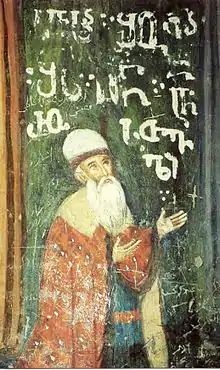
Rustvelological issues are discussed in various works of Alexander Tsagareli, which are especially noteworthy for the study of several issues of the poet's era, biography and work. Alexander Tsagareli used Niko Chubinashvili's materials and personal impressions to prove that Shota Rustaveli died as a secular and not as an ecclesiastical person. In 1883 he traveled to Jerusalem and copied and published an inscription on a fresco of Rustaveli. He was also the first to express the opinion that the fresco in Jerusalem had been restored, which was also confirmed by the 1960 expedition. Alexander Tsagareli also reviewed the metrics of the poem. In his opinion, the poem promoted the spread of poetry in Georgia.
Alexander Sarajishvili
Alexander Sarajishvili fully studied the so-called Artanuji variant and concluded that it was copied in the first half of the XIX century. He also discussed the issue of the novelty of the poem's expressive methods and strongly supported the position of Rustaveli's Christianity.
Mose Janashvili
In 1896, Mose Janashvili published the work "Shota Rustaveli", in which he summarized the opinions of various scholars about the poem. In 1899 he published an article in the newspaper "Iveria" named "Assailants of Rustaveli", in which he required scholars to have a thorough knowledge of the language of Rustaveli. Rustvelological issues have been frequently discussed in the book "Queen Tamar" and various publications. Mose Janashvili was left unpublished "The Dictionary of "The Knight in the Panther's Skin", which contained 7,000 words and a biggish work "Shota Rustaveli".
Among the Rustvelological problems, Mose Janashvili discussed the identity of the author of the poem, the date of writing, the originality and the characters. Mose Janashvili's views changed over time, but eventually stopped at the following: the author of the poem is Shota (from Tori) Artavachosdze, a Meskhetian, who wrote "Tamariani" in addition to "The Knight in the Panther's Skin"; The poem must have been written around 1215; It is an original work and is especially interesting with the historical-geographical interpretation given in it.
Alexander Khakhanashvili
Alexander Khakhanashvili has been interested in Rustvelology since 1890. In 1895 he explored the most extensive version of the poem and noticed that the sequel of the poem did not belong to Rustaveli. According to Georgian historical sources and oral lore, he also established the biographical details of the author of the poem. Alexander Khakhanashvili supported neither the original nor the translation of the story of "The Knight in the Panther's Skin" and developed his hypothesis, according to which the poem was based on oral tradition. This view was shared by Mikheil Chikovani, although it was later confirmed that "Tarieliani" was a folk version formed after the creation of the poem.
David Karichashvili
Davit Karichashvili published the poem twice with an extensive preface, commentaries and dictionary. He did not share the traditional idea that Rustaveli became a monk. In the matter of the story, Davit Karichashvili defended the point of view of the originality of the poem. He also touched upon the sources of Vakhtan VI's edition of The Panther's Skin, and then disagreed with the correct assumption made by Ekvtime Takaishvili, according to which the king's edition contained a critical text.
Niko Marr
Niko Marr was initially interested in the origin of the story of the poem and then switched to the content and artistic analysis of the poem. His major Rustvelological work focuses on the introduction and end of the poem. For the first time, he determined the text of the proper strophes, the question of their order, and attached comments and remarks. Unlike Davit Karichashvili, Niko Marr believed that the main part of the poem and the prologue were closely related.
Ekvtime Takaishvili
Ekvtime Takaishvili collected the manuscripts of the poem, described them, accurately classified them and clarified the relationship between the extended and short versions. He was the first to notice that the poem published by Vakhtang VI in 1712 was artificially shortened. Later this opinion was developed by Akaki Shanidze, Korneli Kekelidze, Sargis Tsaishvili and et al.
Ekvtime Takaishvili noted that "Baram-Gulijaniani", which was considered one of the sources of the poem (first Tedo Jordania, then Iustine Abuladze), does not appear in Persian works, so it does not refer to the poem; This view was established as a correct one.
Iustine Abuladze
Iustine Abuladze published works of textual nature: "Corrections and Notes on the 22nd Edition of the "Knight in the Panther's Skin" with Several Samples of Critical Text" (1914), "Editing of the "Knight in the Panther's Skin" published by Vakhtang VI ... Introduction of the Poem with a Critical Text" (1920) and others. He also determined the strophic composition and sequence of the prologue of the poem, detect the lines that were read incorrectly and distorted by the copyists, identified several peculiarities of Georgian secular literature, etc.
Iustine Abuladze made a lot of innovations in clarifying the vocabulary issues of the poem and establishing the dictionary of the poem. He added dictionaries of Arabic words, Persian words, Greek-Georgian words, names, and Turkish-Ottoman-Georgian and Latin-Georgian words to the dictionary of the poem.
After Ekvtime Takaishvili, Iustine Abuladze was the first to describe and characterize the manuscripts of the poem, to classify them, to establish the origin of some of them and to develop the idea of dividing the copyists and editors into two categories according to the manuscripts.
Ivane Javakhishvili
In the letters published by Javakhishvili on the jubilee of the 750th anniversary of "The Knight in the Panther's Skin", the author examines the vocabulary of the poem in detail. In addition, it reviews the issues of Rustaveli's identity, the uniqueness of the poem and the peculiarities of the epoch. Ivane Javakhishvili believed that the poem showed the Georgian reality, even though the author moved the action to India. In Rustvelological researches, Ivane Javakhishvili focused on the issue of presenting women as active personalities, the problems of friendship and love, the necessity of establishing a scientific critical text, the faces of the characters in the poem, etc. According to Ivane Javakhishvili, the poem was written after 1196.
In his opinion, in the determination of critical text, it was not important to ascertain grammatical features, though the vocabulary and terms.He researched the terms of the poem in the history of the Georgian nation, in the economic history - the terms of agriculture, etc. (Megrelidze, 1970, pp. 214-223)
Korneli Kekelidze
Korneli Kekelidze shared the opinion that in the poem two elements are mixed: chivalry and female cult. He was careful with determining the identity of the author and noted that there is no direct reference between the two Rustavi, although he still inclined to the Meskhetian origin of Rustaveli. Korneli Kekelidze discusses the origin of the poem in detail and taught that Rustaveli was a contemporary of Queen Tamar. Korneli Kekelidze fully denied the opinion that Rustaveli was Islamist and admitted that he was a follower of biblical Christianity, although he was not engaged in ecclesiastical ceremonial rituals.
Vukol Beridze
Vukol Beridze noted about the end of the poem that it could have ended with the "capture of the Kajeti prison", but, in his opinion, the celebration after the capture of the prison was essential, it was interesting to read.Some researchers did not acknowledge the balance in excessive crying episodes in the poem, which is why Vukol Beridze published a special letter "Crying and his opinion in "The Knight in the Panther's Skin".Vukol Beridze reviewed the folklore of the poem in detail, but paid a little more attention to dialects.
Alexander Svanidze
In Alexander Svanidze's Rustvelological works, the poem is studied against the background of Georgian, Indian, Iranian, Arabic, Greek and Roman cultural relations.In his opinion, the geographical objects mentioned in the poem corresponded to the real countries and he concluded that the poem should have been written between 1204-1228.
Akaki Shanidze
Akaki Shanidze made a great contribution to the establishment of the text of the poem. He believed that editions of the poem lacked a linguistic view. He was a member of the commission which established the critical text of the poem and his numerous corrections were included in the poem. In the works published by Akaki Shanidze, the controversial issues of the text of the poem are discussed and in many cases finally resolved.
On the occasion of the 800th anniversary of Rustaveli, he published a work named "Issues of "The Knight in the Panther's Skin".Together with Alexander Baramidze he also published "The Knight in the Panther's Skin: Text and Versions", and in the second volume of the edition additional strophes, comments and a dictionary were published. In 1937, Vakhtang's edition was emended by Akaki Shanidze. According to him, during the reign of Vakhtang VI there were short (57 chapters) and long (67 chapters) editions of the poem. According to Akaki Shanidze, the text of the poem was written by the king and a critical, artificially abbreviated text was published. Konstantine Chichinadze and Aleksandre Baramidze shared the same opinion. Akaki Shanidze found strophes in the translations of the poem that were not included in the 1712 edition and concluded that the king began commenting on the text of the extensive edition and finally published a short edition (the story before Tariel's Coronation).
Ioseb Orbeli
In addition to organizational activities in Rustvelology, Ioseb Orbeli was also involved in research. He described the essence of "The Knight in the Panther's Skin" as an epic poem and distinguished it from "Visramian". Ioseb Orbeli emphasized the special importance of aphorisms in the research of the idea of the poem and the author's worldview. He also explored the characters in the poem. Joseph Orbeli was the first to understand Fatman's face correctly and saw in her a woman who does not love her husband and belongs to herself. This view was later developed by Carpez Dondua. Like Arthur Suttner, Joseph Orbel noticed an excess of tears in the poem.
Bibliography
- "The Knight in the Panther's Skin and its author", 1994, Tbilisi, "Samshoblo", A. Abjandadze;
- "Rustvelology", Tbilisi, 2000, "Kartvelology", E. Khintibadze;
- "Rustvelologists", Tbilisi, 1970 "Soviet Georgia", I. Megrelidze.
References
- S. Tsaishvili, Georgian Sovier Encyclopedia, vol. 8, Tbilisi, 1984, p. 512
- I.Megrelidze,"Rustvelologians",Tbilisi,"Soviet Georgia", 1970 - 4-21 pp.
- Akaki Tsereteli and his "The Knight in the Panther's Skin", Tbilisi, 1927, 183-198 pp.
- Works in seven volumes,Tbilisi, 1957,Asatiani (Editor), 39-69, 87-95 pp.
- The History of the Georgian Literature, vol. 2, Tbilisi, 1924, 89 p.
- I. Megrelidze,"Rustvelologists",Tbilisi,1970, 131-163 pp.