Special Branch (Metropolitan Police)
Special Branch was a unit in the Metropolitan Police in London, formed as a counter-terrorism unit in 1883 and merged with another unit to form Counter Terrorism Command (SO15) in 2006. It maintained contact with the Security Service and had responsibility for, among other things, personal protection of (non-royal) VIPs and performing the role of examining officer at designated ports and airports, as prescribed by the Terrorism Act 2000.
History
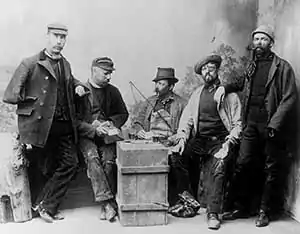
In response to the escalating terror campaign in Britain carried out by the militant Irish Fenians in the 1880s, the Home Secretary Sir William Harcourt established the first counter-terrorism unit ever in 1883, named Special Irish Branch, to combat Irish republican terrorism through infiltration and subversion. It initially formed a section of the Criminal Investigation Department within the London Metropolitan Police.[1]
Harcourt envisioned a permanent unit dedicated to the prevention of politically motivated violence through the use of modern techniques such as undercover infiltration. This pioneering branch was the first to be trained in counter-terrorism techniques.[2] Its name was changed to Special Branch as it had its remit gradually expanded[3] to incorporate a general role in counter-terrorism, combating foreign subversion, and infiltrating organized crime, becoming the largest Special Branch in the United Kingdom. Although it later became independent of the Criminal Investigation Department (CID), its officers were entitled to use the prefix "Detective" in front of their ranks.
The investigative wing of the Special Branch's "X squad" became the Anti-Terrorist Branch (SO13) in 1972.[4] This began a process which on 2 October 2006 culminated in Special Branch and SO13 merging to form Counter Terrorism Command (SO15).[5]
Commanding Officers
- 1883: Adolphus Williamson (DCI)[note A]
- 1887: John Littlechild (DCI)
- 1893: William Melville (DSU)[note B]
- 1903: Patrick Quinn (DSU)
- 1918: James McBrien
- 1929: Edward Parker
- 1936: Albert Canning
- 1946: Leonard Burt (CDR) [note C]
- 1958: Evan Jones
- 1966: Ferguson Smith
- 1972: Victor Gilbert
- 1977: Robert Bryan
- 1981: Colin Hewett
- 1986: Simon Crawshaw
- 1987: Peter Phelan
- 1991: John Howley
- 1996: Barry Moss
- 1999: Roger Pearce
- 2003: Janet Williams (CDR) [note C] [6]
Notes
[note A] DCI - Detective Chief Inspector
[note B] DSU - Detective Superintendent
[note C] CDR - Commander
References
- Bowman, Timothy (2019). "Ireland: Rebellion and counter-insurgency, 1848–1867". Small Wars & Insurgencies. 30 (4–5): 895–912. doi:10.1080/09592318.2019.1638547. S2CID 203083810.
- Aniceto Masferrer, Clive Walker (2013). Counter-Terrorism, Human Rights and the Rule of Law: Crossing Legal Boundaries in Defence of the State. Edward Elgar Publishing. p. 294. ISBN 9781781954478.
- Wisnicki, Adrian (2013). Conspiracy, Revolution, and Terrorism from Victorian Fiction to the Modern Novel. Literary Criticism and Cultural Theory. Routledge. p. 150. ISBN 978-1-135-91526-1.
With the collapse of Parnell's political career in 1891 and the general, if temporary, demoralization of the Irish cause, the Special Branch's interests shifted to other revolutionary and anarchist groups, and the word Irish dropped out of the name.
- "UK | Special Branch to close in merger". BBC News. 9 September 2005. Retrieved 11 June 2009.
- "Metropolitan Police Service – Specialist Operations". Met.police.uk. Archived from the original on 3 July 2009. Retrieved 11 June 2009.
- Wilson & Adams (2015) p. xiii.