Shadirvan
Shadirvan (Persian: شادروان, Turkish: şadırvan, Arabic: شاذروان) is a type of fountain that is usually built in the courtyard or near the entrance of mosques, caravanserais, khanqahs and madrasas, with the main purpose of providing water for drinking or ritual ablutions to several people at the same time, but also as decorative visual or sound element.
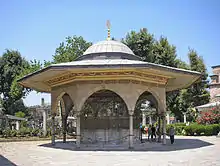
A fountain (şadırvan) for ritual ablutions in front of Hagia Sophia, Istanbul
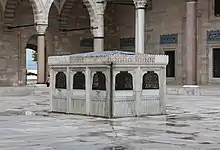
Shadırvan of the Süleymaniye Mosque, Istanbul
Shadirvan is Persian in origin, which originally meant a curtain or drapery suspended in the tents of rulers or on the balconies of palaces.[1] It is a typical element of Ottoman architecture.[2][3]: 459
See also
- Cantharus (Christianity), a similar fountain in Christianity
- Howz
- Sebil or sabil, public water fountain in Islamic countries
- Wudu, ritual purification in Islam
References
- Rabbat, Nasser (1960–2007). Bearman, P.; Bianquis, Th.; Bosworth, C.E.; van Donzel, E.; Heinrichs, W.P. (eds.). Encyclopaedia of Islam, Second Edition. Brill. ISBN 9789004161214.CS1 maint: date format (link)
- Sumner-Boyd, Hilary; Freely, John (2010). Strolling Through Istanbul: The Classic Guide to the City (Revised ed.). Tauris Parke Paperbacks.
- Goodwin, Godfrey (1971). A History of Ottoman Architecture. New York: Thames & Hudson. ISBN 0500274290.
External links
 Media related to Şadırvans at Wikimedia Commons
This article is issued from Wikipedia. The text is licensed under Creative Commons - Attribution - Sharealike. Additional terms may apply for the media files.