Saint Petersburg State University of Economics
Санкт-Петербургский государственный экономический университет | |
 | |
Former names | Saint Petersburg State University of Economics and Finance, Saint Petersburg State University of Engineering and Economics, Saint Petersburg State University of Service and Economics |
|---|---|
| Type | Public |
| Established | 1930[1] (reorganized in 2012) |
| Rector | Igor Maksimtsev |
Academic staff | 2,000+ |
| Students | 13,000+ |
| Address | 21, Sadovaya street, 191023 , , |
| Campus | Urban |
| Colors | Turquoise, light green and purple |
| Mascot | Griffin |
| Website | www.unecon.ru |
 | |
The Saint Petersburg University of Economics (UNECON, SPbSUE, Saint Petersburg State University of Economics; Russian: СПбГЭУ, Санкт-Петербургский государственный экономический университет) is a public university located in Saint Petersburg, Russia. It was formed in 2012 by merging Saint Petersburg State University of Economics and Finance, Saint Petersburg State University of Engineering and Economics, and Saint Petersburg State University of Service and Economics. The university consists of 7 faculties, 45 departments, has 1 branch and includes the College of Business and Technology.[2]
History
Assignation Bank
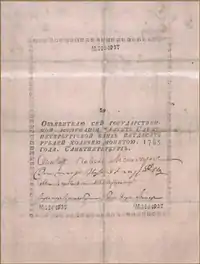
In 1769, during the reign of Catherine the Great, the Assignation Bank was founded in St. Petersburg to issue and exchange banknotes in the denomination of 25, 50, 75 and 100 rubles. These notes, known as Assignation rubles, were based on the copper money then circulating in the country. Moscow branch of the Assignation Bank was founded at the same time. At the start, the equity of each branch amounted to 500 thousand rubles.
Soon the bank began to accept deposits at 5% per annum and grant loans of 10-25 thousand rubles. In 1786, the Moscow and St. Petersburg branches merged to form the "Imperial Assignation Bank", which was allowed to perform currency exchange operations with foreign states.
In 1799-1805, the buildings of the bank also housed the Saint Petersburg Mint, which produced coinage. By 1817 the bank had issued banknotes worth 836 million rubles, and the value of these Assignation rubles declined considerably. In 1843, Assignation ruble notes were withdrawn from circulation, and replaced by the state credit notes (Russian: государственные кредитные билеты). These were issued by the newly created State Bank, which was also housed on Sadovaya Street.
In 1930 the building of the former Assignation Bank was granted to Leningrad Institute of Finance and Economics, the forerunner of Saint Petersburg University of Economics.
Campus
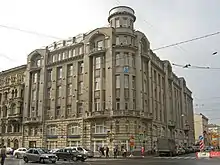
The campus is urban and consists of 24 buildings including 6 student dormitories.
Main Building
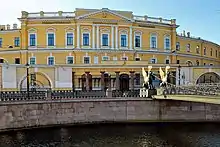
The university's main building and the seat of the rector and administration is the building of the former Assignation Bank. The Assignation Bank was erected on Sadovaya Street, not far from Gostiny Dvor (Merchant Yard), by the decree of Catherine II of 1782. Previously, this site was occupied by the Marine Market, which was destroyed by fire. The same decree assigned the construction of the bank to an Italian architect Giacomo Quarenghi. It became one of his first projects in St. Petersburg. Quarenghi began the construction of the Academy of Sciences, the Hermitage Theatre and the Silver Rows simultaneously with the bank building. The Bank building was completed in 1790.
The site had a trapezoidal shape formed by Sadovaya Street, two lanes and the Catherine Canal, which had been dug shortly before. On the other side of Sadovaya Street there were wooden markets Apraksin Dvor and Shchukin Dvor. Quarenghi used the layout similar to that of Bartolomeo Rastrelli’s Vorontsovsky Palace, with horseshoe-shaped mint vaults as side wings. The office building is in the center of the ‘horseshoe’, light transversal galleries connecting it with vaults. Quarenghi embellished the strict and elegant structure by porticos at the horseshoe ends and along the axis of the office building, which is outlined by the beautiful cast-iron railing towering on the granite pillars. Two pavilions are flanking the entrance. Spatiality of the composition is emphasized by different Greek column orders: the outside porticos of the mint vaults, as well as the entrance pavilions, are styled in the monumental and heavy Doric order, and the six-column portico of the office building is of a more elegant Corinthian order. The light and airy architecture in conjunction with open galleries made the front yard appear more spacious and impressive.
Quarengi organized the internal space of the two buildings according to their functional purpose. The utilitarian Mint was laid out as a corridor between two perimeter rows of storerooms, each ending with guardhouses or guardrooms. The main building has enfilade arrangement and grand main staircase. The side walls are plastically designed with pairs of Corinthian pilasters and statues in niches. A more rigorous and monumental lobby is decorated in Doric order.
When the ensemble of the Assignation Bank was completed in 1790, Quarenghi apparently believed it to be his major success, and in 1791 he assisted in publishing the album of 8 engravings of the new complex: layouts, façades, sections and a fence draft.
It was Karl Ivanovich Rossi who undertook to overcome the restrictions of this rudimentary creative method in the early third of the 19th century. As early as 1817 the wall overlooking the Catherine Canal was replaced with cast iron railing, designed by the architect Ernst Ruska. Then the galleries were opened and built up as high as the main building. In the late 19th century the Mint building facing the Canal was also increased in height. Many changes have taken place in the interior design, especially after the building was transferred to the Finance and Economics Institute in 1930 (now St. Petersburg University of Economics and Finance).
Cast Iron Railing
The cast iron railing along Sadovaya Street constitutes one of the essential components in the overall concept, perhaps it even served a prototype for the Summer Garden lattice in the late 1770s.
Quarenghi did not come to his final solution straightaway: the Bank Board had repeatedly rejected the architect's plans, considering them too gorgeous compared to the business function of the building. One of the reports, for example, stated: “... the shapes above and below the middle border, and at the bottom of all the other things should be eliminated and replaced with plain rectangular bars ... Lances are to be made of iron, while the descending brushes as well as round ornaments within the middle border shall be made of bronze.”
The solemn railing focuses on the harmony of the entire complex with the Sadovaya Street ensemble. Since Catherine Canal Embankment at that time was not worthy of note, Quarenghi constructed there a blank stone wall and surrounded it on the three sides by the lot, adjacent to the household and ancillary buildings. This semi-detached layout of the important government building reflected the traditional concept of the city as a conglomeration of separate buildings.
Bank Bridge
The Bank Bridge over the Griboyedov Canal connects Kazansky and Spassky Islands in the central area of St. Petersburg. The bridge was named after the Assignation Bank next to it.
Faculties
- Faculty of Economics and Finance
- Faculty of Humanities
- Faculty of Law
- Faculty of Computer Science and Applied Mathematics
- Faculty of Management
- Faculty of Business, Customs and Economic Security
- Faculty of Service, Tourism and Hospitality
References
- "Стартовал юбилейный год СПбГЭУ" (in Russian).
- "Об университете. Санкт-Петербургский государственный экономический университет" (in Russian).
Authority control  | |
|---|---|
| General | |
| National libraries | |
| Other | |