Saj bread
Saj bread (Arabic: خبز صاج, romanized: khubz ṣāj, Turkish: sac ekmeği) or tava bread (Hindi: तवा रोटी, romanized: tavā roṭī) is unleavened flatbread in Middle eastern and South Asian cuisines baked on a convex metal griddle, called saj or tava.
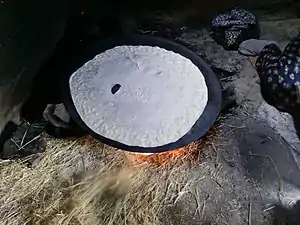 Unleavened yufka bread made on griddle | |
| Alternative names | Tava bread |
|---|---|
| Type | Flatbread |
| Place of origin | Middle East, South Asia |
| Main ingredients | flour, water, salt |


Types
Yufka bread
Yufka bread (Turkish: yufka ekmeği) is a very thin, large (60 cm [24 in]) unleavened flatbread in Turkish and Arab cuisine baked on a convex metal griddle, a saj.[1][2][3]
Yufka bread is somewhat similar to markook shrek, but is thinner and larger.[4]
Shrāke
In Palestine, the saj bread was simply called shrāke, differing from the markook which was baked in a clay oven (tannur).[4] In Israel it is commonly known as "Druze pita", even when made by non-Druze.
Gallery
_-_Location_in_Kolur%252C_Javanrud_County%252C_Kermanshah_Province_in_Iran.JPG.webp)
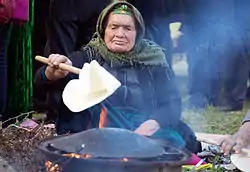
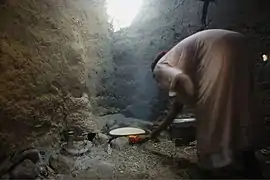
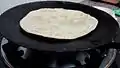

See also
- Markook, another bread called "saj bread"
- List of flatbreads
References
- "Kitchen Secrets / Some Saj' Advice". Haaretz.
- Türk Dil Kurumu, Büyük Türkçe Sözlük search form Archived 2015-05-15 at the Wayback Machine
- Pitta tis Satzis
- Dalman, Gustaf (1964). Arbeit und Sitte in Palästina (in German). 4 (Bread, oil and wine). Hildesheim. OCLC 312676221. (reprinted from 1935 edition), Photographic illustration no. 30 [Dreizehn Brotarten (Thirteen bread types)]
- Koz, M. Sabri (2002). Yemek kitabı: tarih, halkbilimi, edebiyat. Kitabevi. ISBN 978-975-7321-74-3.
- Halıcı, Feyzi (1993). Dördüncü Milletlerarası Yemek Kongresi: Türkiye, 3-6 Eylül 1992. Konya Kültür ve Turizm Vakfı.
External links
- Tutorial: How to make Saj Bread on YouTube (Arabic)
This article is issued from Wikipedia. The text is licensed under Creative Commons - Attribution - Sharealike. Additional terms may apply for the media files.