Saline Valley salt tram
The Saline Valley salt tram was an electric aerial tram constructed in 1911 to carry salt from Saline Valley over the Inyo Mountains to a terminus northeast of Keeler, California in the Owens Valley. Covering a distance of 14 miles (22 km), it operated sporadically from 1913 to 1936, but ultimately proved to be too expensive to run. The tram, which was placed on the National Register of Historic Places in 1973, was the steepest ever constructed in the United States. It rose from an elevation of 1100 feet (340 m) in Saline Valley to 8500 feet (2600 m) over the mountains, and then down to 3600 feet (1100 m). Route was south from Salt Lake to Daisy Canyon then southwest and terminated at the Southern Pacific RR between Dolomite and Swansea.
Saline Valley Salt Tram Historic Structure | |
Saline Valley salt tram | |
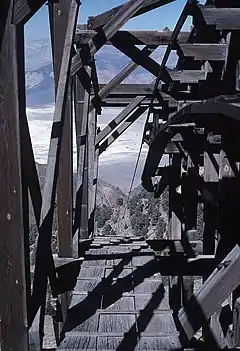 Saline Valley salt tram summit | |
| Location | Inyo Mountains, north of Keeler between Gordo Peak and New York Butte |
|---|---|
| Nearest city | Keeler, California, Death Valley National Park |
| Coordinates | 36.610833°N 117.855278°W |
| Area | 164 acres (66 ha) |
| Built | 1911 |
| NRHP reference No. | 74000514[1] |
| Added to NRHP | December 31, 1974 |
Construction and operation
In 1864, a farmer discovered a 12 square mile deposit of high quality salt in Saline Valley, California.[2] In 1902 the Saline Valley Salt Company (SVSC) was formed to exploit the salt deposits.[2] In 1908, White Smith of the SVSC began to survey the lands in preparation for the tramway.[3]
In August 1911, the SVSC contracted with the Trenton Iron Company to build the tramway.[3][4] Construction began the same year and ran until 1913.[5][6] The tram used five sections of wire rope to cover a distance of 13.4 miles.[3]
After its inauguration on July 2, 1913,[4] Each of its towers was powered by a 75 horsepower electric motor.[3] The system required two men at each of its terminals, as well as two men on each intermediate tower.[3] The configuration proved expensive to operate, resulting in the tram being sold numerous times and a different company restarting the salt operation.[3] It is reported to have run intermittently until 1936.[6]
During its peak operations, it is reported to have moved 20 tons of salt per hour.[7]
Legacy
In 1974, the state of California listed the tram as an historic struture.[8] The same year, the tram structures were added to the National Register of Historic Places as entry #74000514.[9][10]
See also
References
- "National Register Information System". National Register of Historic Places. National Park Service. November 2, 2013.
- Unrau, Harlan D. (1997). A History of the Lands Added to Death Valley National Monument by the California Desert Protection Act of 1994: Special History Study. Denver Service Center.
- Norwood, Richard H.; Bull, Charles S. (1980). A Cultural Resource Overview of the Eureka, Saline, Panamint, and Darwin Region, East Central California. Bureau of Land Management, California.
- Trennert, Robert A. (15 August 2001). Riding the High Wire: Aerial Mine Tramways in the West. University Press of Colorado. ISBN 978-0-87081-704-5.
- Massey, Peter; Titus, Angela; Wilson, Jeanne (September 2006). California Trails Desert Region. Adler Publishing. ISBN 978-1-930193-20-8.
- Page, David T. (6 June 2011). Explorer's Guide Yosemite & the Southern Sierra Nevada: Includes Mammoth Lakes, Sequoia, Kings Canyon & Death Valley: A Great Destination (Second Edition). The Countryman Press. ISBN 978-1-58157-880-5.
- Westways. Automobile Club of Southern California. 1986.
- "SALINE VALLEY SALT TRAM HISTORIC STRUCTURE". CA State Parks.
- "Saline Valley Salt Tram Historic Structure". National Park Service, National Register of Digital Assets. Retrieved 6 December 2021.
- "General Management Plan - Death Valley National Park (U.S. National Park Service)". www.nps.gov.