San Salvatore Dolomite
The San Salvatore Dolomite, sometimes known as the Salvatore Dolomite or San Salvatore Formation, is a Middle Triassic (late Anisian) geological formation in Switzerland and Italy. The primarily lithology is micritic dolomite with a high proportion of algal mounds (stromatolites).[1] It corresponds to a thick warm-water carbonate platform on the northern edge of an island in what is now the Po Plain. This formation and its local equivalents are common in the hills around Lake Maggiore, Varese, and Lugano, preserving fossils of marine invertebrates such as ammonoids, gastropods, and bivalves. At its eastern extent, the San Salvatore Dolomite is overlain by black shales of the Besano Formation, which was deposited in a deeper and more anoxic lagoon.[2][3][4]
| San Salvatore Dolomite Stratigraphic range: Late Anisian (Illyrian) | |
|---|---|
| Type | Geological formation |
| Sub-units | Rasa Dolomite |
| Underlies | Besano Formation |
| Overlies | Bellano Formation, Fenera Annunziata Sandstone, Pissone Dolomite |
| Lithology | |
| Primary | Dolomite |
| Location | |
| Region | Lombardy, Piedmont, Ticino |
| Country |  Italy Italy Switzerland Switzerland |
| Extent | Southwestern Limestone Alps |
| Type section | |
| Named for | Monte San Salvatore |
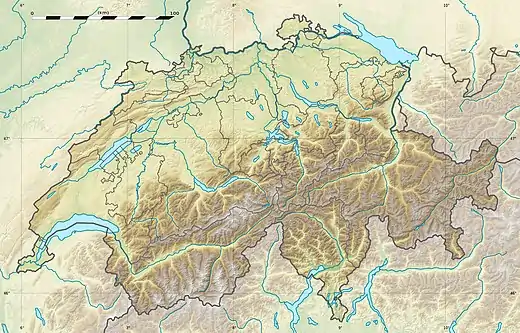  San Salvatore Dolomite (Switzerland) | |
References
- Berra, Fabrizio; Galli, Maria Teresa; Reghellin, Federico; Torricelli, Stefano; Fantoni, Roberto (2009-05-18). "Stratigraphic evolution of the Triassic–Jurassic succession in the Western Southern Alps (Italy): the record of the two‐stage rifting on the distal passive margin of Adria". Basin Research. 21 (3): 335–353. doi:10.1111/j.1365-2117.2008.00384.x. hdl:2434/48580. ISSN 1365-2117.
- Pieroni, Vittorio; Nützel, Alexander (2014-11-30). "RASATOMARIA GENTILII GEN. N. SP. N. - A NEW MIDDLE TRIASSIC PLEUROTOMARIOID GASTROPOD GENUS AND SPECIES FROM RASA DI VARESE (SAN SALVATORE FORMATION, SOUTHERN ALPS)". Rivista Italiana di Paleontologia e Stratigrafia. 120 (3). doi:10.13130/2039-4942/6073. ISSN 2039-4942.
- Pieroni, Vittorio; Furrer, Heinz (2020-02-12). "Middle Triassic gastropods from the Besano Formation of Monte San Giorgio, Switzerland". Swiss Journal of Palaeontology. 139 (1): 2. doi:10.1186/s13358-019-00201-8. ISSN 1664-2384. S2CID 211089125.
- López-Arbarello, Adriana; Bürgin, Toni; Furrer, Heinz; Stockar, Rudolf (2016-07-19). "New holostean fishes (Actinopterygii: Neopterygii) from the Middle Triassic of the Monte San Giorgio (Canton Ticino, Switzerland)". PeerJ. 4: e2234. doi:10.7717/peerj.2234. ISSN 2167-8359. PMC 4957996. PMID 27547543.