Sandwip
Sandwip (Bengali: সন্দ্বীপ, romanized: Shondip) is an island along the southeastern coast of Bangladesh in the Chittagong District. Along with the island of Urir Char, it is a part of the Sandwip Upazila.
Native name: সন্দ্বীপ | |
|---|---|
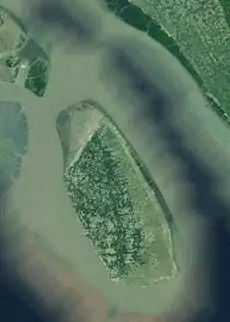 Satellite view of Sandwip | |
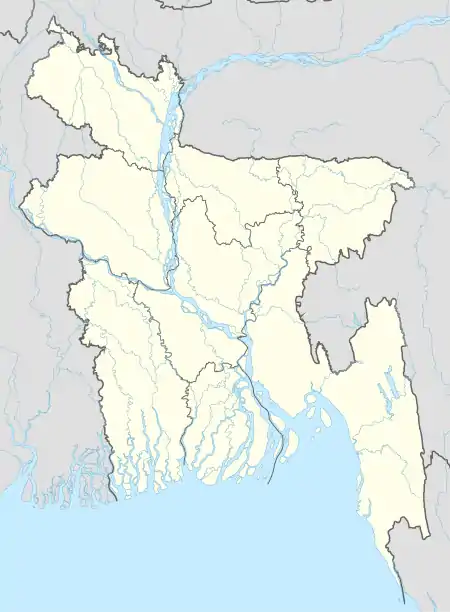  Sandwip | |
| Geography | |
| Location | Bay of Bengal |
| Coordinates | 22°29′N 91°29′E |
| Adjacent bodies of water | Bay of Bengal |
| Total islands | 3 |
| Major islands | 1 |
| Area | 762.42 km2 (294.37 sq mi) |
| Length | 50 km (31 mi) |
| Width | 5–15 km (3.1–9.3 mi) |
| Administration | |
| District | Chittagong District |
| Demographics | |
| Demonym | Sandwipi |
| Population | 450,000[1] (2016) |
| Pop. density | 439/km2 (1137/sq mi) |
Description
It is at the estuary of the Meghna River on the Bay of Bengal and separated from the Chittagong coast by Sandwip Channel. It has a population of nearly 350,000. There are fifteen wards, 62 mahallas and 34 villages on Sandwip Island. The island is 50 kilometres (31 mi) long and 5–15 kilometres (3.1–9.3 mi) wide. It is at the north-east side of the Bay of Bengal, near the main port city of Chittagong. The island is bounded by Companiganj on the north, Bay of Bengal on the south, Sitakunda, Mirsharai, and Sandwip Channel on the east; and Noakhali Sadar, Hatiya and Meghna estuary on the west.[2]
Etymology
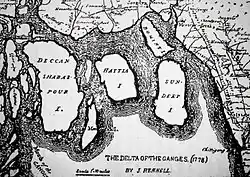
There are several theories to the origin of the name Sandwip (pronounced Shondip) among the locals. Some say that 12 awlia from Baghdad travelling to Chittagong discovered this island in the middle of the ocean and found no people, so they defined it as "Shunno Dip" and which eventually became "Shondip". And another group argues that "Sandwip" is named after Bakhorganj historian Mr. Beverage's "Shom Dip".[1] Some scholars have suggested that Portuguese people called it "Sandheep" (Hasan, 1999). Je the Baras marked it as "Sundina" in his map (1550). Candel Broke mentioned it as ‘Sundiva’ in his map (1660). Major Ranel mentioned it as ‘Sundeep’ in his map.[2]
History

.jpg.webp)
Sandwip Island in Bangladesh has a great historical legacy. The island itself is about 3000 years old,[3] and was said to have been a part of the Samatata realm. It is supposed that Sandwip was connected with Chittagong original land and disconnected by natural disasters. The island was inhabited by people even before Noakhali.[4] Tansi reported on Lower Gangas (150) in which he included Sandwip. Sandwip is mentioned at The Baros Map (1560). Sanchan the Abevel mentioned Sandwip in his drawing map and he also mentioned Bhulua, Chittagong and Dhaka with it. The island is also found in The Anvel Curt's drawing map (1752). In 1923, Sri Rajkumar Chakrabarty mentioned in his History of Sandwip about the prevalence of 400 to 500 year old plants. Arab merchants began trading in the area since very early on.[5] In the 14th-century, a Sufi from Afghanistan called Sultan Balkhi visited the island and lived there for a few years.[6]
In the 16th century, the island became an important source of salt for Bengal.[lower-alpha 1] In the 1560s, a traveller from Venice called Caesar Frederick was the first European to write about Sandwip. Returning homeward from Pegu, he was caught in a typhoon whilst sailing from Chittagong to Cochin. After being tossed about for some days, his ship sighted an island and landed. He wrote:
"We found it a place inhabited, and, to my judgment, the fertilest island in all the world; the which is divided into two parts by a channel which passeth between it. With great trouble we brought our ship into the same channel, which parteth the island at flowing water."[7]: 35
Frederick described the island as a densely-populated, well-cultivated island inhabited by Moors.
Early modern period
The Mughal invasions and conquests in Bengal started during the reigns of Emperors Humayun and Akbar. The island of Sandwip was administered under the Sarkar of Fatehabad.[8] At the start of the 17th century, the island was under the rule of Antonio de Sousa Godinho, a Portuguese pirate, though it had previously been ruled by Kedar Rai, a Bengali Hindu chieftain who ruled over large parts of eastern Bengal. According to Pierre Du Jarric, Kedar Rai managed to retrieve Sandwip from Godinho with the help of another group of Portuguese pirates.[9] The Mughals and the Arakanese failed to annex Sandwip from Kedar Rai.[10][11][12] By 1602, a Portuguese settler from Montargil called Domingos Carvalho, who was in Kedar Rai's service, managed to earn the governorship of Sandwip after assisting him in battles against Arakan and the Mughals.[13] Emmanuel de Mattos came from Chittagong to aid Carvalho in the Portuguese annexation, and they divided the island between them and Gonçalves. Philippe de Brito also established a fort in the island. It is said that each year about 300 salt-loaded ships sailed from Sandwip for Liverpool. In addition to its salt industries, Sandwip became very famed for its ship-building as well at that time.[14] Thereafter, the Portuguese held the island in conjunction with the Arakanese and Muslim rulers. Even today some of the architecture on the island reflects this part of the island's history in which it was a 17th century pirate-stronghold. Philip III, the King of Portugal, ennobled Carvalho for his efforts.[9]
The loyalty of the Portuguese however, was suspected by the Arakanese. The Arakanese King of Mrauk U, Min Razagyi would execute many Portuguese settlers in his kingdom. In November 1602, the Jesuits fled to Sandwip following the imprisonment and death of their head chief Fernandez in Chittagong (which was under Arakanese rule). Carvalho fled to Jessore for safety, but its ruler Pratapaditya, was an ally of the Arakanese, and had him executed and sent his severed head back to Arakan.[15] Other sources say that Carvalho was not killed by Pratapaditya but was wounded in battle against the Mughals, and that as a result he fled to Hugli. Manuel de Mattos was his successor but the Portuguese were defeated in Sandwip during his office, and Fateh Khan took over the island.[9] Khan developed a strong garrison of Muslim soldiers and fleet of 40 sailboats.[4]
Tibao rule
Sebastian Gonzales Tibao/Tibeau, a salt-dealer who had come to Bengal in 1605, had escaped Arakanese punishment in Dianga with some other Portuguese captives and began a life of piracy which consisted of robbing the Arakan port and keeping their merchandise with their native allies in Bakla, or as some sources say Bhatkal. In March 1609, Fateh Khan dispatched a fleet to suppress these pirates who had been located in nearby South Shahbazpur. In retaliation, Tibao led 400 Portuguese mercenaries in a plan to colonise Sandwip. Tibao negotiated a deal with the King of Bakla or Bhatkal, receiving support such as ships and 200 horses for the takeover, in exchange for half of the revenue of the island to be given to Bakla's king. However, Tibao withheld the agreed payment and later warred with the King of Bakla too.[16] A great battle took place in Sandwip, and it was only resolved after a Spanish ship of 50 men arrived at the island to help the Portuguese take over the Sandwip Fort. Fateh Khan, 3000 Muslim pirates and all of the island's male Muslim inhabitants were killed, allowing Tibao to become the ruler of Sandwip.[9]
Razagyi was furious with the Tibao's colonisation of Sandwip, but he faced an even more urgent threat after hearing that the Mughal governor of Bengal was planning an attack on nearby Bhulua, and so he agreed to an alliance with Tibao and married his daughter off to him.[17] Razagyi despatched 700 elephants, 200 ships with 4000 men and 90,000 soldiers, to join Tibao's military, but be under his command. Be that as it may, Tibao later broke the alliance, and seized the entire naval fleet by "murdering its captains at a council" in 1611.[7]: 36 The Mughals had defeated Arakan, with Razagyi fleeing to Chittagong with only a few men. Wishing to take advantage of this and avenge the 1609 Dianga captives, Tibao destroyed the forts of Arakan but was defeated by Razagyi at the capital and returned back to Sandwip.
Tibao was described to have become the "absolute sovereign" of Sandwip, as he was even obeyed by the natives as an independent ruler. In the course of a short time, his territory extended to the up until the Lemro River. He had a house built for himself and heavily increased trade in the island, boosting his economy. Many merchants resorted to the island, and by their commerce contributed much to increase his revenue.[18] Tibao developed a military of 80 cannon ships, 200 horses, 2000 native soldiers and 1000 Portuguese soldiers. Tibao later colonised the islands of South Shahbazpur and Patelbanga from the Raja of Batecala (Bacola). In 1616, Tibao denounced himself as an independent sovereign, offering to become a dependent ruler under the Portuguese Empire and annually provide Portuguese Goa with large amounts of rice. The condition behind the deal was for the Portuguese Viceroy of Goa to assist Tibao in a battle against Arakan which was now ruled by Razagyi's son, Min Khamaung. The Viceroy of Goa accepted the deal and dispatched a fleet led by Don Francisco. They joined Tibao's fifty ships, sailing towards Arakan. Khamaung and his Dutch allies defeated Tibao, who fled back to Sandwip. By 1617, Sandwip was seized by Mrauk U; reducing Tibao to his former miserable condition and killing many of its inhabitants. Many Portuguese pirates were also transported to Chittagong as sailors and gunners as Razagyi feared the growing power of the Muslims.[16][19][20]
Mughal conquest of Sandwip
In the 1620s, Samuel Purchas also described the inhabitants as majority Mohammedans and mentioned the presence of a 300-year old mosque in the island. Abdul Hakim was a prominent medieval Bengali poet from Sandwip who was active in this period. As piracy was prevalent in the island for many decades, many people ruled over it such as Delwar Khan, also known as Raja Dilal, who was the final pirate ruler of Sandwip. A former Mughal officer, he and his private army ruled the island independently for about 50 years. In November 1665, Shaista Khan, the Mughal governor of Bengal, appointed General Abul Hasan to led a conquest to Sandwip with the support of the Dutch military, to defeat Dilwar who was 80-years old at the time.[21][22] Abul Hassan attacked Sandip and fought with Dilawar, who being hit by an arrow fled to the jungles. Meanwhile, the Arrakanese fleet came up to Sandip to render assistance to Dilawar. Abul Hassan prepared to assault the Arrakanese fleet, which withdrew, and then Abul Hasan, not pursuing it, retired to Noakhali. Nawab Shaista Khan, on hearing of this, sent another fleet consisting of 1,500 gunners and 400 cavalry, commanded by Ibn-i-Husain, Superintendent of the Nawarah (Fleet), Jamal Khan, Serandaz Khan, Qaramal Khan and Muhammad Beg, to reinforce Abul Hassan, to co-operate with the latter and occupy Sandlp (Sondip), and to extirpate its zamindar, Dilawar. Ibn-i-Husain with this re-inforcement moved up to Noakhali, which is in front of Sandip, and halted there with Muhammad Beg, in order to blockade the passage of the Arrakanese fleet. Abul Hassan with others then attacked Sandip, wounded and captured Sharif, son of Dilawar, and captured also, after severe fighting, Dilawar with his followers, and sent them prisoners to Jahangirnagar (Dacca) in charge of Manuar, zamindar of Jahangirnagar, and subdued Sandip.[23] Dilwar had many sons and two daughters; Musabibi and Maryam Bibi respectively. Among his sons, only the name of Sharif Khan is known. As a means of compensation, Shaista Khan granted Dilal's younger sons a jagir of 10-12 villages on the banks of the Dhaleshwari River in an area known as Patharghata-Mithapukur near Dhaka. These villages were destroyed due to fluvial erosion two hundred years later. The family then relocated to the village of Ganda in Savar.[24][25]
The Arakanese had also fell out with the Portuguese, which led to the Portguese also assisting the Mughals. By 26 January 1666, the conquest was successful and the Chief Captain of the European pirates were rewarded.[9] Dilwar was successively locked up in an iron cage in Murshidabad.[26], though Abdul Kader refuted this claim as the latter was only founded and made Bengal's capital by Murshid Quli Khan in the early 18th century.[27]
Mughal rule
Abdul Karim Khan was subsequently appointed as the Mughal faujdar (military governor) of Sandwip. He had 100 cavalry and 400 infantry in his control. In order to facilitate the collection of revenue, a skilled man named Muhammad Qasim was appointed as the Ahaddar (secretary) of Sandwip. Naturally the locals were outraged by Dilwar's defeat at the hands of the Mughals and the loss of Sandwip's independent status. The Mughal administration took some public welfare measures to bring the situation in their favour. One of them was to reducing the rate of rent imposed by Dilwar, in their first year. Another notable move was that Sandwip was given a lease arrangement to subdue the island's elite. When the lessees collected the rent and submitted it to Muhammad Qasim, he would arrange for it to be sent to the treasury. They were very satisfied that the lessees enjoyed financial benefits and status in this system.[28]
Dilal's son-in-law Chand Khan rose to prominence in the 1670s. The Mughal administration realised that collecting Sandwip's revenue would not be an easy task if Chand Khan was not in their side. Sandwip lease arrangement was given to Chand Khan to achieve the goal of revenue collection. After settling the lease, Chand Khan realised that it would not be possible for him to collect the revenue of the vast Sandwip alone. From the above considerations, he leased various parts to his two relatives, Bakhtiyar Muhammad and Muhammad Hanif, as well as Madhusudan Choudhury of Bakla-Chandradwip who was an employee of the Qanungo office. It was a lot like a sub-contract. Needless to say, these lessees later became the Zamindars of Sandwip. Chand Khan left more than half of Sandwip Pargana to himself and then distributed five eighths of the remainder to Bakhtiyar Muhammad and Muhammad Hanif and three eighths to Madhusudan Chowdhury. A portion of Sandwip was jointly owned to meet various expenses. It is still known as Sholo Anna. Note that part of the sub-contracted lessees later became known as Dihi Musapur, Dihi Bakharpur and Dihi Rampur. Chand Khan's headquarters was located west of the Musapur Dighi (lake), and continues to be known as Sadari Bhita although the building is no longer extant.
From around 1690 to the 1730s, the next batch of zamindars were Chand Khan's two sons, Junud Khan and Muqim Khan, Muhammad Hanif's son Muhammad Muqim, as well as Madhusudan Chowdhury's son Janardan Chowdhury. Being the successors of Chand Khan, Junud Khan and Muqim Khan generally dominated rule over the island. In the next period, the prominent landowners of the island were Muhammad Raja (son of Junud Khan), Muhammad Husayn (son of Muqim Khan), Bakhar Muhammad and Zafar Muhammad (sons of Muhammad Muqim) and Ramchandra Chowdhury (son of Janardan Chowdhury). Bakharpur was named after Bakhar Muhammad's zamindari. Muhammad Husayn died in 1743.
The next zamindars of Sandwip were Abu Torab, Muhammad Murad, Muhammad Ibrahim, Muhammad Wasim, Muhammad Akbar and Surya Narayan Chowdhury. From 1750 to 1763, Abu Torab overpowered the other zamindars, dominated the island under a single authority. Ghoshal was the founder of Khidrpur's Ghoshal dynasty and was the clerk of Harry Verelst, the first British governor of Chittagong. At Ghoshal's suggestion, Verelst colonised Sandwip in 1763 and replaced the Mughal wadadar Ozakur Mal with Goshal. One of his loyal employees Vishnucharan Basu took the role as the first Wadadar in British Sandwip. At that time Ram Kishore Badujej was appointed as Basu's deputy. Needless to say, Abu Torab Chowdhury could not accept Gokul Ghoshal's authority. He readied his defence as soon as Ram Kishore step foot in Sandwip.
The volume of shipbuilding swelled extensively during the Mughal period. During the 17th century, the shipyards of Sandwip used to build warships for the Ottoman caliphs.[29][30]
In the late 18th century to early 19th century, Armenian merchants began to do business here. Khojah Kaworke, Khojah Michael and Agha Barshick owned several salt farms in Sandwip and the existent of such factories were also noted by Italian traveller Niccolao Manucci.[31][32]
Modern period
By the time the island came under British rule, it had a mixed population of Bengalis, both Muslim and Hindu, many of whom had arrived from Dhaka, as well as the Buddhist Arakanese. The working population consisted of farmers, fishermen, pirates and robbers. The British initially struggled in administrating the island as its inhabitants used to frequently make complaints. They eventually appointed a Commissioner but he too would complain of the difficulties in managing the island with constant petitions of the Taluqdars. Abu Torab, a descendant of Chand Khan who was the son-in-law of Raja Dilal, led Bengal's first anti-British peasant rebellion against Captain Nollekins in 1767. As a result of troublesome administration, the island was subsequently given direct attention to the District Collector in 1785. In 1822, the island joined the District of Noakhali.[26] In 1912, many Muslim men from Sandwip travelled to the Balkan Peninsula to fight alongside the Ottoman Empire during the Balkan Wars. Keshab Ghosh, a President of the Indian National Congress, led the Violation of Law movement in Sandwip in 1930.[33]
It is said that Sheikh Mujibur Rahman's 1966 Six point movement began in Sandwip. During the 1970 Pakistani general election campaign, Mohammad Shah Bangali of Sandwip was the folk singer mascot for the Awami League.[33] The area was heavily affected during the 1970 Bhola cyclone and as a response, the Government of Pakistan sent three gunboats and a hospital ship carrying medical personnel and supplies.[34] The Government of Singapore sent a military medical mission to the country, which was then deployed to Sandwip where they treated nearly 27,000 people and carried out a smallpox vaccination effort.[35] During the Bangladesh Liberation War of 1971, Sandwip was included in Sector 1. On 10 May, many civilians were murdered including Jahedur Rahman, a lawyer in Sandwip town killed in Kargil Bridge. On the same day, Jasim Uddin, a student at the Chittagong College, was arrested in Sandwip and taken to Chittagong to be imprisoned. He was later released but continued as a Bengali freedom fighter, leading to his execution on 10 December.[33]
The construction works of a Bangladesh Navy fleet headquarters at the Sandwip Channel with ship berthing facilities is also going on as part of the Forces Goal 2030.[36]
Agriculture
Agriculture is the main occupation of many people on the island. They cultivate paddy, jute, potato, betel leaf, betel nut, sugarcane, radish, tomato, brinjal, cauliflower, sweet potato, carrot, etc. They cultivate fruit including water melon, mango, jackfruit, banana, papaya, guava, kul, and date.
Ecology

Sandwip Island has been formed by silt deposits from the estuary of the Meghna river. This makes it an incredibly fertile island – something which the people of the island have been exploiting for years. Large crops of rice, dal, vegetables, coconuts, battle leave and wheat have all been grown on the island at some point in its history. Today the main crops are melons, mangos, pineapples, gaab, jam and coconut.
Natural disaster

In the years 1825, 1876, 1985, 1991 Sandwip was affected by devastating cyclones & tornadoes. On 29 April 1991, the most damaging storm affected the island. The death toll was about 40,000, and 80% of the houses in Sandwip were destroyed. The velocity of the cyclone was 225 km/h (140 mph).[37]
Notable people
- Wajihullah, 20th-century Islamic scholar
- Abu Torab, leader of Bengal's first anti-British uprising
- Abul Kashem Sandwip, educationist and a founder of Bangladesh Betar
- Abdul Haq
- Abdul Hakim, 17th-century poet
- Abul Fazal Ziaur Rahman, physician and army officer
- AKM Asadul Haq, physician and army officer
- AKM Rafiq Ullah Choudhury, politician and language activist
- Alhaz Mustafizur Rahman, politician
- Belal Muhammad, a founder of Swadhin Bangla Betar Kendra
- Belayet Hossain, Bangladeshi freedom fighter
- Chowdhury Hasan Sarwardy, former lieutenant general of the Bangladesh Army
- Dilal Khan, final independent ruler of Sandwip
- Mahfuzur Rahaman, politician
- M. Obaidul Huq, politician
- Mostafa Kamal Pasha, politician
- Muzaffar Ahmad, politician and journalist; one of the founders of the Communist Party of India
- Mohammed Didarul Alam
- Lalmohan Sen, revolutionary involved in the Chittagong armoury raid
- Mohit Kamal, psychotherapist
Gallery
 |
Wikimedia Commons has media related to Sandwip. |
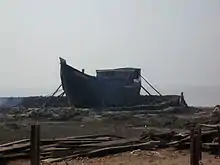
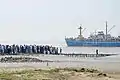 Ships Wharf, Sandwip
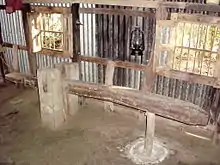 Dheki (husking pedal) once was very common in houses of Sandwip
 Kakataruya
Notes
- "Sandwip is evidently a very old island, and seems to have been of more importance three hundred years ago than it is now [mid-1800s], because it was one of the chief sources from which Bengal was supplied with salt." "Du Jarric ... tells us that it is opposite Sripur, and that it supplies all Bengal with salt."[7]: 35, 36
References
- "Sandwip Upazila (সন্দ্বীপ উপজেলা)". Chittagong. 26 May 2011. Retrieved 7 November 2012.
- "Sandwip Island". Ebbd.info. Retrieved 7 November 2012.
- Noakhali District Gazetters
- Webster, John Edward (1911). Eastern Bengal and Assam District Gazetteers. 4. Noakhali. Allahabad: The Pioneer Press.
- Muslehuddin, ATM (2012). "Arabic". In Islam, Sirajul; Miah, Sajahan; Khanam, Mahfuza; Ahmed, Sabbir (eds.). Banglapedia: the National Encyclopedia of Bangladesh (Online ed.). Dhaka, Bangladesh: Banglapedia Trust, Asiatic Society of Bangladesh. ISBN 984-32-0576-6. OCLC 52727562. Retrieved 10 December 2021.
- Abdul Karim (2012). "Shah Sultan Mahisawar (R)". In Islam, Sirajul; Miah, Sajahan; Khanam, Mahfuza; Ahmed, Sabbir (eds.). Banglapedia: the National Encyclopedia of Bangladesh (Online ed.). Dhaka, Bangladesh: Banglapedia Trust, Asiatic Society of Bangladesh. ISBN 984-32-0576-6. OCLC 52727562. Retrieved 10 December 2021.
- Beveridge, Henry (1876). The district of Bákarganj; its history and statistics. London: Trübner & Co.
- Khan, Nurul Islam, ed. (1977). Bangladesh District Gazetteers: Noakhali. Dacca: Bangladesh Government Press. pp. 230–231. OCLC 85190093.
- Ray, Aniruddha (2012). "Portuguese, The". In Islam, Sirajul; Miah, Sajahan; Khanam, Mahfuza; Ahmed, Sabbir (eds.). Banglapedia: the National Encyclopedia of Bangladesh (Online ed.). Dhaka, Bangladesh: Banglapedia Trust, Asiatic Society of Bangladesh. ISBN 984-32-0576-6. OCLC 52727562. Retrieved 10 December 2021.
- পাতা:ঐতিহাসিক চিত্র (তৃতীয় বর্ষ) - নিখিলনাথ রায়.pdf/২২ - উইকিসংকলন একটি মুক্ত পাঠাগার. bn.wikisource.org. Retrieved 5 March 2019.
- কেদার রায়. Bangladesher Khabor (in Bengali). Retrieved 4 March 2019.
- পাতা:প্রতাপাদিত্য-নিখিল নাথ রায়.djvu/৭৩ - উইকিসংকলন একটি মুক্ত পাঠাগার. bn.wikisource.org. Retrieved 5 March 2019.
- Mandal, Asim Kumar (2003). The Sundarbans of India : a development analysis. New Delhi: Indus Publ. Co. p. 44. ISBN 8173871434. Retrieved 28 June 2015.
- Editorial. "Sandwipees should respond to the call of Master Shahjahan for development of Sandwip". The Guardian. Retrieved 12 July 2015.
- Beveridge, Henry (1876). The district of Bákarganj; its history and statistics. London: Trübner & Co. pp. 173–179.
- Manuel de Faria y Sousa, Asia Portuguesa, 1666. English translation 1695 by Captain John Stevens, quoted by Beveridge 1876, p. 37.
- (Sandamala Linkara Vol. 2 1999: 84): Tuesday, 4th waxing of Natdaw 971 ME = 1 December 1609
- Stewart, History of Bengal, quoted in Beveridge, 1876, p. 36.
- Phayre, Arthur Purves (1967) [First published 1883]. History of Burma: Including Burma Proper, Pegu, Taungu, Tenasserim, and Arakan. From the Earliest Time to the End of the First War with British India. London: Trübner & Company. pp. 174–177.
- Harvey, G. E. (1925). History of Burma: From the Earliest Times to 10 March 1824. London: Frank Cass & Co. pp. 142–143.
- Abdul Karim (2012). "Shaista Khan". In Islam, Sirajul; Miah, Sajahan; Khanam, Mahfuza; Ahmed, Sabbir (eds.). Banglapedia: the National Encyclopedia of Bangladesh (Online ed.). Dhaka, Bangladesh: Banglapedia Trust, Asiatic Society of Bangladesh. ISBN 984-32-0576-6. OCLC 52727562. Retrieved 10 December 2021.
- {{cite book |editor-last=Sarkar |editor-first=Jadunath |editor-link=Jadunath Sarkar|quote=It was Shāista Khan's task to put an end to this terror [the Arakan pirates] ... The Bengal flotilla (nawwāra) had been wofully depleted ... Shāista Khan's energy and persistence overcame every obstacle. A new navy was created, manned and equipped in a little over a year ... In a short time 300 vessels were ... ready in war-trim ... The island of Sondip ... [was] captured ... (November 1665.) A still more important gain was the seduction of the Feringis of Chātgāon from the side of the Arakanese ... A feud had just then broken out between the Magh ruler of Chātgāon and the local Portuguese ... Shāista Khan gave their chief captain a bounty ... and their other leaders were all enlisted in the Mughal service|year=1973 |orig-year=First published 1948 |title=The History of Bengal |volume=Volume II: Muslim Period, 1200-1757 |location=Patna |publisher=Academica Asiatica |page=379 |oclc=924890 |quote
- Alamgirnama,Mirza Muhammad Kazim(Pers.text P.943)
- Prof Rajib Humayun, Sandiper Itihas, Somaj O Songskriti(1987)(সন্দ্বীপের ইতিহাস, সমাজ ও সংস্কৃতি) P.80,91
- Chowdhury, ABM Siddiq (1988). শাশ্বত সন্দ্বীপ [Eternal Sandwip] (in Bengali).
- George Abraham Grierson. "Sandip, Noakhali District". Linguistic Survey of India. V Pt 1. pp. 247-.
- Muhammad Abdul Kader (1988). Historical Fallacies Unveiled. Islamic Foundation Bangladesh. p. 161-167.
- Shahidullah, Muhammad. সন্দ্বীপ উত্তরন (in Bengali).
- Islam, Sirajul; Miah, Sajahan; Khanam, Mahfuza; Ahmed, Sabbir, eds. (2012). "Shipbuilding Industry". Banglapedia: the National Encyclopedia of Bangladesh (Online ed.). Dhaka, Bangladesh: Banglapedia Trust, Asiatic Society of Bangladesh. ISBN 984-32-0576-6. OCLC 52727562. Retrieved 10 December 2021.
- "Prospects of shipbuilding industry in Bangladesh". Archived from the original on 17 December 2013. Retrieved 30 July 2015.
- Ray, Aniruddha (2012). "Manucci, Niccolao". In Islam, Sirajul; Miah, Sajahan; Khanam, Mahfuza; Ahmed, Sabbir (eds.). Banglapedia: the National Encyclopedia of Bangladesh (Online ed.). Dhaka, Bangladesh: Banglapedia Trust, Asiatic Society of Bangladesh. ISBN 984-32-0576-6. OCLC 52727562. Retrieved 10 December 2021.
- Ansar Ali, Sushil Chaudhury & Sirajul Islam (2012). "Armenians, The". In Islam, Sirajul; Miah, Sajahan; Khanam, Mahfuza; Ahmed, Sabbir (eds.). Banglapedia: the National Encyclopedia of Bangladesh (Online ed.). Dhaka, Bangladesh: Banglapedia Trust, Asiatic Society of Bangladesh. ISBN 984-32-0576-6. OCLC 52727562. Retrieved 10 December 2021.
- Abul Kalam Elias (16 December 2003). "The contribution of Sandwip to the struggle for freedom". The Daily Star. 4.
- "Thousands of Pakistanis Are Killed by Tidal Wave". The New York Times. 14 November 1970.
- Choy Choi Kee (7 November 1999). "Medical Mission to East Pakistan". Ministry of Defence. Archived from the original on 26 June 2007. Retrieved 15 April 2007.
- "One day BD Navy to become builder from buyer, hopes PM". UNB. 24 December 2017. Archived from the original on 25 December 2017. Retrieved 24 December 2017.
- "The Yellow page of Sandwip - প্রাকৃতিক দূর্যোগ". Sandwip-uttaran.org. Archived from the original on 26 November 2013. Retrieved 7 November 2012.
External links
- Sandwip Chittagong, Sandwip Chittagong, Bangladesh