Sangrai festival in Bangladesh
Sangrai (eng.Year changes) is the name of the New Year celebration of the Bangladeshi Marma and Rakhine ethnic groups,[1][2] which is celebrated from April 13 to 15 every year. Although it is one of the main traditional ceremonies of the Marmas, the Rakhine also celebrate the New Year with their own rules. In the case of the Marmas, it is celebrated according to their Burmese calendar. The calendar of the Marmas is called "Mraima Sakraoy". The Marmaras observe Sangrai as a total of three days, including the last two days of the old year and the first day of the new year. Earlier, according to "Mraima Sacramento", these three days fell in the middle of April of the English calendar, but now they are observed on April 13, 14 and 15 in line with the English calendar. The traditional games of the Marmas are also held on the morning of the 13th with Pangchowai (Flower Sangrai), the main Sangrai on the 14th and the water on the 15th.[3]
| ကင် Sangrai সাংগ্রাই | |
|---|---|
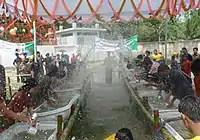 water festival of 'Sangrai' | |
| Official name | Sangrai Festival |
| Also called | Jye Sakroi |
| Observed by | Marma, |
| Liturgical color | Green |
| Type | Cultural, ethnic & Buddhist |
| Significance | Sign Of Coming New Year |
| Celebrations | Decorating the house with flowers, lighting candles and praying in Bihar, walking around the neighbor's house. |
| Observances |
|
| Begins | 12 April |
| Ends | 15/16 April |
| Date | 14 April (Main Sangrai) |
| Frequency | Annual |
| First time | 1359 |
| Related to | Voisabi |
Origin
Marma community is different from other communities in the form of old, from ancient times of the year to say goodbye and welcome the arrival of the new year has been celebrated in a variety of what is known as Sangrai Marma language. The word 'Sangrai' is thought to have originated from the word 'Sakrai' (Bengali Saal meaning year). Which is known as 'Sankranti' (last day of the year) in Bengali. The day of Sangrai is fixed by forming the 'Sangrai Jai' (Marma Calendar) of the Marma community. This 'sakrai' or year is calculated before 1359 AD, which is known as 'jya sakrai'.
Pre-preparation
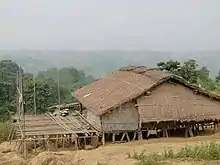
Although Sangrai started on April 13, the excitement about Sangrai among the Marmas started from January. The accountants of Marma village started making various plans for Sangrai. They redecorate their houses. The mud houses are re-coated with mud, and in the houses of Machang and Chhan, the old huts are removed and new huts are brought from the hills and planted in the houses. Besides, the rice obtained from Jhum is kept for various types of cakes.
Marma pig traders have been raising new piglets for three months so that they can sell them at the Sangrai market. Marma hunters pack their weapons before Sangrai so that they can hunt large deer, guisaps, turtles and other animals before Sangrai. Besides, other traders also started making their business plans with Sangrai.
Pangchowai (Flower Sangrai)
Description
'Paanchowai' means the day of flowering. This is usually done on the night of April 12. With the arrival of spring after winter, the hills of Chittagong Hill Tracts also feel the touch of spring, as a result of which the hills can be seen with various flower arrangements. The hills surrounding the village swell with the smell of different colors and become monotonous. And since these flowers are reserved for Sangrai, they are not torn at all before, so that the flowers spread in the mountains are eye-catching.
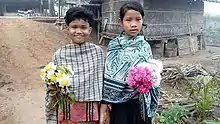
Absolutely one night of "Paanchowai" is used for worshiping Buddha and decorating houses. Although there are many flowers in the mountains, certain flowers are used to decorate the houses. The most popular of these is the cloud-colored flower called "Sangrai Paing". Everyone mainly decorates their houses on the day after "Paanchhoai" with this flower as the main thing.[4]
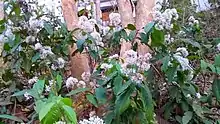
Sangrai Pang (flower)
Sangrai Pang or Sangrai flower is a white mountain flower with compound inflorescence. It has a number of well-arranged inflorescences of about one to one and a half inches. In the hilly areas of Bangladesh such as Bandarban, Chittagong, these flowers can be seen spreading in the hills in spring.
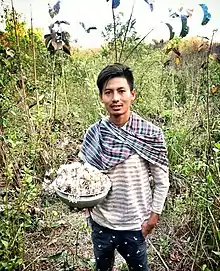
Celebration
The work of plucking this flower is mainly done by the Marma youth. On the night of 'Paanchowai', Marma youths organize various events around it. Many people stay up all night making cakes, while others arrange various traditional games for the Marmas. Some even arrange traditional Marma dances and songs. Basically, Marma youths use various tactics to stay awake all night. Then, after the arrival of the last night, that is, before dawn, they went to the mountains in groups and picked up 'Sangrai Paing' and handed it over to their mother. Ginnis decorate the flowers with needle and thread in the morning. First Lord Buddha is worshiped with flowers and every door of every house is decorated with them. With the flowers arranged on the door of the house, it can be understood that Sangrai i.e. the new year has started.[5]
Not only young people but also young Marma boys and girls are interested in this 'Paanchhoai'. However, taking them to the mountains is very risky, as the elders always prevent the little boys and girls from going to the mountains for fear of the 'Frujuma' (Marma witch). There are even a lot of stories about this "Paanchhoai". The most popular of these is the story of 'Frujuma's Trap'. The Fruzuma witch, in the lure of 'Sangrai Paing', takes one of the children away to a deep forest that will never be released before daybreak. Because after falling into the trap, wherever he goes, he will find only jungle and jungle.[6]
Sangrai Ji (Sangrai Bazar)
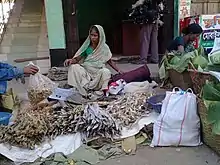
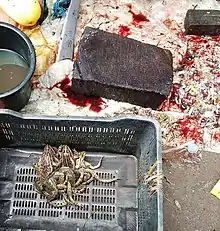
On 13 April the day of 'Paanchowai', the full day Sangrai Ji started from dawn. On the occasion of Sangrai, a huge market is set up in the hills. The market has almost all the essentials used for Sangrai. The Ginnis bought a lot of good food to send to Sangrai in Bihar. He also bought holy water, ripe coconut, china paper, candles, incense sticks, etc. to bathe Gautam Buddha in Bihar according to his ability. Besides, there will be new clothes for everyone in Sangrai, big and small. And the little ones also buy water bottles and various plastic weapons to kill water in Sangrai.
Marma pig traders also market the piglets raised in Sangrai a few months ago. Marma hunters also sell pre-hunted deer, guisaps, turtles and frogs as well as a variety of other animals and birds.
Chief Sangrai
The main Sangrai is currently celebrated on April 14 according to the English calendar. Marma housewives (inghsang) go to Bihar with good choyah (food sent to Bihar is called 'chhoyah') and cakes. Apart from their own monasteries, 'Choyah' was also sent to nearby monasteries. 'Choya' is sent not only for the purpose of God, but also for those who observe fasting among their relatives. Apart from Bihar, various Marma deities are also worshiped. Besides, food and cakes were also sent to the well-known elders of the village.
And the Marma youths go to the neighborhoods in groups to bathe the elderly. The elders of each family greet the youngsters at the end of the bath. At the same time, young people bring New Year blessings to the elders at the beginning of the year. Not only bathing, Marma youths from every family have to eat something or other.
Buddha bathing and preaching
In the main Sangrai in Bihar, Lord Buddha is bathed in holy water. The Marmaras eat the water bathed in the Buddha because the Marmas believe that this Buddha bathed water will put an end to all diseases in their body. And after that the sermon is given. All the men and women of the area joined it. All the families bring rice-coconut-china paper-candles to Bihar for various purposes. The chief Buddhist monk of Bihar preaches for the happy new year. He also prays for the new year to be filled with good wishes. After the sermon, everyone in the Buddhist monastery lit candles for the Lord. Not only God but many of their ancestors also lit candles in Jadi.
Candle lighting
As soon as the daylight of chief Sangrai was over, the Marma youths left for Bihar in their traditional attire. They go to Bihar and light candles. Every monastery is filled with the light of thousands of waxes. Every monastery is decorated with a new outfit on this night centering on Sangrai.
After lighting the candles, the Marma youths sit together with the Buddhist monks and listen to the sermons. Also sit down and discuss for the next day's "Dilangpoye".
"Ri lang poye" (water festival)
Description
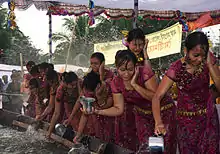
The main attraction of Sangrai is the water sport called Marmara "Ri Long Poye". This water sports festival is held on the last day of Sangrai festival.[7] Sangrai water sports are performed not only by the Marmas, but also by the Dai tribes of Southeast Asia, Myanmar, Thailand, Laos, Cambodia and China in mid-April. In Myanmar, such events are called "Thingon" and in Thailand and Laos this ceremony is called "Sankran". "Sankran" in Thai means change. Sangrai actually means saying goodbye to the old year and welcoming the new year. At the same time, the new Jhum farming season in the Chittagong Hill Tracts begins after Sangrai. Not only Jhum farming, the Marmaras do not get married again after the Maghi full moon until Sangrai, which means that the Marmaras in Sangrai mean to start anew by throwing away all the old things, including the beginning of the new year. And so the Marmaras celebrate the New Year with a joyous ceremony in the hope of blessings and good wishes.[8]
Celebration
After the main Sangrai, "Rilangpoye" is organized in different places. It is held not only on April 15, but also on April 16, 17 and 18 in many places so that everyone can participate in all the events. From the morning of the day of the ceremony, Marmaras from different parts of the country started attending the ceremony after their traditional 'Thami' (girls) and ' Lungi ' (boys). Very early in the morning, the local youth gather in Sangrai. Marma youths from far and wide sang ' Sangrai ma ninii nnai, rig jaing kai pai meh / meaning: Come on everyone, joined on Sangrai's Maitri Water Raining festival' and started participating in the program in groups.
The Marma Royaja (village head of the Marmas) then inaugurated the event. The official "Ri long Poye" started immediately after the ceremony. Water is kept in the open field by filling huge pots or boats. Then the Marma youths stand face to face in groups and throw water at each other until the water container or the boat in front of them becomes waterless. In this way, one group after another started playing the game of throwing water.
In this way, apart from playing water officially, everyone has a bottle of water in their hands on that day. He can sprinkle water on whomever he wants, no one objects to it but takes it as a symbol of blessings and good omens.[9]
Other events
Tang tang (bamboo climbing)
Other traditional Marma games are held immediately after the water game. For example: girls play rope pulling game, boys play wrestling, bamboo climbing (tang tang) game etc. The most interesting game from here is the boys' bashing game ("Tang Tang"). It has a long 25+ foot bamboo with a large amount of money at the very top. It can be reached only if there are five to six people. And the team that can take it first will get that money. However, the matter seems very simple, but not so much, because the upper hole of the bamboo is filled with oil, so the more the bamboo is shaken, the more the bamboo will be slippery after the oil from the top.
.jpg.webp)
Mraima Sakray
A cultural program was organized in the afternoon. In it, the traditions of the Marmas are highlighted in various ways. A variety of dances, including the Sangrai dance, are performed. Besides, various Marma songs are performed with the participation of Marma Guni artists. Nowadays, the concert is held after the Marma cultural program. With this Marma cultural event and concert, the Marma youth chose their new "Mraima Sakroy".
.png.webp)
See also
| Wikimedia Commons has media related to Marma people. |
References
- "সাংগ্রাই". Daily Nayadiganta (in Bengali). Retrieved 2021-10-19.
- Correspondent, Our; B; arban (2014-04-14). "Four-day Sangrai festival begins in Bandarban". The Daily Star. Retrieved 2021-10-19.
- "Four-day Sangrai festival begins in Bandarban". The Daily Star. 2014-04-14. Retrieved 2021-10-19.
- "Sangrai festival spreads wave of festivity in the hills". bdnews24.com. Retrieved 2021-10-19.
- "Sangrai festival spreads wave of festivity in the hills". bdnews24.com. Retrieved 2021-10-19.
- "Sangrai festival spreads wave of festivity in the hills". bdnews24.com. Retrieved 2021-10-19.
- "Sangrai water festival of Marma celebrated in Rangamati". Dhaka Tribune. 2018-04-15. Retrieved 2021-10-19.
- "Sangrai water festival of Marma celebrated in Rangamati". Dhaka Tribune. 2018-04-15. Retrieved 2021-10-19.
- "Sangrai water festival of Marma celebrated in Rangamati". Dhaka Tribune. 2018-04-15. Retrieved 2021-10-19.