Sant'Ignazio all'Olivella
The Church of Saint Ignatius (Italian: Chiesa di Sant'Ignazio or Sant'Ignazio all'Olivella) is a Baroque church of Palermo. It is located in the ancient neighborhood of the Olivella, in the quarter of the Loggia, within the historic centre of Palermo.
| Church of Saint'Ignatius | |
|---|---|
Chiesa di Sant'Ignazio all'Olivella (in Italian) | |
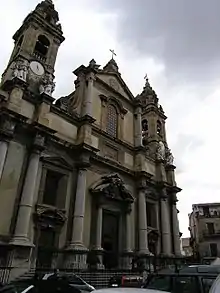 Façade of the church | |
| Religion | |
| Affiliation | Roman Catholic |
| Province | Archdiocese of Palermo |
| Rite | Roman Rite |
| Year consecrated | 1711 |
| Location | |
| Location | Palermo, Italy |
| Geographic coordinates | 38°07′14.34″N 13°21′38.63″E |
| Architecture | |
| Architect(s) | Antonio Muttone |
| Style | Baroque |
| Groundbreaking | 1598 |
| Completed | 1622 |
The church was begun in 1598 by the Congregation of the Oratory of Saint Philip Neri. It is located near the former house of the congregation, now Regional Archeological Museum Antonio Salinas, and the Saint Catherine Oratory. It is believed that during 12th century Saint Rosalia, patron saint of Palermo, had lived in this area together her family.
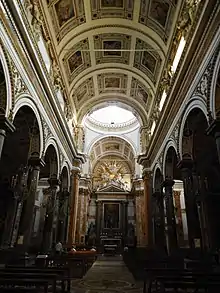
The dome interior was completed in 1732. The ceiling decorated with frescoed coffered panels, painted by Antonio Manno. The floor pavement was made with multicolor marbles. The main altarpiece depicted a Trinity by Sebastiano Conca. It was flanked by stucco and marble statues on an imposing main altar; the marble statues of Saints Peter and Paul by Marabitti. A lateral altar has a canvas depicting the Martyrdom of St Ignatius by Filippo Paladino. Another altarpiece is a copy of Guido Reni's portrait of St Phillip Neri. A blessed Sebastiano Valfre was painted by Salvatore Loforte; he also painted the large altarpiece depicting San Nicolo di Bari appears in the clouds of a tempest to the Abbott Elpino. The chapel of St Mary Magdalen has an altarpiece by Mario Menniti. An Annuciation was completed by Giacomo Loverde in imitation of the style of Pietro Novelli. A 15th-century altarpiece depicting the Virgin and Child with a young John the Baptist attributed to Lorenzo di Credi.[1]
References
- Dizionario topografico della Sicilia, Volume 2, by Vito Amico, Palermo (1856); page 271.
