Peninsular Arabic
Peninsular Arabic are the varieties of Arabic spoken throughout the Arabian Peninsula. This includes the countries of Saudi Arabia, Yemen, Oman, United Arab Emirates, Kuwait, Bahrain, Qatar, Southern Iran, and Southern Iraq.[1]
| Peninsular Arabic | |
|---|---|
| Geographic distribution | Arabian Peninsula |
| Linguistic classification | Afro-Asiatic
|
| Glottolog | arab1393 |
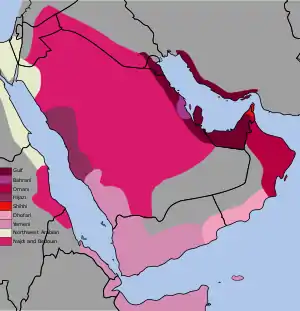 | |
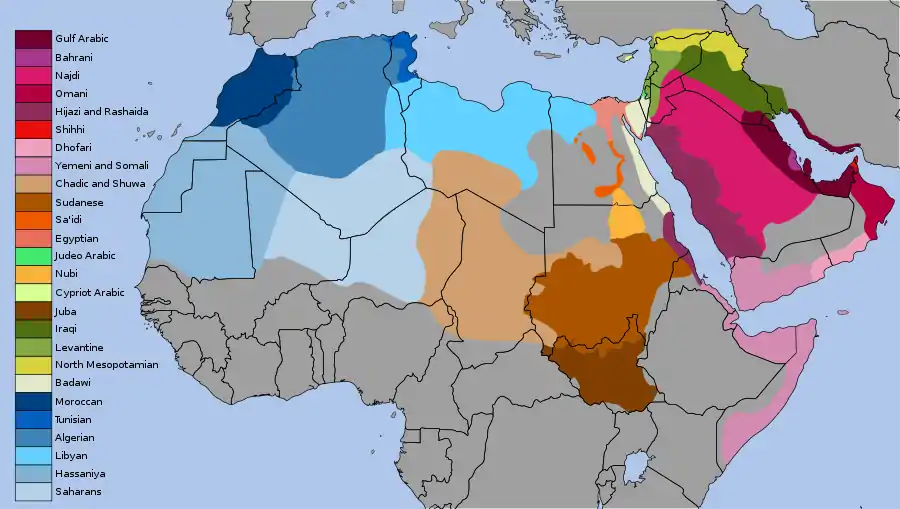
The modern dialects spoken in the Arabian Peninsula are closer to Classical Arabic than elsewhere.[2][3] Some of the local dialects have retained many archaic features lost in other dialects, such as the conservation of nunation for indeterminate nouns. They retain most Classical syntax and vocabulary but still have some differences from Classical Arabic like the other dialects.
Varieties
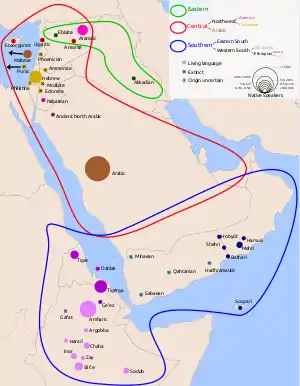
Ingham[4] and Holes[5] both note the existence of two peninsular dialect groups:
- A southwestern dialect group that includes most of the dialects of South Arabia, stretching as far north as Al Bahah. Holes generalizes it to a "sedentary" or "peripheral" group that also includes dialects of historically sedentary populations on the Persian Gulf coast, such as Omani Arabic and Bahrani Arabic. These dialects share certain syntactic features with Modern South Arabian languages.
- A central-eastern dialect group originating in the center, that spread with the migration of Arab tribes. This group includes the dialects of most bedouin tribes in the peninsula, spanning an area extending from the Syrian Desert to the Empty Quarter. Its most notable examples are Najdi Arabic and Gulf Arabic.
The following varieties are usually noted:
- Yemeni Arabic, displays a past conjugation with the very archaic -k suffix, as in southern Semitic languages. It has to be noted that the dialect of Aden has /ɡʲ/ > [ɡ] as in Cairo.
- Hejazi Arabic, spoken in Saudi Arabia along the coast of the Red Sea, especially in the cities of Mecca and Jeddah. Strictly speaking, there are two distinct dialects spoken in the Hejaz region, one by the Bedouin rural population and another by the urban population in cities such as Jeddah, Mecca, Medina and Yanbu.
- Najdi Arabic, spoken in the center of the peninsula in Saudi Arabia and is characterized by a shift of /q/ to /ɡ/ and affrication of /k/ and /ɡ/ to [ts] and [dz], respectively, in certain contexts.
- Dhofari Arabic, Spoken in Dhofar in southern Arabia, spoken in Yemen, Oman, and the surrounding regions.
- Gulf Arabic (excluding Omani Arabic, Dhofari Arabic and Bahrani Arabic), spoken in the coast of the Persian Gulf.
- Bahrani Arabic, spoken in Bahrain, Eastern Saudi Arabia, and Oman.
The following table compares the Arabic terms between Saudi dialects of urban Hejazi and urban Najdi in addition to the dialect of the Harb tribe[6] with its parts (Najdi and Hejazi parts) which shows a correlation between those dialects:
| Term | Standard Arabic | Urban Hejazi | Ḥarb tribe (Hejazi) | Ḥarb tribe (Najdi) | Urban Najdi |
|---|---|---|---|---|---|
| "water" | ماء māʼ | موية mōya | ما mā or موية mōya | موية mōya | |
| "I want" | أريد ʼurīd | أبغى ʼabḡa or rarely أبى ʼaba | أبى ʼaba | أبي ʼabi | |
| "where?" | أين ʼayn | فين fēn | وين wēn | ||
| "what?" | ماذا māḏā | إيش ʾēš | ويش wēš | وش wiš | |
| "why?" | لماذا limāḏā | ليش lēš or ليه lēh | |||
| "early morning" | ضُحَى ḍuḥā | ضُحَى ḍuḥa | ضَحى ẓaḥa (ظَحى) | ||
| "now" | الآن alʼān | دحين daḥīn or daḥēn | ذحين daḥīn | هالحين hal-ḥīn | الحين il-ḥīn |
| "coffee" | قَهْوَة qahwa | قَهْوَة gahwa | قْهَوَة ghawa | قْهَوَة ghawa or قَهْوَة gahwa | |
| "bread" | خُبْز ḵubz | خُبْز ḵubuz or عيش ʿēš | عيش ʿayš | خِبْز ḵibz | خِبْز ḵibz |
| "also" | أيْضًا ʾayḍan or كَذَٰلِكَ ka-ḏālika | كمان kamān or برضه barḍu | كمان kamān or برضه barẓu (برظه) | كَذَٰلِكَ ka-ḏālik | بَعَد baʿad |
| "run" | يَرْكُض yarkuḍu or يَجْرِي yajrī | يِجْري yijri | يَجْرِي yajri | يَرْكُض yarkiẓ (يَرْكِظ) | |
| "maybe" | يُمْكِن yumkin | يِمْكِن yimkin | يِمْكِن yimkin | ||
| "we were" | كُنَّا kunnā | كُنَّا kunna | كِنَّا kinna | ||
| "they said" | قالوا qālū | قالوا gālu | قالوا gālaw | قالوا gālaw or قالوا gālu | |
| "cows" | بَقَر baqar | بَقَر bagar | بُقَر bugar | بِقَر bigar | |
| "neck" | رَقَبة raqaba | رَقَبة ragaba | رْقُبة rguba | رْقَبة rgaba | |
| "little" | قَليل qalīl | قَليل galīl | قِليل gilīl | ||
| "strong" | قَوِيّ qawiyy | قَوي gawi | قُوي guwi | ||
| "talked to you" | كَلَّمَكَ kallamaka | كَلَّمَك kallamak | كَلَّمْك kallamk | ||
| "all" | كُلّ kull | كُلّ kull | كِل kill | ||
| "got bigger" | كَبُرَ kabura | كِبِر kibir | كِبَر kibar | ||
| "he drank" | شَرِب šarib | شِرِب širib | شِرَب širab | ||
| "he inhabited" | سَكَن sakan | سَكَن sakan | سِكَن sikan | ||
| "he told the truth" | صَدَق ṣadaqa | صَدَق ṣadag | صِدَق ṣidag | ||
| "he knows" | يَعْرِف yaʿrif | يِعْرِف yiʿrif | يْعَرِف yʿarif | ||
| "he wrote" | كَتَبَ kataba | كَتَب katab | كِتَب kitab | ||
| "he writes" | يَكْتُبُ yaktubu | يِكْتُب yiktub | يَكْتِب yaktib | يَكْتِب yaktib or يْكَتِب ykatib | |
| "he enters" | يَدْخُل yadḵul | يِدْخُل yidḵul | يَدْخِل yadḵil | ||
| "we count" | نَحْسِبُ naḥsibu | نِحْسِب niḥsib | نْحَسِب nḥasib | نْحَسِب nḥasib or نِحْسِب niḥsib | |
| "piece of wood" | خَشَبَة ḵašaba | خَشَبَة ḵašaba | خْشِبَة ḵšiba | خْشِبَة ḵšiba or خَشَبَة ḵašaba | |
| "she sits" | تَقْعُد taqʿud | تِقْعُد tigʿud | تَقْعُد tagʿud | تَقْعِد tagʿid | |
| "I said" | قُلْت qult | قُلْت gult | قِلْت gilt | ||
| "he woke up" | صَحِيَ ṣaḥiya | صِحِي ṣiḥi | صَحَى ṣaḥa | ||
| "dig" | اِحْفِرْ iḥfir | اَحْفُر aḥfur | اِحْفِرْ iḥfir | ||
| "take!" | خُذْ ḵuḏ | خُذْ ḵud (خُد) | خُذْ ḵuḏ | خِذْ ḵiḏ | |
| "say!" | قُل qul | قول gūl | قِل gil or rarely قول gūl | ||
| "go!" | اِذْهَب iḏhab | روح rūḥ | رح riḥ or rarely روح rūḥ | ||
| "leave!" | خَلِّ ḵalli | خَلِّي ḵalli | خل ḵall | ||
| "tomb" | قَبْر qabr | قَبُر gabur | قبر gabir | ||
| "poverty" | فَقْر faqr | فَقِر fagir | فَقُر fagur | فَقِر fagir | |
| "afternoon" | عَصْر ʿaṣr | عَصُر ʿaṣur | عَصِر ʿaṣir | ||
| "camel" | جَمَل jamal | جَمَل jamal | جِمَل jimal | جِمَل jimal or جَمَل jamal | |
| "truth" | حَقيقة ḥaqīqa | حَقيقة ḥagīga | حِقيقة ḥigīga | ||
| "big" | كَبير kabīr | كَبير kabīr | كِبير kibīr | كِبير kibīr or كَبير kabīr | |
| "it dried" | يَبِس yabisa | يِبِس yibis | يِبَس yibas | ||
| "we" | نَحْن naḥnu | احنا iḥna or نحنا niḥna | حنا ḥinna | ||
| "them" | هُم hum | َّهُم humma | هُم hum | ||
| "he" | هُوَ huwa | هُوَّ huwwa | هو hū or huw or huwah or اهو ihwa | هو hū or huw | |
| "this" | هذا hāḏā | هذا hāda (هدا) | هذا hāḏa | ||
| "like" | مِثْل miṯl or كما kama | زَي zay | مِثْل miṯl or كما kima or زَي zay | مِثْل miṯl or زَي zay | |
Footnotes
- Holes, Clive (2001). Dialect, Culture, and Society in Eastern Arabia: Glossary. Clive Holes. pp. XIX. ISBN 9004107630.
- Zhluktenko, Y. A. (1988). Interlanguage relations and language policy. Capitalist states and countries of the "Third World". Naukova dumka. p. 190. ISBN 9785120001410.
- Alexeyev, B. A. (2003). All Asia. Geographical handbook. АСТ. p. 311. ISBN 9785897371518.
- Ingham, Bruce (1994). Najdi Arabic : central Arabian. Amsterdam: J. Benjamins Pub. Co. p. 8. ISBN 155619725X.
- Holes, Clive (2006). "The Arabic dialects of Arabia". Proceedings of the Seminar for Arabian Studies. 36: 25–34. ISSN 0308-8421. JSTOR 41223878.
- Il-Hazmy (1975:234)
Bibliography
- Il-Hazmy, Alayan (1975). A critical and comparative study of the spoken dialect of the Harb tribe in Saudi Arabia (PDF).
Arabic language | |||||||||||||||||||||||||||||||||||||||||||||||||
|---|---|---|---|---|---|---|---|---|---|---|---|---|---|---|---|---|---|---|---|---|---|---|---|---|---|---|---|---|---|---|---|---|---|---|---|---|---|---|---|---|---|---|---|---|---|---|---|---|---|
| Overviews | |||||||||||||||||||||||||||||||||||||||||||||||||
| Alphabet | |||||||||||||||||||||||||||||||||||||||||||||||||
| Letters | |||||||||||||||||||||||||||||||||||||||||||||||||
| Varieties |
| ||||||||||||||||||||||||||||||||||||||||||||||||
| Academic | |||||||||||||||||||||||||||||||||||||||||||||||||
| Linguistics | |||||||||||||||||||||||||||||||||||||||||||||||||
| Technical |
| ||||||||||||||||||||||||||||||||||||||||||||||||
 Category Category | |||||||||||||||||||||||||||||||||||||||||||||||||
Arabic language | |||||||||||||||||||||||||||||||||||||||||||||||||
|---|---|---|---|---|---|---|---|---|---|---|---|---|---|---|---|---|---|---|---|---|---|---|---|---|---|---|---|---|---|---|---|---|---|---|---|---|---|---|---|---|---|---|---|---|---|---|---|---|---|
| Overviews | |||||||||||||||||||||||||||||||||||||||||||||||||
| Alphabet | |||||||||||||||||||||||||||||||||||||||||||||||||
| Letters | |||||||||||||||||||||||||||||||||||||||||||||||||
| Varieties |
| ||||||||||||||||||||||||||||||||||||||||||||||||
| Academic | |||||||||||||||||||||||||||||||||||||||||||||||||
| Linguistics | |||||||||||||||||||||||||||||||||||||||||||||||||
| Technical |
| ||||||||||||||||||||||||||||||||||||||||||||||||
Category | |||||||||||||||||||||||||||||||||||||||||||||||||