Ali Akbar ibn Hasan ibn Ali ibn Muhammad
Sayyid Ali Akbar was an Islamic saint, the son of Imam Hasan al-Askari the eleventh Imam in the Shia Islam. He was the second son of the eleventh Imam Hasan al-Askari and the brother of the twelfth Imam Muhammad al-Mahdi. His existence was hidden because of contemporary political conflicts with the political leadership of the Abbasids, reaching its peak at that time.[5][6][7]
Ali Akbar | |
|---|---|
| Born | 868–874 |
| Died | Unknown |
| Other names | (nickname), Abdullah, Akbar, Asghar, al Taqi, al Muttaqi |
| Title | Sayyid ul Sadaat Sultan Saadat (leader of the sayyids)
Imamzadeh (son of the Imam) Najm Ahl al-Bayt Rasul Allah (Star of the Household of the Prophet of Allah) |
| Children | Sayyid Abu Muhammad Mahmud Makki, Sayyid Ali Asghar, Sayyid Uthman, Sayyid Musa, Sayyid Isa, Sayyid Hussain |
| Parent(s) | Hasan al-Askari |
| Relatives | Muhammad (forefather), Fatimah (sister), Muhammad al-Mahdi (brother), Musa (brother), Ja'far (brother), Ibrahim (brother)[1][2][3][4] |
| Part of a series on Islam Shia Islam |
|---|
 |
 Shia Islam portal Shia Islam portal |
| Part of a series on Islam Sufism |
|---|
 |
 Islam portal Islam portal |
Sayyid Ali Akbar is venerated in Sunni and Shiite Sufi Islam as the patriarch of various Sufi Saints.[8][9] Jafari Shiites, who constitute the majority of Shiites, according to authentic Shiite documents, consider only Muhammad al-Mahdi to be the son of Hasan al-Askari.
Introduction
The genealogical records of some Middle Eastern families, especially from Persia and Khorasan, indicate that Hasan al-Askari had a second son, Ali Akbar.[10][11] This is supported by the belief of various followers of Sufi saints, like the sunni saints Moinuddin Chishti and Bahauddin Naqshband, who were the founders of the Chishtiyya and Naqshbandiyya sufi orders and also the prominent Sufi Saint Khwaja Maudood Chishti, who were all saints preaching the twelver creed of Imamah[12][13]
In his Usul al-Kafi, al-Kulayni wrote, "Ali confirms the claim that Hasan al-Askari had more than one wife, in addition to slave girls, with whom he had relations" and, "when the caliph received news of Imam Hasan al-Askari's illness, he instructed his agents to keep a constant watch over the house of the Imam... he sent some of these midwives to examine the slave girls of the Imam to determine if they were pregnant. If a woman was found pregnant she was detained and imprisoned."[5][14][7]
Descendants
According to the earliest reports as cited below from official family tree documents and records, Imam Hasan al-Askari fathered seven children and was survived by six.[15][16] The names of his illustrious biological children were: Imam Muhammad al-Mahdi, Musa, Ja’far, Ibrahim, Fatima and ‘Ali, sometimes referred to as Akbar, Asghar, al-Taqi, al-Muttaqi or Abdullah.[17][18][19][20][4][21] Еarly books on sayyid genealogy also mention that the descendants of Sayyid Ali Asghar ibn Imam Hassan Askari lived in the city of Sabzevar in shiite Muslims Iran.[22][23]
Notable descendants of Ali Akbar include the eleventh generation Sufi saints, Maudood Chishti and Bahauddin Naqshband.[24][25][26] One descendant after eighteen generations was Hazrat Ishaan. Maternal descendants of imam Hasan al-Askari and Hazrat Ishaan included the brothers, Sayyid Mir Jan, Sayyid Mahmud Agha and Sayyid Mir Fazlullah Agha, the Chief Justice of the Emirate of Afghanistan. And paternal descendant of imam Hasan Al-Askari Jamāl al-Dīn al-Afghānī also known as Sayyid Jamāl ad-Dīn Asadābādī and commonly known as Al-Afghani - a political activist and Islamic ideologist who travelled throughout the Muslim world during the late 19th century and Sayyid Mohammed Uthman al-Mirghani, known as "Al-Khatim", was the founder of the Khatmiyya sufi tariqa that has a following in Egypt, Sudan, Eritrea, Somalia and Ethiopia.
Annemarie Schimmel wrote, "Khwaja Mir Dard's family, like many nobles from Bukhara, led their pedigree back to Baha'uddin Naqshband, after whom the Naqshbandi order is named, and who was a descendant, in the eleventh generation of the eleventh Shia imam, al-Hasan al-Askari."[14]
Burial place
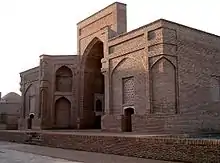
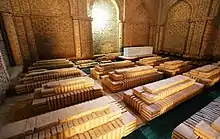
The genealogy of Khwaja Samandar Muhammad ibn Baqi al-Termizi - the famous sheikh and poet, writer and scholar, author of "Dastur al Mulk" (Guide to Kings) (XVII сentury), goes back to Sultan Saadat - Amir Sayyid Ali Akbar Termizi - in turn Amir Sayyid Ali Akbar bin Imam Hassan Askari, it is mentioned in his history book called "Dastur al Mulk". The 15th century famous poet, musicologist, scholar of language and other sciences Sahib Balkhi Sharifi wrote about the Sayyids of Termiz. His one of the poems begins with the name of Sultan Saadat (Sultan of Sayyids), i.e. the praise of Amir Sayyid Ali Akbar Termizi. Therefore, Sultan Saadat (Sodot) is the Sultan of Sayyids and the owner (historians suggest that Sayyid Ali Akbar bin Imam Hassan al-Askari's burial place is located in the main mausoleum Sultan Saodat memorial complex) "Sultan Saodat" Mausoleum (erected 9-15 centuries) in Termez city - and Sultan Saadat is Sayyid Ali Akbar Termizi, which is also mentioned with the nickname (kunyat) Sayyid Abu Muhammad who presumably died at the end of the 9th century or early 10th century in Termez. Many tombs and nameless graves of more than a thousand sayyids are located in the "Sultan Saodat" memorial complex and its territory in Termez.[27][28][29][30][31]
List of notable descendants
- Bahauddin Naqshband
- Hazrat Ishaan
- Moinuddin Hadi Naqshband
- Sayyid Mir Jan
- Sayyid Mahmud Agha
- Sayyid Mir Fazlullah Agha
- H.E. Sayyid Sultan Masood Dakik
- Ishan Imlo
- Tajuddin Muhammad Badruddin
- Pir Baba
- Qozi Sayyid Bahodirxon
- Shaal Pir Baba
- Maudood Chishti
- Ahmed Badawi
- Wali Kirani
- Khwaja Abdullah Chishti
- Ibrahim Yukpasi
- Salih al-Ja'fari
- Jamāl al-Dīn al-Afghānī
- Muhammad Mirgani
- Ali Mirgani
- Muhammad Usman Mirgani
- Mohammed Uthman al-Mirghani al-Khatim
- Ahmed al-Mirghani
- Shah Sayyid Nasruddin
References
- Ibn Abi l-Thalj (d.322 hijrah) Majmuat nafisa fi tarikh al-a'imma, pages 21-22
- Ali Al Arbali (d.693 h.) Siraj al-Ansab, page 222
- "Shajara-e-nasab lineages of descendants of Imam Hasan al-Askari". Archived from the original on 2020-07-03. Retrieved 2020-06-30.
- page 41 "النجف الأشرف) السيد محمد مهدي ابن السيد محمد اصفهاني الموسوي الكاظمي "دوائر المعارف في الأسماء الحسنى)
- Islamic Culture and the names of the Ahl al-Bait - Tazkare Khwanadane Hazrat Eshan ("Genealogy of the family of Hazrat Eshan") Edara Talimat Naqshbandiyya, Lahore p.63.
- Kulayni M. Y. and Sarwar M. (trans.) al-Kafi, chapter 124 "The Birth of Imam Abi Muhammad al-Hasan ibn 'Ali" p.705.
- "ZiaIslamic "Gulzar auliya"". Archived from the original on 2016-08-11.
- "Naqshbandiya shajarasi izidan". Archived from the original on 2017-08-03. Retrieved 2017-08-03.
- "Ҳазрат Хожа Баҳоуддин Нақшбанд". Archived from the original on 2017-08-03. Retrieved 2017-08-03.
- Kashani “Kitab al aqaid al iyman” page 259
- "Two hundred seventy-seven pirs" by Salim Bukhari
- Tazkare Khwanadane Hazrat Eshan(genealogy of the family of Hazrat Eshan)(by author and investigator:Muhammad Yasin Qasvari Naqshbandi company:Edara Talimat Naqshbandiyya Lahore) p. 57-63
- Kāndhlawi, Muhammad Zakariyyah. "Khwaajah Maudood Chishti". Mashāyikh-e-Chisht [The Mashaikh of Chisht]. Translated by Mujlisul Ulma of South Africa. New Delhi: Adam Publishers and Distributors. pp. 150-`152. ISBN 81-7435-592-8.
- Schimmel A. Pain and Grace: A Study of Two Mystical Writers of Eighteenth-Century Muslim India BRILL 1976, ISBN 9004047719
- Muhammed bin Yusuf Al Zarandi (d.720 hijrah) “Marij a’wusul ila ma’rifat fadlal” page 176
- Ibn Abi l-Thalj (d.322 hijrah) “Majmuat nafisa fi tarikh al-a’imma” pages 21-22
- Abul Hasan Ali bin Isa (d.1293 m.) “Kashf ul-Ghumma”
- Fahr Al-Razi Shafeiy (b.534 hijrah) “Al shajarat al mubaraka fi ansab” page 79
- Al Khasibi (b.890 hijrah) "Al-Hidaya al-kubra” page 328
- H.Hadjazada “Hidaqat ul Awliya”
- "Shajara-e-nasab lineages of descendants of Imam Hasan al-Askari r.a.-Shajara.org". Retrieved 2020-06-29.
- Ali Al Arbali (d.693 h.) “Siraj al-Ansab” page 222
- https://shajara.org/1426-shajara-e-nasab-lineages-of-descendants-of-imam-hasan-al-askari/ Shajara-e-nasab lineages of descendants of Imam Hasan al-Askari r.a.
- Tariq, Author: Mujtaba. "Faizan-e-Umoor.com Hazrat Bahaauddin Naqshbandi (R. A.)". webcache.googleusercontent.com.
- "Род Бахауддина Накшбанда по линии матери происходит от хазрата Абу Бакра Сиддика (р.а.)". Studopedia.
- Naqshbandiya shajarasi izidan Archived 2017-08-03 at the Wayback Machine Shajara website.
- "Dastur al Mulk" (Guide to Kings) (XVII сentury) by Khwaja Samandar Muhammad ibn Baqi al-Termizi, translator professor of history Jabbor Esonov, "Sharq", Tashkent 2001, page 22
- "Durdonahoi Nasr" book, "Adib", Dushanbe 1985, page 375
- "Sayyidlar Shajarasi", "Islamic university", Tashkent 2017, page 14
- "Sulton Sodot Amir Sayyid Ali Akbar". Shajara.
- «Buyuk Termiziylar» (Буюк Термизийлар) book by Mirzo Kenjabek, “Uzbekistan National encyclopedias” 2017, page-267