Scotland Malawi Partnership
The Scotland Malawi Partnership (SMP) is a non-profit umbrella organisation which co-ordinates the activities of Scottish individuals and organisations with existing links to Malawi, and aims to foster further links between both countries. It is a charitable membership organisation, with over 1,200 members. It is independent of the Scottish Government and Scottish Parliament, although it works closely with both.
| Founded | 2004 |
|---|---|
| Type | Umbrella Organisation |
| Focus | Creation of a more effective Scottish involvement with Malawi |
| Location |
|
Area served | Scotland, Malawi |
| Method | Co-ordination of existing projects/links, investigation into and promotion of new projects, and advocacy on behalf of members |
Key people | David Hope-Jones OBE, Chief Executive Stuart Brown, Deputy Chief Executive |
Employees | 6 |
| Website | https://www.scotland-malawipartnership.org/ |
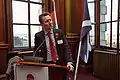
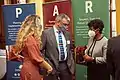
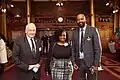
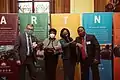
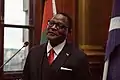
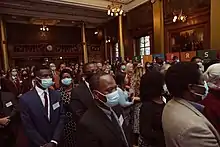 Scotland-Malawi Climate Cooperation: Malawi’s COP26 Homecoming.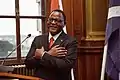


Vision and mission
We exist to help coordinate, support and represent Scotland's many civic links with Malawi.
The Scotland Malawi Partnership (SMP) is the national civil society network coordinating, supporting and representing the people-to-people links between our two nations. We represent a community of 109,000 Scots with active links to Malawi.
We are a membership organisation which anyone in Scotland with an interest in Malawi can join. We are non-governmental and politically neutral. We exist to support our members and we are led by members.
We have over 1,200 member organisations and key individuals, including half Scotland's local authorities, every Scottish university and most of its colleges, 200 primary and secondary schools, dozens of different churches and faith-based groups, hospitals, businesses, charities and NGOs, and a wide range of grass-root community-based organisations. Our work permeates almost all aspects of Scottish civil society.
We exist to inspire the people and organisations of Scotland to be involved with Malawi in an informed, coordinated and effective way for the benefit of both nations. We do this by harnessing experience, expertise and enthusiasm across Scotland and providing forums where ideas, activities and information can be shared between our members.
Our work isn't just about 'international development', with donors on one side and recipients on the other. It's about partnership, about joint working, and about friendship.
Our project is to build connections and collaboration on a multi-sectoral basis between two small nations in ways that are transformational for both. There is no template for doing this. So far as we know, we are the first to develop this model of partnership.
History
Scottish links with Malawi
Links between Scotland and Malawi began with David Livingstone's journeys up the Zambezi and Shire Rivers to Lake Malawi in 1859, long before the borders of the modern nation of Malawi had been established. Both the Church of Scotland and the Free Church of Scotland had established missions in Malawi by the mid-1870s. These missionaries persuaded the UK government to declare the area a British Protectorate. This colonial arrangement lasted, in various forms, until full independence was achieved on 6 July 1964, with Malawi becoming a member of the Commonwealth.
Origins
The Scotland Malawi Partnership was born from the 'Malawi Millennium Project' of the University of Strathclyde and Bell College, in response to the belief that there was a need to bring together under a single umbrella the many organizations and individuals throughout Scotland engaged in fostering and developing links between Scotland and Malawi.[1]
The Partnership was officially launched in the Glasgow City Chambers on 22 April 2004 by the Lord Provosts of Glasgow and Edinburgh, with the support of Ibrahim Milazi, the High Commissioner of Malawi, and representatives from the Universities of Glasgow and Strathclyde, the Church of Scotland, and the Scottish Catholic International Aid Fund (SCIAF).[2] The Lord Provost of Glasgow and Dr Peter West (Secretary of the University of Strathclyde) thereafter travelled to Malawi, and, with the support of Norman Ling, the (then) British High Commissioner, and numerous prominent Malawians, established the Malawi Committee of the Scotland Malawi Partnership which held its first meeting on 28 September 2004.
Activities and impacts
We're really proud of what we achieve, together, as a network.
As a member-led national network, which receives public funding to cover much of our core costs from the Scottish Government, we think its hugely important that the SMP is transparent and accountable about all aspects of our work, its value and impact:
Read the results of our 2021 Member Needs and Impact Survey
Read 479 pieces of positive feedback (‘impact statements’) we have received in 2020-2021 from named individuals – from the President of Malawi and the First Minister of Scotland to individual SMP members.
Read the expert external review of our work in 2020-21, undertaken by the Corra Foundation.
Read the feedback we received from those who contacted the SMP with an enquiry in 2020-21.
Explore the hundreds of events we’ve hosted and co-hosted, attended by thousands.
Read our summary of how we did in 2020-21.
Read our colour-coded 2020-21 ‘logical framework’ (logframe) through which we report to the Scottish Government on for our Core Funding.
Of the 68 target indicators (all set pre-Covid):
- 64 (93%) have been rated “Green” – target met or exceeded
- 5 (7%) have been rated “Amber” – target missed by within 25%
- 0 (0%) have been rated “Red” – target missed by more than 25%
References
- Scotland and Malawi: New Developments, Malawi Update, June, 2005
- "Cities join to bring aid to the poor of Malawi". www.scotsman.com. Retrieved 5 June 2019.