Scott Russell linkage
A Scott Russell linkage is a type of straight line mechanism which gives a theoretically linear motion by using a linkage form with three portions of the links all equal, and a rolling or sliding connection. It can be used to form a right-angle change of motion, linear-to-linear.
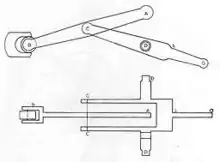
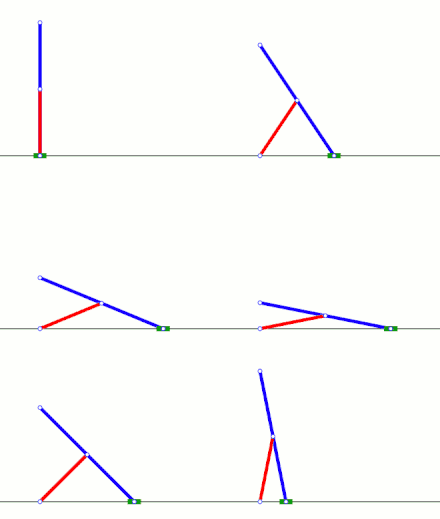
The linkage is named for John Scott Russell (1808–1882), although watchmaker William Freemantle had already patented it in 1803.[1][2]
A different form of the linkage has been used in a front-wheel-drive vehicle with solid rear axle to control lateral movement, and with a flexing elastomeric connection instead of the rolling or sliding connection.[3]
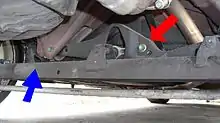
The linkage does not share the disadvantages of the asymmetric Panhard rod, and although more compact than Watt's linkage, it has all the forces concentrated in one link.[4]
References
- British Patent 2741, November 17, 1803
- Project Gutenberg: KINEMATICS OF MECHANISMS FROM THE TIME OF WATT, Eugene S. Ferguson
- , "Vehicle rear suspension apparatus", issued 1998-04-14
- "SCC Technobabble - October '98". www.se-r.net. Retrieved 2021-04-19.
External links
 |
Wikimedia Commons has media related to Scott Russell linkage. |