Serapeum of Saqqara
The Serapeum of Saqqara is a serapeum located north west of the Pyramid of Djoser at Saqqara, a necropolis near Memphis in Lower Egypt. It was a burial place of Apis bulls, sacred bulls that were incarnations of the ancient Egyptian deity Ptah. It was believed that the bulls became immortal after death as Osiris Apis, a name that appears in Coptic as ⲟⲩⲥⲉⲣϩⲁⲡⲓ, Userhapi, which was borrowed in Greek as Σέραπις, Serapis, in the Hellenistic period.
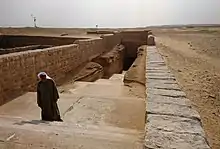 Gate of the Serapeum of Saqqara | |
 .svg.png.webp) Shown within Northeast Africa 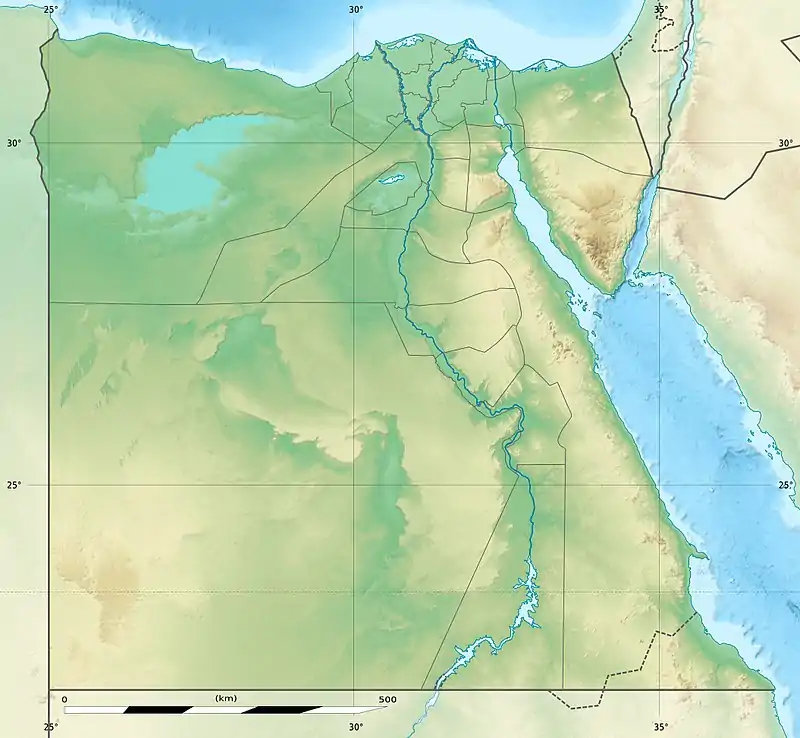 Serapeum of Saqqara (Egypt) | |
| Location | Saqqara |
|---|---|
| Coordinates | 29.874722°N 31.2125°E |
| Type | Serapeum |
| History | |
| Builder | Amenhotep III - Cleopatra |
| Founded | c. 1400 BC |
| Abandoned | c. 30 BC |
| Periods | New Kingdom - Ptolemaic Egypt |
| Site notes | |
| Excavation dates | 1850-3 |
| Archaeologists | Auguste Mariette |
| Public access | Limited |
History
The Apis cult dates back to very early times, possibly founded by pharaoh Menes, around 3,000 BC.[1]
The most ancient burials at the Serapeum, found in isolated tombs, date back to the reign of Amenhotep III, the ninth pharaoh of the Eighteenth Dynasty during the 1350s BC.
Working as an administrator during the reign of his father, Khaemweset, a son of Ramesses II (1279–1213 BC) of the Nineteenth Dynasty, ordered that a tunnel be excavated at the site, and a catacomb of galleries – now known as "The Lesser Vaults" – be designed with side chambers to contain the sarcophagi for the mummified remains of the bulls.
A second gallery of chambers, now known as "The Greater Vaults", was excavated under Psamtik I (664–610 BC) of the Twenty-sixth Dynasty and later extended to approximately 350 m in length, 5 m tall and 3 m wide during the Ptolemaic dynasty along with a long, parallel service tunnel. These gallery chambers contained granite and diorite sarcophagi weighing up to 70 tonnes each, though all were found empty.
A long avenue, flanked by 600 sphinxes, likely was built under Nectanebo I, (379/8–361/0 BC) the founder of the Thirtieth Dynasty (the last native one).
Disuse
The Serapeum was abandoned at the beginning of the Roman Period, shortly after 30 BC,[2] and swallowed by the sands. Strabo (64 BC–30 AD) noted that some of the Sphinxes of the dromos had been covered in sand by the wind.[3]
Evidence suggests that the Apis cult continued elsewhere at Saqqara until the 4th century AD.[4] Arnobius, around 300 AD, stated that the Egyptians penalized anyone who revealed the places in which Apis lay hidden.[5]
Rediscovery
The temple was discovered by Auguste Mariette,[6] who had gone to Egypt to collect Coptic-language manuscripts, but later grew interested in the remains of the Saqqara necropolis.[7]
In 1850, Mariette found the head of one sphinx sticking out of the shifting desert dunes, cleared the sand and followed the boulevard to the site.
After using explosives to clear rocks blocking the entrance to the catacomb, he excavated most of the complex.[3] He found one undisturbed burial in the Lesser Vaults, which is now at the Agricultural Museum in Cairo.
Unfortunately, Mariette left many of his notes unpublished and many of them got destroyed when the Nile flooded the Museum of Egyptian Antiquities at Bulaq in 1878.[8][9] Gaston Maspero released one volume of Le Sérapeum de Memphis based on the surviving manuscripts in 1882, a year after Mariette's death.
Rituals
Four events marked the career of an Apis bull: birth, installation, death and burial.[10]
Diodorus Siculus (c. 90–30 BC) reports that Apis bulls are honored as gods and consecrated to Osiris, and when one died, it is buried in splendor. The priests then seek out a young bull whose appearance is similar to that of its predecessor: black, with a white spot on its forehead, the likeness of an eagle on its back, and a knot under its tongue (Herodotus[11]). Each of these marks has a specific meaning; they symbolize stars, the shape of the crescent moon and universe, when the Nile will rise, etc. (Aelian[12]). When the calf is found, the people stop their mourning, and it is brought to Nilopolis, where it is kept for forty days. Afterwards, the Apis is brought to the temple of Hephaestus in Memphis, in a gilded stall on a barge. For the next forty days only women are allowed to look at the calf, who reveal their generative parts to it. But at all other times women are forbidden in its presence.[13]
Description
Isolated Tombs
| Tomb | Apis | Date |
|---|---|---|
| A | 18.1 | Amenhotep III |
| B | 18.2 | Amenhotep III or IV |
| C | 18.3 | Tutankhamun |
| D | 18.4 | Horemheb |
| E | 18.5 | Horemheb |
| F | 19.1 | Seti I |
| G | 19.2 | Ramesses II - Year 16 |
| G | 19.3 | Ramesses II - Year 30 |
| H | Canopic Room for 19.3 | |
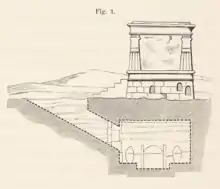
Crown prince Thutmose carried out the earliest known Apis burial (A) during the reign of Amenhotep III, the ninth pharaoh of the Eighteenth Dynasty, during the 14th century BC.
Subsequent burials (B-H) until the middle of Ramesses II's reign would follow the same style: Above ground a platform supported a columned chapel, which was adorned by wall reliefs. In the bedrock below, a sloping passage led to a rectangular chamber which housed the mummified bull in a wooden coffin, its canopic jars and other burial items.[15]
Lesser Vaults
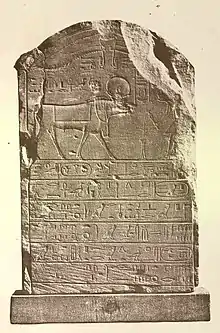
Working as an administrator during the reign of his father, Khaemweset, a son of Ramesses II (1279–1213 BC) of the Nineteenth Dynasty, ordered that a tunnel be excavated at the site, and a catacomb of galleries – now known as the "Lesser Vaults" – be designed with side chambers to contain the sarcophagi for the mummified remains of the bulls. But for one, all chambers were found emptied of their contents except for a disarray of dedication stelae.[16][17][18]
Greater Vaults
The excavation of a second gallery of chambers, now known as the "Greater Vaults", was started under Psamtik I (664–610 BC) of the Twenty-sixth Dynasty.
Nowadays, 24 sarcophagi still remain in the underground structure, of which three are inscribed with the names of Amasis II, Cambyses II, and Khabash; a fourth bears empty cartouches.[19]
Amasis II
Two bulls died under Amasis II, one in year 5, the other in year 23 of his reign. A stela (Tablet V) documents the life of the latter. An excerpt reads:[20]
Year 23, month Pakhons, day 15, under the reign of King Amasis (II), [...]
He had a great sarcophagus made for him, because his Majesty approved the custom, that all the kings in every age had caused it (the sarcophagus of each Apis) to be made out of costly stone. He caused curtains of woven stuffs to be made for the north and south side (of the sarcophagus) He had his talismans put therein, and all his ornaments of gold and costly precious stones. They were prepared more splendidly than ever before, for his Majesty had loved the living Apis better than all (the other) kings.
His birth took place in year 5, month Tehuti, day 7, his inauguration at Memphis in the month Payni, day 8. The full lifetime of this god amounted to 18 years, 6 months. [...]
The sarcophagus of this Apis still stands in situ in the Serapeum (chamber Y) and is decorated with inscriptions and paneled reliefs. Its lid is inscribed with the words:[20]
The king Amasis (II). He has caused this to be made for his memorial of the living Apis, this huge sarcophagus of red granite, for his Majesty approved the custom, that all the kings in all ages had such made of costly stone. This he did, the bestower of life forever.
Cambyses II
A sarcophagus (Z) obstructs the original entrance way to the Greater Vaults.[21] Its lid bears an inscriptions dedicated by the first Persian pharaoh Cambyses II, which reads:[22]
Horus Sema-Tawy [uniter of the Two Lands], king of Upper and Lower Egypt, Ms-tjw-Re (Cambyses' throne name), son of Re, Cambyses, may he live forever; He made as his monument to his father Apis-Osiris a large granite sarcophagus, dedicated by the king of Upper and Lower Egypt, Ms-tjw-Re, son of Re, Cambyses, endowed with all health and prosperity in perpetuity, all health, all joy, appearing as the king of Upper and Lower Egypt for eternity.
According to Herodotus, when Cambyses II returned to Memphis, the people were celebrating. Cambyses asked the local rulers why they had not done so on his previous arrival, they explained that the Egyptians rejoiced not because of him, but a god—the Apis—that had revealed himself. Judging this to be a lie, he put them all to death. Next, the priests were summoned before him, who gave the same account. Thus he ordered the Apis to be brought. On its arrival, Cambyses drew his dagger and stabbed the calf in the stomach and smote its thigh. He laughed: "Wretched wights, are these your gods, creatures of flesh and blood that can feel weapons of iron? That is a god worthy of the Egyptians. But for you, you shall suffer for making me your laughing-stock." The priests were punished and the festival ended. The Apis died of the leg wound and was buried without Cambyses' knowledge.[11]
Depuydt argues that the aforementioned sarcophagus was that for the predecessor of the Apis Cambyses allegedly slew, giving several reasons to corroborate Herodotus' story:[10]
- Herodotus speaks of a calf, whereas the bull attested would have been quite old.
- That the people celebrated the installation of the new calf, one of the few reasons for an Apis to appear before the people.
- That the calf was buried in secrecy, thus no sarcophagus would be expected for it in the vaults.
Darius I
Three Apix bulls were buried during the reign of Darius the Great. Since the entry way was essentially blocked by Cabyses' sarcophagus, a new makeshift entrance was cut closeby, that was used for the first two burials.
A stele, dedicated to the first Apis that died in year 4 of Darius, states:[23]
Year 4, third month of the Season of the Harvest, day 13, under the majesty of the king of Upper and Lower Egypt Darius, endowed with life [as] Ra [forever...], this god was led in [peace] towards the beautiful west and was left to rest in the necropolis, in his place which is the place which his majesty had made for him - we had never [done the same thing before - after having done all the ceremonies] in the embalming room. Indeed his majesty glorified him [as Horus had done to his father Osiris].
We made him (the Apis) a large sarcophagus of solid material of value, as we did before. [We made him vestments], we sent him his amulets and all his excellent ornaments, they were more beautiful than what we did before. Indeed his majesty loved [the living Apis] more than any king.
The majesty of his god ascended to heaven in the year 4, the first month of the Season of Harvest, [it was born on day 4], in year 5, first month of the Season of the Emergence, day 29, [under] the majesty of the king of Upper and Lower Egypt [Ms-tjw-Re]. It was [installed] in the temple of Ptah in the year[,,, The beautiful lifespan] of the god was 8 years, 3 months and 5 days. May Darius be, for him (the Apis), [endowed with life and prosperity forever.]
30 years later, for the burial of the third Apis, a considerably larger approach into the Greater Vaults was cut by extending the main ramp westwards beyond the old entrance stairway to a door in the bedrock, where a corridor was excavated to the south until it joined the Psmatik I gallery. A stela, now located in the Louvre, attests this expansion.[21]
Khabash
A lengthy tunnel continues from the southwards corridor, perhaps intended for a new set of tombs, though it was not used. One smaller sarcophagus was placed at its entrance, dating to year 2 of Khabash.[21] An inscription on its lid reads:[24]
Year 2, month Athyr, under the Majesty of King Khabash, the friend of Apis-Osiris, of Horus 'of Kakem' (a name for the locality of the Apis tombs).
Ptolemaic Egypt
The main corridor of the Greater Vaults was extended to approximately 203 metres (666 ft) in length, (2.3–2.8 metres (7.5–9.2 ft) m wide, and 4.75 metres (15.6 ft) high) by the Ptolemaic dynasty, along with a parallel service tunnel.[25][26]
The thirteen niches in this section correspond to the thirteen bulls attested during this period, from the one that died in year 6 of Ptolemy I Soter to the bull Octavian refused to visit.[27] All but one contain a sarcophagus, the missing one was abandoned in the service tunnel.[2]
Ptolemy II
Two bulls died during Ptolemy II's reign, in years 5 and 29 respectively.[28]
A tablet commemorates the making of the underground burial chamber for the third Apis to live under Ptolemy II, including how long each phase took:[29][30]
| Creation of the burial chamber for the Apis of the mother-cow Ta-ranen | Time | Included
Rest Days | |
|---|---|---|---|
| Months | Days | ||
| From year 32 (of Ptomely II's reign), 21st Payni, to the year 33, 1st Paphi, procuring materials for the interior of the burial chamber for the living Apis: | 3 | 15 | 17 |
| From the year 33, 4th Paophi, to [the year 33, 9th Pharmuthi], excavation and construction of the burial chamber: | 6 | 5 | 33 |
| Starting in year 37, 8th Mesori, transport of the sarcophagus and its lid into the burial chamber: | 1 | 5 | 7 |
| In year 38, 17th Athyr, completion of the whole edifice, after work continued for: | 2 | 9 | 12 |
Ptomely III
The next Apis, was born in year 15 of Ptolemy III. A surviving stela states that the burial vault was under construction when the calf was three years old:[31]
In the year 18, month Phamenoth, of King Ptolemy, son of Ptolemy and Arsinoe I, god-brother, under construction is the burial vault of the living Apis of the cow Kerka, in Apis-year 3, for the living Apis in the Apieum.
Temple and dromos
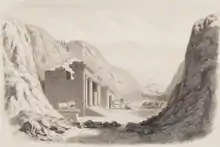
The long boulevard leading to the Serapeum, flanked by 600 sphinxes, was likely built under Nectanebo I, (379/8–361/0 BC) the founder of the Thirtieth Dynasty (the last native one). In front of the precinct, a Greek Temple stood besides an Egyptian-style chapel.
Statues of eleven Greek poets and philosophers faced the temple. Under the pavement, hundreds of bronze statuettes were found buried, representing all the deities of the Egyptian pantheon.[32]
Sarcophagi
Weight and dimensions
Linant-Bey measured one of the large sarcophagi of the Greater Vaults at random and calculated it to have a total mass of 62 tonnes (137,000 lb) at most: 37.6 tonnes (83,000 lb) for the body and 24.4 tonnes (54,000 lb) for the lid. The stone had external dimensions of 2.32 metres (7.6 ft) in height and width, and 3.85 metres (12.6 ft) in length. Internally, the rectangular hollow measured 1.73 metres (5.7 ft) high, 1.46 metres (4.8 ft) wide and 3.17 metres (10.4 ft) long. The lid had a height of 89 centimetres (2.92 ft).[33]
Method of transport
Mariette recognized traces of rollers on the floor of the galleries, and found two wooden horizontal winches, each operated with eight levers, in one of the niches.[34] Heinrich Brugsch, visiting the Serapeum in 1853, noted that the "double-rails" on which the sarcophagi were rolled in are still clearly preserved on the floor of the Ptolematic service tunnel and the following shafts.[35]
The floors of the burial chambers lie 2–3 metres (6.6–9.8 ft) below that of the hallway, thus the sarcophagi had to be lowered to their final positions. Mariette describes that the rooms would be filled with sand to the level of the hallway so that the sarcophagi could be moved in horizontally, then the sand would be gradually removed to gently lower them. For further protection, the ancient Egyptians cut a recesses with the exact width and length of the sarcophagi and about 1 metre (3.3 ft) deep, into the bedrock. A special niche on each side allowed workers to remove the sand under the stones. Mariette found one sarcophagus that had only partially been lowered into its recess, and conducted an experiment to test the aforementioned method. He was able to lower it with perfect regularity, even though its hollow was filled with rubble.[34]
Gallery
 Sphinxes of the dromos, now at the Louvre
 Detail of a sphinx of the dromos
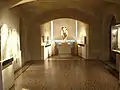 The crypt of the Louvre
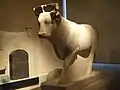 Statue of Apis, from a chapel of the Serapeum (at the Louvre)
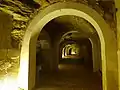 The main tunnel of the Greater Vaults in the Serapeum of Saqqara
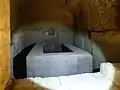 Sarcophagus for bull that died in the 23th year of the reign of Amasis II, without lid
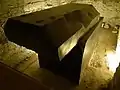 Sarcophagus in the Greater Vaults with slightly moved lid
 Sarcophagus in the Ptolemaic group of the Greater Vaults, with rough inscriptions
See also
 |
Wikimedia Commons has media related to Serapeum of Saqqara. |
Notes
- Dodson 2005, p. 72.
- Dodson 2005, p. 88.
- Dodson 2000.
- Boutantin 2014.
- Arnobius. Seven Books against the Heathen. VI.
- Málek 1983.
- Adès 2007, p. 274.
- Fagan, Brian (2003). Archaeologists: Explorers of the Human Past. Oxford University Press. p. 61.
- "Cairo, Bulaq Museum".
- Depuydt 1995.
- Herodotus. "28-29". Histories. III.
- Aelian. "10". Characteristics Of Animals (De Natura Animalium). XI.
- Diodorus Siculus. "21, 85, 88". On Egypt (in Ancient Greek).
- Dodson 2005, p. 90.
- Dodson 1995, p. 76-79.
- Mathieson 1997.
- Mathieson 1999.
- Dodson 2005.
- Mariette 1890, p. 119.
- Brugsch 1891, p. 426.
- Dodson 2005, p. 85.
- Posener 1936, pp. 35–36.
- Posener 1936, p. 36-41.
- Brugsch 1891, p. 429.
- Dodson 2005, p. 86.
- Hamdy, Gehan Abdel Rahman (2021). "Stabilization of the Ancient Serapeum at Saqqara—Strengthening Proposals Using Advanced Composite Materials". Cities' Identity Through Architecture and Arts. pp. 15–24.
- Cassius Dio. "16.5". Roman History. 51.
- Dodson 2005, p. 91.
- Brugsch 1884, p. 112.
- Brugsch 1891, p. 427English translation slightly inaccurate.
- Burgsch 1884, p. 117.
- Mariette 1856, p. 7-8.
- Mariette 1882, p. 113.
- Mariette 1882, pp. 80–83.
- Burgsch 1855, p. 34.
References
- Boutantin, Céline (2014). "Quelques documents de la région memphite relatifs au taureau Apis". BIFAO (in French). 113: 81–110.
- Brugsch, Heinrich (1855). Reiseberichte aus Aegypten: geschrieben in den Jahren 1853 und 1854 (in German). Leipzig.
- Brugsch, Heinrich (1891). Egypt under the pharaohs: a history derived entirely from the monuments. London.
- Mariette, Auguste; Mariette, Alphonse (1890). The monuments of Upper Egypt. Translated by Dickerman, Lysander.
- Mathieson; Bettles; Clarke; Duhig; Ikram; Maguire; Quie; Tavares (1997). "The National Museums of Scotland Saqqara survey project 1993-1995". Journal of Egyptian Archaeology. 83: 17–53. doi:10.1177/030751339708300103.
- Mathieson; Bettles; Dittmer; Reader (1999). "The National Museums of Scotland Saqqara survey project 1990-1998". Journal of Egyptian archaeology. 85 (1): 21–43. doi:10.1177/030751339908500103.
- Adès, Harry (2007). A Traveller's History of Egypt. ISBN 1-905214-01-4.
Bibliography
- Brugsch, Heinrich (1884). "Der Apiskreis aus den Zeiten der Ptolemäer nach den hieroglyphischen und demotischen Weihinschriften des Serapeums von Memphis". Zeitschrift für ägyptische Sprache und Altertumskunde (in German): 110–136.
- Depuydt, Leo (1995). "Murder in Memphis: The Story of Cambyses's Mortal Wounding of the Apis Bull (Ca. 523 B. C. E.)". Journal of Near Eastern Studies. 54 (2): 119–126.
- Dodson, Aidan (1995). "Of Bulls & Princes, the early years of the Serapeum at Sakkara". KMT. 6 (1): 18–32.
- Dodson, Aidan (2000). "The Eighteenth-Century Discovery of the Serapeum". KMT. 11 (3): 48–53.
- Dodson, Aidan (2005). "Bull Cults". Divine CreaturesAnimal Mummies in Ancient Egypt. pp. 72–102. doi:10.5743/cairo/9789774248580.003.0004.
- Málek, Jaromir (1983). "Who Was the First to Identify the Saqqara Serapeum?". Chronique d'Egypte. 58 (115–116): 65–72. doi:10.1484/J.CDE.2.308620.
- Malinine; Posener; Vercoutter (1968). Catalogue des Stèles du Sérapéum de Memphis (in French). Éditions des Musées nationaux.
- Mariette, Auguste (1856). Choix de monuments et de dessins découverts ou exécutés pendant le déblaiement du Sérapéum de Memphis (in French).
- Mariette, Auguste (1857). Le Sérapéum de Memphis (in French).
- Mariette, Auguste (1882). Maspero (ed.). Le Sérapéum de Memphis (in French). 1.
- Posener, Georges (1936). La première domination Perse En Égypte. Institut Français d'Archéologie Orientale.
- Thijs, Ad (2018). "The Ramesside Section of the Serapeum". Studien zur Altägyptischen Kultur. 47 (3): 293–318.
Authority control  | |
|---|---|
| General | |
| National libraries | |