Sergey Brilev
Sergey Borisovich Brilev (Russian: Сергей Борисович Брилёв) is a Russian journalist, TV anchor and writer, multi-winner of Russia's top TV prize TEFI.[1] He is also known for participating in global informational, scientific, energetical and political projects such as Global Energy Prize.[2][3][4] Due to his origins, he has close ties to Latin America and the United Kingdom, where many of his activities are concentrated.
Sergey Brilev | |
|---|---|
| Сергей Брилёв | |
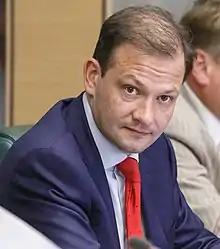 | |
| Born | July 12, 1972 Havana, Cuba |
| Citizenship | Russia, UK; Honorary citizen of Montevideo, Uruguay |
| Occupation | TV anchor, public figure |
| Spouse(s) | Irina A Brileva |
| Children | Alexandra Brileva (11.08.2006) |
He is the deputy director of the TV Channel Rossiya 1[5][6][7] for ad hoc information projects, PhD in history, President of the Global Energy Association (Moscow), co-founder and president of the Bering-Bellingshausen Institute for the Americas (IBBA: Montevideo, Uruguay), member of the governing Board of the Council for Foreign and Defence Policy (Russia's oldest NGO), WE-speaker with the World Energy Council (London).[8]
Early life and education
Sergey Brilev was born on 24 July 1972 in Havana, Cuba, where his father worked as an interpreter for Soviet civil aircraft exporters. His early life was spent between Cuba, Ecuador, Uruguay (where his parents were posted with Soviet trade missions) and Moscow.[9]
As a schoolboy and student, he took part in amateur theatre (at Moscow school No. 109, known as the "Yamburg school"). Brilev made his first appearance on Russian television while still a schoolboy in 1988 on the popular programme "The 12h Floor" — cast as one of the heroes. One of the show's co-presenters, Vladislav Flyarkovsky, remarked on his "silver tongue" and suggested he take up journalism rather than law as Brilev had planned.
He read international journalism at the Moscow State Institute of International Relations (MGIMO). Brilev took a sabbatical in 1990–1991 to attend the Montevideo Institute of Foreign Languages (Uruguay). He also took courses through the BBC (UK) and the United States Agency for International Development (USAID). He studied for a very short time at the management faculty of Westminster University in London, but left because of work commitments.
Media career
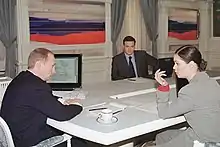
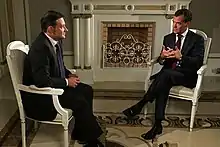

.jpg.webp)
During 1990–1993 he was a correspondent-intern at the Science and Education department of Komsomolskaya Pravda daily newspaper.
While studying in Uruguay (1990–1991), he was a columnist at the Uruguayan newspapers La República and El Observador Económico. He also started his career on TV as a co-producer of a special report "SODRE" at TV Canal 5 (Uruguay) on ethnic Russians residing in the depths of Uruguay's inner Río Negro Department.
1993–1995: special correspondent of the foreign desk of The Moscow News newspaper, writing mostly about Latin America. He became the first correspondent to visit Cuba after a ban was imposed on The Moscow News in connection with refugees leaving the country on rafts and was summoned as an expert by Russia's Duma (the lower house of parliament). Simultaneously he was Moscow contributing correspondent of El Observador Económico and the Argentinian newspaper La Razón.
He was also the author of a series of reports for the programme International Panorama for national television along with journalist Dmitry Yakushkin and for Formula 730 programme, after which he received an offer to work for the television news programme Vesti.
1995–1996: special correspondent of the daily news programme Vesti of TV channel Rossiya during the First Chechen War and the hostage crisis in Budennovsk. Completed BBC courses in London between assignments.
1996–2001: Vesti London correspondent. During that period, he became a regular panellist with Sky News and the BBC (e.g. the Europe Direct programme), he subsequently divided his time between Moscow and London.
In 2001, he accepted an offer from the head of Russian television Oleg Dobrodeyev to become a presenter of the Vesti programme. September 11, 2001 was his first day as a presenter. Brilev had been due to start work on 17 September, but was called in urgently to cover the attacks on U. S. targets live on air because of his knowledge of English and international realities. He was on the air for almost the entire day, this instantly made him one of the Russia's top presenters.
2001–2003: anchor of evening prime time daily news Vesti. 2003–2007: anchor of Sunday weekly review Vesti nedeli ("Weekly news"). Since 2008: author and anchor of his own political programme Vesti v subbotu ("Saturday news with Sergey Brilev").
In 2002, 2006 and 2018 he was named the best TV news and current affairs presenter by the Russian TV Academy which gave him Russia's top television award TEFI in those years.[1]
One of Brilev's specialities has been interviewing global movers and shakers. E. g. as far as top statesmen of the countries of the UN Security Council permanent members are concerned, Brilev has interviewed such Americans as George W. Bush, Barack Obama, Colin Powell, Condoleezza Rice, John Kerry, Henry Kissinger, George Shultz, Britain's Tony Blair, Gordon Brown, Boris Johnson, Robin Cook, Jack Straw and David Miliband, China's President Xi, former and future French Presidents Valéry Giscard d'Éstaing, Nicolas Sarkozy and Emmanuel Macron, and Russia's Vladimir Putin, Dmitry Medvedev, Evgeny Primakov, Sergey Ivanov and Sergey Lavrov.
As a journalist he keeps being a regular visitor to Latin America and the Caribbean where he has interviewed, among others, Presidents Evo Morales of Bolivia, Dilma Rousseff of Brazil, Michelle Bachelet of Chile, Daniel Ortega of Nicaragua, Juan Carlos Varela of Panama, Mario Abdo Benítez of Paraguay, Julio María Sanguinetti and Tabaré Vázquez of Uruguay, Hugo Chávez of Venezuela, etc. It is also in Latin America, where Brilev filmed some of his investigative documentaries, which were broadcast on both Russian and Latin American television: on the Cuban Missile Crisis, on a group of Soviet submarines which sailed through the Panama Canal at the height of WW2, on the Soviet ice-breaker Mikoyan, which visited Montevideo also at the height of WW2, on Soviet espionage in Uruguay during the cold war.
Brilev's other documentaries range from oil, gas, coal and the electricity industry to lighter travel formats on Russian regions and such countries as Bosnia, Cuba, Grenada, Mongolia and Uruguay. Also, on a parallel course, Brilev acted as host of purely entertainment TV shows: the Russian edition of the French adventure show Fort Boyard (2002 season) and an entertainment quiz show "Knowledge is Power".
In 2004, 2008, 2012 and 2018 he acted as the official co-commentator of the live ceremony of the inauguration of the President of the Russian Federation, along with Channel One's Ekaterina Andreyeva, with whom he also anchored Putin's early phone-in shows (2002–2007). In 2012–2018 he also paricipated in the annual live broadcast "Talk with Dmitry Medvedev".
Academic, public and international activity
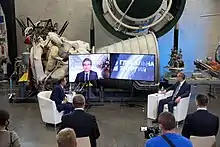
As a media personality and head and prominent figure of several non-governmental organizations (NGOs), Brilev regularly moderates high-level plenary sessions at economic and political forums. E. g. his plenary sessions at the Eastern Economic Forums in 2019–2020 in Vladivostok included Presidents Vladimir Putin of Russia, Xi Jìnpíng of China, Khaltmaagiin Battulga of Mongolia and Prime Ministers Modi of India, Shinzō Abe of Japan, Lee Nak-yeon of South Korea and Mahathir bin Mohamad of Malaysia.
In 2013, Brilev acted as a co-founder of the Bering-Bellinghausen Institute for the Americas (IBBA),[10] a non-governmental organisation pledged to foster dialogue between the Commonwealth of Independent States and Latin America. The NGO is registered in Montevideo, Uruguay and has acted as the organiser and co-organiser of numerous activities such as the placing of a monument to Fabian Bellinghausen in Montevideo, the Antarctic island of King George and Rio de Janeiro and dozens of media, cultural and business events in Argentina, Chile, Cuba, Grenada, Honduras, Nicaragua, Russia, St Vincent and the Grenadines, Venezuela and Uruguay. For his contribution to Uruguayan-Russian relations, Brilev was awarded the silver medal of "visitante ilustre" (a form of honorary citizenship for foreigners) of Montevideo.
With his British co-author Bernard O'Connor Brilev has published dozens of articles and two books on Anglo-Soviet intelligence cooperation (SOE-NKVD) during World War II. Together they co-organised international conferences on the subject in Moscow, Kazan and Ufa, attended by both scientists and British, French, Russian and Spanish diplomats. This also led to a series of TV special reports and documentaries.
Brilev's own books include "Fidel. Football. Falklands" (which was widely quoted for its analysis of Soviet involvement in the 1982 war in the South Atlantic) and "Forgotten Allies" about small countries fighting in WW2 on the Allies' side (which in 2016 became the basis of his Ph.D. at his alma mater, the MGIMO).
Since he headed the Global Energy Association (the operator of the Global Energy Prize) in February 2020, Brilev has tripled the number of candidates for the prize and became a regular WE-speaker with the World Energy Council in London. He was also invited by British and Italian governments to moderate the Moscow countdown to the COP26 conference in Glasgow.
Views and controversy
Russia's anti-establishment critic Alexey Navalny accused Brilev of being a "Putin propagandist", who "never criticises the Kremlin" yet holds a British passport.[11] However, Brilev is viewed by other prominent Russian commentators as "the most liberal figure on state TV".[12] He supported the 2020 amendments to Russian constitution, which are said to cement the existing structure of power, but explained that for him the most important part was that parliament will from now participate in the formation the federal government, which was previously composed exclusively by presidential decrees. On the other hand, Brilev openly confronted Putin on the ban of US adoptions of Russian orphans and was the first journalist to ask Putin about the Skripal affair in Salisbury. He has publicly stated that in the past he had often voted for the Russian opposition Yabloko party, but became disillusioned by its weakness. In Latin America, Brilev is known as an active supporter of the Sputnik-V anti-Covid-19 vaccine. However, on numerous occasions he stated "the more vaccines there are, the better. His views on Brexit are unknown, but he dedicated a lot of time to the coverage of it on the air, visiting himself the Irish border and indicating that Brexit could mean a return to pre-Good Friday agreement realities.
Family
Brilev is married to Irina Brileva (nee Konstantinova). They met in 1989 in Moscow and got married in 1998 in London. The couple has one daughter.
References
- (in Russian) Брилев Сергей Борисович — profile at TEFI website
- Levy, Clifford J.; Barry, Ellen (8 July 2009). "In Russia, Obama's Star Power Does Not Translate". The New York Times.
- "Sergey Brilev profile". at Russian International Affairs Council
- "President of Global Energy Association Dr Sergey Brilev: To burn or not to burn? Waste and bridges". Interfax. 21 May 2020.
- "Interview of the President by Sergey Brilev of Channel Rossiya, Russian Television". obamawhitehouse.archives.gov. 8 May 2010.
- "Interview With Sergey Brilev of Rossiya TV". Govinfo.gov. May 6, 2010.
- https://pulitzercenter.org/stories/inside-russias-propaganda-machine Inside Russia’s Propaganda Machine — Pulitzer Center, Juy 12, 2017
- "COVID-19: Accelerating a Better Energy Future for All". World Energy Council. 17 June 2020.
- (in Russian) Сергей Брилев — profile at VGTRK website
- "About institute". Institute Bering-Bellingshausen / IBBA.
- Moscow, Marc Bennetts. "Russia propagandist Sergei Brilev is Briton with flat in Chiswick".
- (in Russian) Олег Кашин — Персонально ваш — Эхо Москвы, 23.11.2018 — Echo of Moscow, 23.11.2018
 |
Wikimedia Commons has media related to Sergey Brilev. |