Shakespeare's signet ring
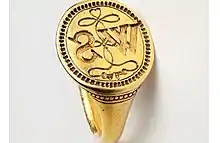
The purported Shakespeare's signet ring or seal ring, is a gold signet ring with the initials WS. It was found in Stratford-upon-Avon, United Kingdom, in 1810 and may have belonged to William Shakespeare. It is kept by the Shakespeare Birthplace Trust (SBT).
Discovery

The ring was found in March 1810 by a Mrs. Martin, while she was working in a field near the Holy Trinity Church in Stratford. Robert Bell Wheler, local historian and solicitor, bought it from her the same day, though she cleaned it with nitric acid first and removed the patina.[1][2][3] He paid 36 shillings, the approximate gold price at the time.[4]
After Wheler's death, his sister Anne donated it to the Shakespeare Birthplace Trust (SBT).[5]
Descripton
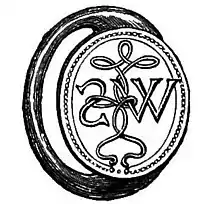
The signet ring is in the style of such a ring for a wealthy man of the Elizabethan era, made of gold and somewhat heavy at about 18 grams. The face (bezel) has the initials "WS", reversed for use as a seal stamp. Combined with the letters is a knotted rope. Above the letters the rope forms a true lover's knot with 4 loops, the topmost one in the shape of a heart. Between the letters it forms a Bowen knot. The rope's ends below the letters have tassels.[6][7][2] Width 19 mm and height 16 mm.[8]
Speculation
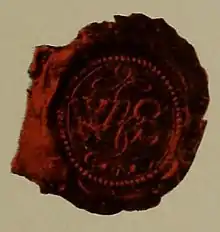
No seal impressions by William Shakespeare are preserved.[2] Wheler believed that the ring had belonged to him, and that it had been his wedding ring.[1][2] He saw no other plausible owner.[5] Wheler consulted Shakespearean scholar Edmond Malone, who mentioned as an alternative William Smith (c.1550–1618), another wealthy Stratfordian. However, Smith's seal is known and of a different design.[6][2] It is also possible that the ring was a gift from "WS" to a friend, or for the use of a business representative.[7] Author Charles Edwards suggests that it was a gift to William from his wife Anne.[9]
Scholars have suggested that Shakespeare could have lost the ring at his daughter Judith's wedding at the Holy Trinity Church in 1616.[10][1] A possible indication of this is a correction made in Shakespeare's will, written the same year. Where it had originally read "whereof I have hereunto put my hand and seal" near the end, "and seal" has been struck.[6][1][10]
Another signet ring with the initials WS was kept by the English 18th century actor David Garrick in his Temple to Shakespeare.[7][11]
Merchandising
In 2016, the SBT licensed the making of a version of the ring for sale to a Stratford jeweller firm. These rings were made with the same gold alloy as the original.[12][13] Other SBT merchandise based on the ring include pendants and fridge magnets.[14][15][16]
In fiction
In Graham Holderness' story "The Adventure of Shakespeare's Ring", the ring is stolen and the theft investigated by Sherlock Holmes. The thief is Oscar Wilde, who wanted it because he believed it was a love token given to Shakespeare by Henry Wriothesley, Earl of Southampton.[17]
See also
References
- Bramley, Zoe (15 March 2016). William Shakespeare in 100 Facts. Amberley Publishing Limited. p. 147. ISBN 978-1-4456-5625-0.
- "The Mystery of the Ring". Shakespeare Birthplace Trust. 3 September 2010. Retrieved 5 November 2021.
- Grant Wilson, James (November 1883). "Contributors' Table". Shakespeariana. 1 (1): 84. Retrieved 5 November 2021.
- Kunz, George Frederick (1917). Rings for the finger, from the earliest known times, to the present, with full descriptions of the origin, early making, materials, the archaeology, history, for affection, for love, for engagement, for wedding, commemorative, mourning, etc. Philadelphia, London, J. B. Lippincott & Co. p. 151.
- Holderness, Graham (12 September 2013). Nine Lives of William Shakespeare. A&C Black. p. 169. ISBN 978-1-4411-6846-7.
- Cooper, Tarnya (1 January 2006). Searching for Shakespeare. Yale University Press. p. 143. ISBN 978-0-300-11611-3.
- Hewitt, Peter (19 November 2012). "Shakespeare in 100 Objects: Shakespeare's Signet Ring". Shakespeare Birthplace Trust. Retrieved 5 November 2021.
- "Signet ring". collections.shakespeare.org.uk. Shakespeare Birthplace Trust. Retrieved 7 November 2021.
- Edwards, Charles (1855). The history and poetry of finger-rings. Redfield. p. 16.
- Edmondson, Paul; Wells, Stanley (22 October 2015). The Shakespeare Circle: An Alternative Biography. Cambridge University Press. p. iix. doi:10.1017/CBO9781107286580. ISBN 978-1-316-40462-1.
- Shapiro, James (19 April 2011). Contested Will: Who Wrote Shakespeare?. Simon and Schuster. p. 30. ISBN 978-1-4165-4163-9.
- Smith, Chris (9 April 2016). "Sales of recreated Shakespeare ring will boost Trust coffers". Stratford-upon-Avon Herald. Retrieved 5 November 2021.
- Davidson, Annabel (5 May 2016). "George Pragnell recreates Shakespeare's signet ring". The Daily Telegraph. Retrieved 25 November 2021.
- "William Shakespeare Seal Magnet". Shakespeare Shop. Retrieved 5 November 2021.
- "WS Charm". Shakespeare Shop. Retrieved 5 November 2021.
- "[Withdrawn] Shakespeare's life and works inspire export sales". GOV.UK. 21 April 2016. Retrieved 5 November 2021.
- Franssen, Paul (21 January 2016). Shakespeare's Literary Lives: The Author as Character in Fiction and Film. Cambridge University Press. p. 127. ISBN 978-1-107-12561-2.
External links
- Picture gallery by Shakespeare Birthplace Trust (click gallery button)
- A signet ring from Stratford, video with Stanley Wells
.png.webp)


