Sharpe's Assassin
Sharpe's Assassin is the twenty-first[1] historical novel in the Richard Sharpe series by Bernard Cornwell, published in 2021. The story is set in June 1815, immediately after the Battle of Waterloo, and during the occupation of Paris.[2][3]
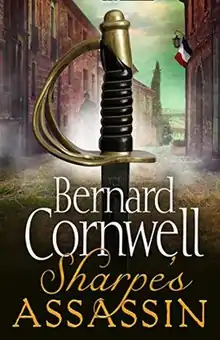 First edition cover | |
| Author | Bernard Cornwell |
|---|---|
| Country | United Kingdom |
| Language | English |
| Series | Richard Sharpe stories |
| Genre | Historical novel |
| Publisher | HarperCollins |
Publication date | 30 September 2021 |
| Media type | Print (Hardback) and audiobook |
| Pages | 400 pp (first edition, hardback) |
| ISBN | 0-00-818401-1 (first edition, hardback) |
| Preceded by | Sharpe's Waterloo (chronological) Sharpe's Fury (publication) |
| Followed by | Sharpe's Devil |
Plot summary
Following the Battle of Waterloo, Lieutenant-Colonel Richard Sharpe, now in official command of the Prince of Wales' Own Volunteers, is tasked by the Duke of Wellington to lead his men into France and rescue a high-value prisoner from the citadel in the commune of Ham.
Accompanied by his friend, retired Regimental Sergeant Major Patrick Harper and exploring officer Major Vincent, Sharpe uses subterfuge to gain access to the seemingly impenetrable fortress, allowing the rest of the battalion to enter and quickly overwhelm the defences. They rescue the prisoner, an art dealer and British spy named Alan Fox, and execute via guillotine the citadel's commandant as punishment for the murder of several of the other prisoners.
Upon returning to the army Sharpe is appalled to find that his former commanding officer, Charles Morris, who had Sharpe flogged in India,[N 1] has been drafted into his battalion due to a shortage of experienced officers. After threatening to flog Morris if he hears of any mistreatment of the men during his absence, Sharpe is dispatched with Fox to Paris with Harper, Charlie Weller, and nine other men to investigate a rumoured plot by a Bonapartist cabal calling themselves La Fraternité to assassinate Wellington, Prince Blücher, Louis XVIII, and other allied leaders. Despite orders from Fox against it, Sharpe informs his lover, Lucille Castineau, of his mission, and she passes on a request from her host, the Dowager Countess of Maubeuges, to evict a group of deserters who have invaded her vacant Parisian mansion.
After arriving in Paris and setting up a hideout in Fox's warehouse, Sharpe and Fox meet with Fox's informant, Felix Collignon, who soon reveals himself to be a member of La Fraternité and assists two men in ambushing them. With the aid of Harper and his men, Sharpe fends off the attack, captures Collignon, and, after Fox has interrogated him, kills him. Fox and Sharpe argue the following morning over Collignon's death; Collingnon had given up two names — Colonel Lanier and General Delaunay — but Fox believes he could have been pressed for more information, and leaves to find and question one of the men alone. When Fox does not return, Sharpe and Harper presume him captured, and fearing that the warehouse will soon be attacked by La Fraternité, relocate with their men to the Dowager Countess' mansion, killing several of the deserters after discovering they had kidnapped and raped two of the mansion's maids. The next day Sharpe witnesses French troops raiding the warehouse, confirming his fears that La Fraternité are hunting them.
With the help of Harper and the Dowager Countess' steward, Sharpe deduces that General Delaunay owns a vineyard on the outskirts of Paris, and that evening takes his men to investigate. After sneaking into the vineyard's house through an open window Sharpe finds himself held at gunpoint by the general's English wife, who informs him that her husband, a cuirassier, had been killed at Waterloo, and that Fox is her captive. After disarming him, she expresses curiosity about Sharpe's rifle and test-fires it out of the window, but the recoil injures her and distracts the house's guards long enough for Sharpe's men to overpower them.
Sharpe questions Madame Delaunay, who confesses that La Fraternité was formed by her husband from loyalist soldiers to avenge the potential death of Napoleon in battle, but dismisses it as "medieval claptrap" that likely died with him. Retrieving Fox, who had been held and interrogated in the house's mushroom cellar, Sharpe and his men withdraw under fire back to the Maubeuges mansion. Spurred by Fox's assertion that Madame Delaunay is using tunnels to smuggle wine into the city to avoid paying duty taxes, and his own doubts about her honesty, Sharpe returns with Harper to the vineyard the next morning and discovers an entire infantry corps stationed there, led away from the Battle of Wavre by Colonel Lanier, nicknamed "Le Monstre" by his men.
Several days later Wellington leads the allied armies into Paris, freeing Fox to return to his official duty of cataloguing and returning to its original owners art in the Louvre stolen by the French during the war. Wellington is unconvinced of Sharpe's claim that Lanier is hiding troops in the Delaunay vineyard after a search of the vineyard's house and warehouse finds nothing, but after failed attempts on Sharpe and Wellington's lives by Lanier's men Sharpe is ordered to find and kill Lanier. While attending a dinner to which Madame Delaunay is invited, Sharpe meets Lanier face-to-face and foils a ruse to smuggle in and set fire to eight barrels of gunpowder in the mansion's cellar, prompting Wellington to order an attack on the Delaunay vineyard. Despite this, Sharpe grudgingly confesses to himself a liking and respect for the French colonel.
Sharpe leads the light company through a smuggling tunnel from a nearby tavern into the Delauany house, but is wounded in the shoulder by a six-pounder cannon placed at the end of the tunnel. The Prussian company assisting the South Essex lead a frontal attack on the house and warehouse through the vineyard, but take heavy casualties when Morris chooses to hold the battalion back rather than face a prepared and hostile enemy. After a fight inside the Delaunay house which leaves it ablaze, Sharpe eventually re-joins his men and turns the tide of battle until Lanier challenges Sharpe to single combat, with the stipulation that the loser's troops withdraw. Sharpe agrees, but first offers Morris the chance to take his place due to the wound he took in the tunnel. When, as Sharpe's expects, Morris refuses, Sharpe relieves him of command and arrests him for cowardice in the face of the enemy. In the ensuing duel, Lanier uses his superior fencing skills to further wound Sharpe, but rather than kill him instead offers the chance to yield in acknowledgement of the growing respect between the two. Knowing he cannot out-fence Lanier, Sharpe resorts to "gutter fighting", breaking Lanier's sword arm and forcing him to yield. Lanier confirms that he is the last member of La Fraternité, and is allowed to peacefully depart from Paris with his men.
Wellington confirms Sharpe's promotion to Lieutenant-Colonel but expresses his surprise at Sharpe's decision to retire and hand command of the battalion to Peter D'Alembord, despite the loss of D'Alembord's leg at Waterloo. The Duke apologises for not being aware of Sharpe's history with Morris, who resigned his commission in disgrace rather than face a court martial, and requests Sharpe's services again if the army should ever need him, to which Sharpe agrees. Finally thanking him for his many years of service, Wellington asks Sharpe if he had meant to kill or merely wound the Prince of Orange.[N 2] Not wishing to part from his long-time commander with a lie, Sharpe hesitates for a moment before admitting that he had tried to kill the Prince, to which Wellington approvingly responds that it was "a damn fine miss," expressing incredulously that Orange is claiming the victory at Waterloo as his own, before confessing that it was the Sharpe and the British infantry who truly won both the battle and the war.
One year later, Sharpe, peacefully retired to his and Lucille's farm in Normandy, receives a letter from Harper informing him of the birth of his son, Richard. He and Lucille agree that they must visit Ireland, so their son and Harper's may meet.
Publication history
References
- "Sharpe's Assassin (The Sharpe Series, Book 21)". HarperCollins Publishers UK. Retrieved 2021-10-01.
- "Cornwell brings back Sharpe after 15 years | The Bookseller". www.thebookseller.com. Retrieved 2021-10-01.
- Rennison, Nick (12 September 2021). "Sharpe's Assassin by Bernard Cornwell review — is the first Sharpe novel for 15 years worth the wait?". News UK. The Times. Retrieved 13 November 2021.