Samaria (ancient city)
Samaria (Hebrew: שומרון, Shomron; Ancient Greek: Σαμάρεια, Samareia; Arabic: السامرة, as-Samira) was, according to the Hebrew Bible, an ancient capital of the northern Kingdom of Israel in the 9th and 8th centuries BC.
שומרון | |
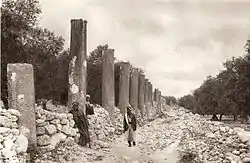 Ruins of the city of Samaria (1925) | |
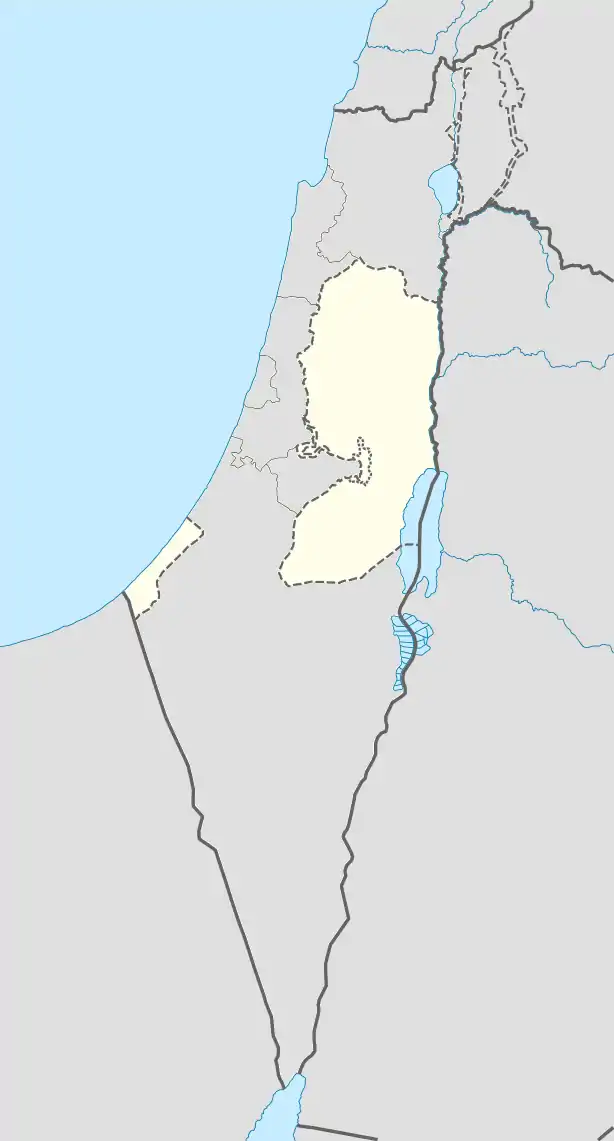 .svg.png.webp) Shown within State of Palestine | |
| Alternative name | السامرة |
|---|---|
| Location | Nablus Governorate, Palestinian territories |
| Coordinates | 32°16′35″N 35°11′42″E |
According to Roman-Jewish historian Josephus, when ancient Judaea became a Roman province, the Hebrew settlement of Samaria was renamed to Sebastia by King Herod the Great, in honor of emperor Augustus.
History
Kingdom of Israel
Israelite Shomron (lit. "watch-tower"; also written "Shomeron") was located in the heart of the mountains of Samaria, a few miles northwest of Shechem. The ruins of the Israelite town, as well the ruins of towns built at this same location later in history, are all adjacent or within the modern Palestinian town of Sebastia. The earliest reference to a settlement at this location may be the town of Shamir, which according to the Hebrew Bible was the home of the judge Tola in the 12th century BC (Judges 10:1–2).[1]
The "hill of Shomron" is an oblong hill, with steep but not inaccessible sides, and a long flat top. According to the Bible, Omri, the king of the northern kingdom of Israel (reigned c. 870s BC), purchased this hill from Shemer its owner for two talents of silver, and built on its broad summit the city to which he gave the name of "Shomron", i.e., Samaria, as the new capital of his kingdom instead of Tirzah (1 Kings 16:24). As such it possessed many advantages. Omri resided here during the last six years of his reign.
Omri is thought to have granted the Arameans the right to "make streets in Samaria" as a sign of submission (1 Kings 20:34). This probably meant permission was granted to the Aramean merchants to carry on their trade in the city. This would imply the existence of a considerable Aramean population.
It was the only great city of Israel created by the sovereign. All the others had been already consecrated by patriarchal tradition or previous possession. But Samaria was the choice of Omri alone. He, indeed, gave to the city which he had built the name of its former owner, but its especial connection with himself as its founder is proved by the designation which it seems Samaria bears in Assyrian inscriptions, "Beth-Khumri" ("the house or palace of Omri"). (Stanley)
According to Biblical tradition, Samaria was frequently besieged. In the days of Ahab, Benhadad II came up against it with thirty-two vassal kings, but was defeated with a great slaughter (1 Kings 20:1–21). A second time, the next year, he assailed it; but was again utterly routed, and was compelled to surrender to Ahab (1 Kings 20:28–34), whose army, as compared with that of Ben Hadad, was no more than "two little flocks of kids" (1 Kings 20:27).
The Bible teaches that in the days of Jehoram, Ben Hadad again laid siege to Samaria. But just when success seemed to be within their reach, they suddenly broke off the siege, alarmed by a mysterious noise of chariots and horses and a great army, and fled, leaving their camp with all its contents behind them. The famished inhabitants of the city were soon relieved from the abundance of the spoil of the Syrian camp; and it came to pass, according to the word of Elisha, that "a measure of fine flour was sold for a shekel, and two measures of barley for a shekel, in the gates of Samaria" (2 Kings 7:1–20).
According to Josephus, the ancient name of the site Shomron (Samaria) was changed to Sebastia by King Herod the Great, in honor of Augustus.[2]
Modern era
In 1867, visitors found the village to have a population of 400, 'almost all Moslems'.[3]
In late 1976, the Israeli settlers movement, Gush Emunim, attempted to re-establish a settlement at the Ottoman train station. The Israeli government did not approve and the group that was removed from the site would later found the settlement of Elon Moreh adjacent to Nablus/Shechem.
Archaeology
The site was first excavated by the Harvard Expedition, initially directed by Gottlieb Schumacher in 1908 and then by George Andrew Reisner in 1909 and 1910; with the assistance of architect C.S. Fisher and D.G. Lyon.[4] The second expedition was known as the Joint Expedition, a consortium of 5 institutions directed by John Winter Crowfoot between 1931 and 1935; with the assistance of Kathleen Mary Kenyon, Eliezer Sukenik and G.M. Crowfoot. The leading institutions were the British School of Archaeology in Jerusalem, the Palestine Exploration Fund, and the Hebrew University.[5][6][7] In the 1960s small scale excavations directed by Fawzi Zayadine were carried out on behalf of the Department of Antiquities of Jordan.[8]
See also
References
- Boling, R.G. (1975). Judges: Introduction, Translation, and Commentary. (Anchor Bible, Volume 6a), Page 185
- Josephus, Antiquities 15.8.5.
- Ellen Clare Miller, 'Eastern Sketches – notes of scenery, schools and tent life in Syria and British Palestine'. Edinburgh: William Oliphant and Company. 1871. p. 179: 'stigmatized in guide-books as remarkable for rudeness and fanaticism' although this was not Ms Miller's experience.
- Reisner, G. A.; C.S. Fisher, and D.G. Lyon (1924). Harvard Excavations at Samaria, 1908–1910. (Vol 1: Text , Vol 2: Plans and Plates ), Cambridge, Mass.: Harvard University Press
- Crowfoot, J. W.; G.M. Crowfoot (1938). Early Ivories from Samaria (Samaria-Sebaste. reports of the work of the Joint expedition in 1931–1933 and of the British expedition in 1935; no. 2). London: Palestine Exploration Fund, ISBN 0-9502279-0-0
- Crowfoot, J. W.; K.M. Kenyon and E.L. Sukenik (1942). The Buildings at Samaria (Samaria-Sebaste. Reports of the work of the joint expedition in 1931–1933 and of the British expedition in 1935; no.1). London: Palestine Exploration Fund.
- Crowfoot, J. W.; K.M. Kenyon and G.M. Crowfoot (1957). The Objects from Samaria (Samaria; Sebaste, reports of the work of the joint expedition in 1931;1933, and of the British expedition in 1935; no.3). London: Palestine Exploration Fund.
- Zayadine, F (1966). "Samaria-Sebaste: Clearance and Excavations (October 1965 – June 1967)". Annual of the Department of Antiquities of Jordan, vol. 12, pp. 77–80
Further reading
- Tappy, R. E. (1992). The Archaeology of Israelite Samaria: Vol. I, Early Iron Age through the Ninth Century BCE. Harvard Semitic Studies 44. Atlanta, GA: Scholars Press.
- Tappy, R. E. (2001). The Archaeology of Israelite Samaria: Vol. II, The Eighth Century BCE. Harvard Semitic Studies 50. Winona Lake, IN: Eisenbrauns.
External links
- Samaria (city), biblewalks
 Texts on Wikisource:
- "Samaria". New International Encyclopedia. 1905.
- "Samaria". Encyclopædia Britannica (11th ed.). 1911.
- Vailhé, S. (1913). "Samaria". Catholic Encyclopedia.
Authority control  |
|---|