Brook of Egypt
The Brook of Egypt is the name used in some English translations of the Bible for the Hebrew Naḥal Mizraim ("River of Egypt"), used for the river defining the westernmost border of the Land of Israel. A number of scholars in the past have identified it with Wadi El-Arish,[1] an epiphemeral river pouring at the Mediterranean sea near the Egyptian city of Arish, while other scholars, including Israeli archaeologist Nadav Na'aman and the Italian Mario Liverani believe that the Besor stream, just to the south of Gaza, is the "Brook of Egypt" referenced in the Bible.[2][3] A related phrase is Nahar Mizraim, used in Genesis 15:18.
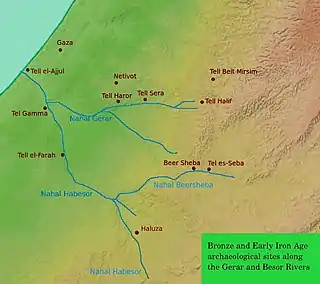
Nahal Besor
The Israeli archaeologist Nadav Na'aman and the Italian Mario Liverani have suggested that Wadi Gaza or Nahal Besor, was the Brook of Egypt.[2][3] Certainly, it was controlled by Egypt in the Late Bronze Age and inhabited by Philistines into the Iron Age.[4]
Wadi el-Arish
According to Exodus 13:18–20 the locality from which the Israelites journeyed after departing Egypt was Sukkot. The name Sukkot means "palm huts" in Hebrew and was translated El-Arish in Arabic. It lies in the vicinity of El-Arish, the hometown of the Jewish commentator Saadia Gaon who identified Naḥal Mizraim with the wadi of El-Arish.
The Septuagint translates Naḥal Mizraim in Isaiah 27:12 as Rhinocorura.
Although in later Hebrew the term naḥal tended to be used for small rivers, in Biblical Hebrew, the word could be used for any flowing stream.
According to Sara Japhet,
"Nahal Mizraim" is Wadi el-Arish, which empties into the Mediterranean Sea about 30 miles south of Raphia, and "Shihor Mizraim" is the Nile.[5]
Possible interpretation as the Nile
The traditional Jewish understanding of the term Naḥal Mizraim is that it refers to the Nile. This view is made explicit in the Jerusalem Targum, the Targum Jonathan, the Targum Neofiti and the Fragment Targums (where in all cases the term is translated Nilus) as well as in the commentaries of Rashi and Rabbi Yehuda Halevi. Rashi explicitly states in his commentary on Joshua 13:3: "the Nile, the same as Naḥal Mizraim".
Nevertheless, the term Naḥal Mizraim is only used when discussing the border of the Land of Israel whereas Ye'or is typically used for the main body of the Nile. This suggests that there is indeed some difference in meaning.
References
- M. Patrick Graham; William P. Brown; Jeffrey K. Kuan (1 November 1993). History and Interpretation: Essays in Honour of John H. Hayes. A&C Black. p. 204. ISBN 978-0-567-26995-9.
- Nadav Na'aman, The Brook of Egypt and Assyrian Policy on the Egyptian Border. Tel Aviv 6 (1979), pp. 68-90
- Mario Liverani (1995). Neo-Assyrian geography, p. 111. Università di Roma, Dipartimento di scienze storiche, archeologiche e antropologiche dell'Antichità.
- Othmar Keel; Christoph Uehlinger (1998). Gods, goddesses, and images of God in ancient Israel. Continuum International Publishing Group. pp. 144–. ISBN 978-0-567-08591-7. Retrieved 2 May 2011.
- Sara Japhet, From the Rivers of Babylon to the Highlands of Judah: Collected Studies on the Restoration Period. Eisenbrauns, 2006 ISBN 157506121X p42
Authority control  |
|---|