Shima Sakon
Shima Kiyooki (島 清興, 9 June 1543 -1600 ?), also known as Shima Sakon (島 左近), Shima Tomoyuki and Shima Katsutake, was a Japanese samurai of the late Sengoku period. Sakon eventually left the service of the Tsutsui, Toyotomi and eventually joined and serve under Ishida Mitsunari.[1]
Shima Sakon 島 左近 | |
|---|---|
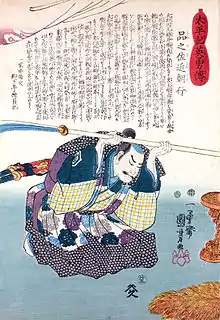 Shima Sakon | |
| Other name(s) | Shima Kiyooki, Shima Tomoyuki, Shima Katsutake |
| Born | June 9, 1543 Yamato province, Japan |
| Died | October , 1600 |
| Allegiance |  Tsutsui clan Tsutsui clan Toyotomi clan Toyotomi clan Western Army Western Army |
| Commands held | Tsutsui Junkei Toyotomi Hideyoshi Ishida Mitsunari |
| Battles/wars | Siege of Hijiyama Battle of Komaki-Nagakute Kyushu Campaign Battle of Kuisegawa Battle of Sekigahara |
| Relations | Shima Matsukatsu (father) |
Biography
He was born in the Yamato province to Shima Matsukatsu, Sakon became one of the two primary officers under Tsutsui Junkei alongside Matsukura Shigenobu.
In 1586, after the death of Junkei, Sakon was convinced to serve the Toyotomi under Toyotomi Hidenaga (Hideyoshi’s brother) at Kyushu Campaign.
In 1598, after Hideyoshi's died, Ishida Mitsunari recruited him into his army as a leading strategist. Sakon proceeded to help Mitsunari as he struggled against Tokugawa Ieyasu.
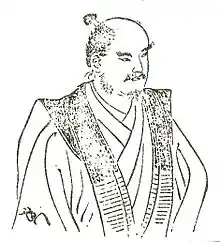
Battle of Sekigahara
In 1600, a few days before the battle of Sekigahara, Sakon led an assault on Ieyasu’s Eastern army at Kuisegawa with great success. As always, he was one of the bravest generals of Ishida Mitsunari on the battlefield. Later at the Battle of Sekigahara, Shima served as one of Ishida's higher-ranking officers, commanding a unit of 1,000 men. Some sources suggest Shima led musketmen and that his position had cannons. He fought against Hosokawa Tadaoki and was shot by riflemen led by Kuroda Kanbei's son Nagamasa, forcing him to retreat. His fourth son, Shima Kiyomasa within Yoshitsugu's ranks, killed by an 'Eastern' samurai named Takagi Heizaburō. His fate remains somewhat of a mystery since he or his body was not on the battlefield after the battle. Some say he died of his wounds after the battle or escaped and died a few years later.
References
- "デジタル版 日本人名大辞典+Plus「島清興」の解説". Kotobank. Retrieved 15 December 2021.
External links
