Shinshi
In Shinto, an animal is a messenger of Kami, or a member of Kami's family who is considered to be in contact with this world on behalf of Kami's will. The animals are also called "messengers of the gods," "tsukawasame," or misaki. Sometimes, they are considered to be gods themselves. The animals that have been the subject of this study range from mammals to birds, reptiles, and imaginary creatures.
The story of a particular animal transmitting the will of a god can be found in Japanese mythology. In the account of Emperor Keikō in Nihon Shoki, it is said that the Mount Ibuki god Araburukami appeared to Yamato Takeru in the form of a serpent, and that Takeru said, "The serpent must be a messenger of Araburukami." The Empress of the Chronicles of Japan In the Empress Kōgyoku of the Chronicles of Japan (4th year, New Year's article), there is a description of a monkey that could not be seen, but was heard crying, and people believed it to be a messenger of the great god Ise, and judged good or bad fortune by its voice. In the same Emperor Sujin account, Omononushi himself visits his wife in the form of a snake.[1]
In Fusō Sakki, a book published in the middle of the Heian, it is said that a person who shot and killed a white fox (shiratoume) in the vicinity of the Ise Shrine was exiled to the region, suggesting that there was a belief in spiritual foxes in ancient times.[2]
As time went on, the animals that were regarded as divine messengers became fixed based on the mythological descriptions of the deity or the auspiciousness of the shrine, and were even raised within the precincts of the shrine. In addition, animals that were originally divine messengers, such as the fox at Inari Shrine, came to be worshipped. It is thought that the animals themselves were seen as spiritual beings of some kind, irrespective of the gods.
Some of the animals that are considered to be divine messengers include:
| Animal | God |
|---|---|
| Mouse | Daikokuten |
| Cattle | Tenmangū See Tenjin worship. |
| Tiger | Chōgosonshi-ji |
| Wasp | Futarasan Shrine |
| Rabbit | Sumiyoshi-taisha・岡崎神社・調神社 |
| Turtle | Matsunoo Taisha |
| Crab | Kotohira-gū |
| Unagi | Mishima Taisha |
| Snake | Benzaiten・Ōmiwa Shrine |
| Sea snake | Izumo-taisha |
| albino Japanese rat snake | Suwa Shrine |
| Fox | Inari shrine ※Inari Ōkamiを参照のこと。 |
| Deer | Kasuga-taisha・Kashima Shrine |
| Monkey | Hiyoshi Taisha・Asama shrine |
| Crow | 熊野三山・Itsukushima Shrine |
| Crane | Suwa-taisha |
| Columba | Hachiman |
| Heron | Kehi Shrine |
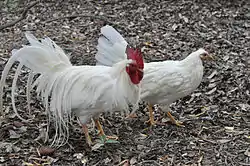
| Chicken | Ise Grand Shrine・Atsuta Shrine・Isonokami Shrine |
| Wolf | 武蔵御嶽神社・三峰神社など奥多摩・秩父地方の神社 |
| Common carp | Omae Shrine |
| Wild boar | Goō Shrine・和気神社 |
| Centipede | Vaiśravaṇa |
Gallery
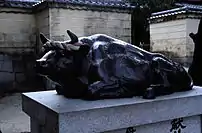 Reclining Cow Statue (Dazaifu City, Dazaifu Tenmangu Shrine)
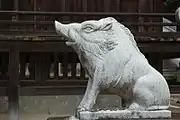 Guardians (Wake Shrine, Wake Town)
 Reclining Cow Statue (Domyoji Tenmangu Shrine, Fujiidera City, Osaka Prefecture)
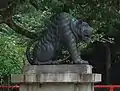 A-Un Tiger (Kuramadera, Kyoto City)
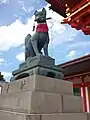 Statue of Inari (Fushimi Inari Taisha, Kyoto City)
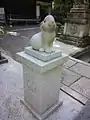 Koma rabbit (Okazaki Shrine, Kyoto City)
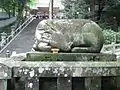 Statue of a deer (Higashiosaka City, Hiraoka Shrine)
 Yatagarasu Post (Kumano Hongu Taisha Shrine, Tanabe City)
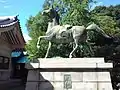 Statue of a sacred horse (Ookami Shrine, Ichinomiya City)
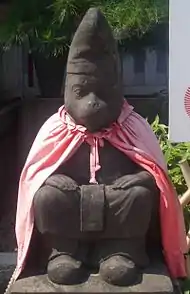 Statue of Monkey God (Hie Shrine, Tokyo)
References
- 箸墓古墳#名の由来 参照
- 関裕二 『寺社が語る秦氏の正体』 祥伝社新書 2018年 ISBN 978-4-396-11553-1 p.38.