Gondola (rail)
In US railroad terminology, a gondola is an open-topped rail vehicle used for transporting loose bulk materials. Because of their low side walls, gondolas are also suitable for the carriage of such high-density cargos as steel plates or coils, or of bulky items such as prefabricated sections of rail track.
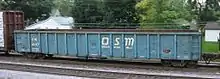
In Australia these wagons are called open wagons.
History
Before the opening of the Baltimore & Ohio Railroad and the Chesapeake & Ohio Canal in Harpers Ferry, Virginia (now West Virginia), considerable amounts of coal were carried via the Potomac River. Since timber was an abundant resource, flat boats, called "gondolas" (a spoof on Venetian rowing boats), were constructed to navigate the "black diamonds" downriver to markets around Washington, DC. There, both the boat and cargo were sold and the boatmen returned home by foot. The railroad cars first employed in the haulage of coal were thus named after these shallow-draft boats called "gondola cars".
Specialized car types
Gondolas as open observation cars
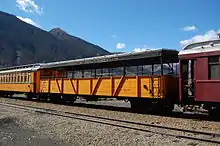
Open observation gondolas are gondolas changed into open observation cars
"Bathtub" gondolas
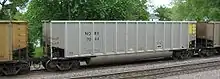
In the second half of the 20th century, coal haulage shifted from open hopper cars to high-sided gondolas. Using a gondola, the railroads are able to haul a larger amount of coal per car since gondolas do not include the equipment needed for unloading. However, since these cars do not have hatches for unloading the products shipped in them, railroads must use rotary car dumpers (mechanisms that hold a car against a short section of track as the car and track are slowly rotated upside down to empty the car) or other means to empty them. The term "bathtub" refers to the shape of the car.
The "Double Rotary" coal gondola is required in this consist. The "Double Rotary" referring to this car that has rotary couplers on both ends instead of one end.
Track ballast gondolas
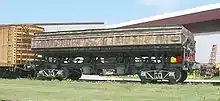
Track ballast gondolas carry ballast. These gondolas are side tipping.
See also
References
- Chaldron wagon Archived 2008-12-08 at the Wayback Machine
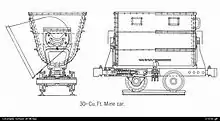
- "30-Cu. Ft. Mine car". Archived from the original on 2011-07-17. Retrieved 2010-10-13.


Sources
- doublestackinter Archived May 18, 2006, at the Wayback Machine
- Origin of name Archived October 7, 2007, at the Wayback Machine
- Origin of name