Singapore–United States relations
Relations between Singapore and the United States began in the early 19th century when American merchants began visiting the port of Singapore.[1][2]
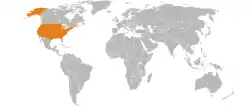 | |
 Singapore |
 United States |
|---|---|
| Diplomatic mission | |
| Embassy of Singapore, Washington, D.C. | Embassy of the United States, Singapore |
| Envoy | |
| Singapore Ambassador to the United States Ashok Mirpuri | United States Ambassador to Singapore Rafik Mansour (Chargé d'affaires) |

According to the U.S. Global Leadership Report, 77% of Singaporeans approved of U.S. leadership under the Obama Administration in 2010, and while this approval rating decreased slightly down to 75% in 2011, it nonetheless remains one of the highest ratings of the U.S. for any surveyed country in the Asia-Pacific region. Likewise, most Americans generally perceive Singapore and Singaporeans positively.[3]
In recent years, Singapore's Prime Minister Lee Hsien Loong has enjoyed cordial relations with U.S. Presidents George W. Bush, Barack Obama, Donald Trump and Joe Biden, with several meetings in the United States, Singapore and other international conferences, most recently at the 2018 North Korea–United States Singapore Summit.
History
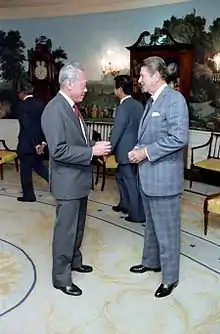
The United States first opened a consulate in Singapore in 1836, when the island was part of the Straits Settlements of the British Empire. Singapore and the United States have maintained formal diplomatic relations since the independence of Singapore in 1965.[2] Singapore's efforts to maintain economic growth and political stability and its support for regional cooperation harmonize with U.S. policy in the region and form a solid basis for amicable relations between the two countries.[4]}}
Hendrickson affair
E. Mason "Hank" Hendrickson was serving as the First Secretary of the United States Embassy when he was expelled by the Singaporean government in May 1988.[5][6][7] Prior to his expulsion, he arranged for Francis Seow and Patrick Seong to travel to Washington, D.C. to meet with American officials at Hendrickson's arrangement.[8] After their return, Singapore detained them under the Internal Security Act.[9] Based on Seow and Seong's statements while in custody, the Singaporean government alleged that Hendrickson attempted to interfere in Singapore's internal affairs by cultivating opposition figures in a "Marxist conspiracy".[8] Then-First Deputy Prime Minister Goh Chok Tong claimed that Hendrickson's alleged conspiracy could have resulted in the election of 20 or 30 opposition politicians to Parliament, which in his words could lead to "horrendous" effects, possibly even the paralysis and fall of the Singaporean government.[9]
In the aftermath of Hendrickson's expulsion, the U.S. State Department praised his performance in Singapore and denied any impropriety in his actions.[5] The State Department also expelled Robert Chua, a senior-level Singaporean diplomat equal in rank to Mason, from Washington, D.C. in response.[10][11] The State Department's refusal to reprimand Hendrickson, along with their expulsion of the Singaporean diplomat, sparked a protest in Singapore by the National Trades Union Congress; they drove buses around the U.S. embassy, held a rally attended by four thousand workers, and issued a statement deriding the U.S. as "sneaky, arrogant, and untrustworthy".[12]
A Heritage Foundation paper speculated that Singapore's angry public reaction to the Hendrickson affair may have been a response to the January 1988 termination of Singapore's eligibility for the Generalized System of Preferences, which provided tariff exemptions on Singaporean exports to the United States. This was reversed a few years later as relations improved again.[10]
Singapore–United States Free Trade Agreement
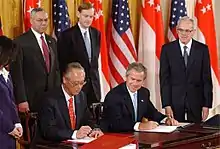
Relations in the early 2000s were significantly improved which culminated when Singapore and the United States signed a bilateral free trade agreement on 6 May 2003; the agreement entered into force on 1 January 2004. The growth of U.S. investment in Singapore and the large number of Americans living there enhance opportunities for contact between Singapore and the United States. Singapore is a Visa Waiver Program (VWP) country, one of the only four countries in Asia in the program. Today, large numbers of American and Singaporean expatriates live and work in each other's countries due to the relatively easy freedom of movement established between the two countries.[4]
In addition to lowering of tariffs, the agreement also allowed easier movement of citizens from both countries. With its implementation, it became possible for Singaporean citizens to reside in the United States for extended periods of time. Business people and traders with an E-1 or E-2 visa are allowed a two-year stay period with an indefinite extension allowed.
Furthermore, Professionals with a H-1B1 visa (also known as H-1B1-Singapore) are allowed to stay for a maximum period of up to 18 months with also the possibility of an indefinite extension. This visa was specifically created for Singaporeans, and there is an annual priority quota of 5,400 visas, but this quota has yet to be reached to date. Any unused quota is transferred to the general pool for use by citizens of other countries.[13]
United States citizens coming to Singapore are also allowed to work in most business occupations for 3 months without a visa or a "Professional Visit Pass".[14]
2018 North Korea–United States Singapore Summit

The latest high profile meeting between the two countries was held on 11 June 2018 between Prime Minister Lee Hsien Loong and President Donald Trump at the The Istana, the official residence and office of the President of Singapore and also the working office of the Prime Minister of Singapore, before meeting Supreme Leader of North Korea Kim Jong Un the next day at the Capella Hotel, Sentosa, Singapore.[15] At the time, Singapore was chosen for its neutrality in geopolitical affairs, as it had diplomatic relations with both the United States and North Korea, and was one of the few countries that have relationships with both countries.[16]
The summit meeting between North Korean Chairman Kim Jong-un and U.S. President Donald Trump was the first-ever meeting between leaders of North Korea and the United States.[17]
Fields of relations
During the Asean Summit of 2015 when US President Barack Obama met Singapore Prime Minister Lee Hsien Loong, Obama described the state of bilateral relations as being "very, very strong".[18]
Free trade agreement
The United States and Singapore signed a bilateral free trade agreement on 6 May 2003; the agreement entered into force on 1 January 2004. The growth of U.S. investment in Singapore and the large number of Americans living there enhance opportunities for contact between Singapore and the United States. Singapore is a Visa Waiver Program country.[4]
Military relations
.jpg.webp)
_leads_a_formation_followed_by_the_Republic_of_Singapore_Navy_(RSN)_frigate_RSS_Formidable_(FFS_68)_(48826767583).jpg.webp)
Singapore has long standing military relations with the United States. The United States sells arms to Singapore and provides access to its bases to train the Singaporean armed services outside of their small city-state.[19] Under the U.S.–Singapore Strategic Framework Agreement, some U.S. Navy littoral combat ships are rotationally deployed to Singapore's Changi Naval Base.[20] Air Force One also lands at Paya Lebar Air Base whenever the president visits the country. On September 23, 2019, Prime Minister Lee Hsien Loong and US President Donald Trump renewed a key defence pact which allows American forces to use Singapore's air and naval bases, extending it by another 15 years to 2035.[21]
Relief operations
Following that devastation of the United States Gulf Coast by Hurricane Katrina, three Singaporean CH-47 Chinook helicopters and thirty-eight RSAF personnel from a training detachment based in Grand Prairie, Texas, assisted in relief operations from 1 September. They ferried about 700 evacuees and hauled tons of supplies in 39 sorties on 4 September. One more CH-47 Chinook helicopter was sent to aid in relief efforts.[22][23]
Academic exchanges
In 2011, more than 4,300 Singaporeans were studying in the United States, the highest figure in 10 years. The number of Singaporean students studying in the United States grew by 7 percent since 2010. American universities with the most number of Singaporeans are among the most prestigious in the country which includes Harvard University, Cornell University, Stanford University, and University of California, Berkeley. To add to the rising number of college students study in the United States, many local students in Singapore have also opted to study in American High Schools. US Ambassador to Singapore David I. Adelman said that the high number of Singaporeans studying in the United States reflects that Singapore–United States relations "have never been better".[24]
In 2012, Singapore and the United States signed a Memorandum of Understanding (MOU) to enhance collaboration in education between the two countries. This is the second MOU between the United States and Singapore on education. The first MOU signed in 2002 primarily focused on the teaching and learning of the Singaporean method of Mathematics and Science. The 2012 MOU have enhanced the teaching of Mathematics and Science, teacher development and school leadership, and educational research and benchmarking studies. In addition, the conference also announced that the National Institute of Education (NIE) in Singapore and Columbia University's Teachers College are launching a joint Masters of Arts in Leadership and Educational Change. This joint Masters programme will take in up to 30 students from January 2013.[25]
The U.S. government sponsors visitors from Singapore each year under the International Visitor Leadership Program (IVLP). The U.S. Government provides Fulbright Awards to enable selected American professors to teach or conduct research at the National University of Singapore and the Institute of Southeast Asian Studies. It awards scholarships to outstanding Singaporean students for graduate studies at American universities and to American students to study in Singapore. The U.S. government also sponsors occasional cultural presentations in Singapore. The East-West Center and private American organizations, such as the Asia Foundation and Ford Foundation, also sponsor exchanges involving Singaporeans.[4]
Diplomatic representation
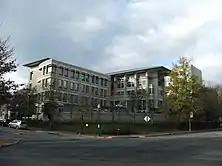
Singapore's chief diplomatic mission to the United States is the Singaporean Embassy in Washington, D.C. It is further supported by many consulates located through the United States. The Singaporean Government maintains consulates-general in several major U.S. cities including: Chicago, Miami, Houston, New York City[note 1] and San Francisco.[26]
The current Singaporean ambassador to the United States is Ashok Mirpuri.[26] Former United States Ambassador to Singapore, Steven J. Green, is the Honorary Consul in Miami while the Former Chairman of the Federal Communications Commission, Newton N. Minow, is the Honorary Consul in Chicago.[27][28]
The United States first opened a consulate in Singapore, then part of the British Straits Settlements, in 1836, appointing Joseph Balestier to the post of consul. The American embassy in Singapore was established on 4 April 1966, under chargé d'affaires ad interim Richard H. Donald.[2] Kirk Wagar most recently served as the U.S. Ambassador to Singapore from September 2013 to January 2017.[29][30]
Since the Trump administration, the United States has yet to appoint a new ambassador to Singapore. Former deputy US National Security Adviser K. T. McFarland was reportedly offered the ambassadorship,[31] but withdrew her nomination citing differences with the Trump administration. In September 2019, Trump nominated Barbera Hale Thornhill, president of Impact Design, a business-focused interior design firm in Los Angeles, California, as ambassador.[32] She too was never confirmed and withdrawn by his successor Joe Biden in February 2021.[33]
See also
Notes
References
 This article incorporates public domain material from the United States Department of State website https://www.state.gov/countries-areas/. (U.S. Bilateral Relations Fact Sheets)
- "History of the U.S. and Singapore". U.S. Embassy in Singapore. Archived from the original on 13 August 2020. Retrieved 13 August 2020.
- U.S. State Dept. 2011
- U.S. Global Leadership Project Report - 2011 Archived 2015-09-24 at the Wayback Machine Gallup
- U.S. State Dept. 2009
Cold War and Lee Kuan Yew era
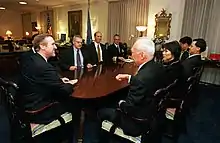 U.S. Secretary of Defense William S. Cohen meets with Lee Kuan Yew (now a Senior Minister) in the Pentagon on February 29, 2000.{{cquote|It is inherent in America's position as the preeminent economic, political and military power to have to settle and uphold the rules for orderly change and progress... In the interests of peace and security America must uphold the rules of international conduct which rewards peaceful cooperative behaviour and punishes transgressions of the peace. A replay of the depression of the 1930s, which led to World War II, will be ruinous for all. All the major powers of the West share the responsibility of not repeating this mistake. But America's is the primary responsibility, for she is the anchor economy of the free market economies of the world.|30px|30px|Prime Minister Lee Kuan Yew, United States Congress, Washington, D.C., 9 October 1985.<ref name="Dinner at the White House">"Dinner at the White House". The Straits Times. Archived from the original on 3 August 2020. Retrieved 27 April 2020.
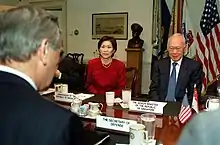 Lee Kuan Yew and U.S. Secretary of Defense Donald H. Rumsfeld (foreground) in the Pentagon on May 2, 2002, discussing the war on terrorism after the September 11 attacks which happened a few months prior
 - Crossette, Barbara (1988-05-08), "Singapore Asks Removal of U.S. Envoy", The New York Times, archived from the original on 2014-08-08, retrieved 2010-03-03
- Rogers 2002, p. 131
- American Ambassador to Azerbaijan Anne E. Derse, USAID, 2007-07-06, archived from the original on 2009-05-17, retrieved 2010-03-03
- Bellows 1989
- "Hendrickson affair angers local leaders", New Sunday Times, 1988-05-10, archived from the original on 2020-06-05, retrieved 2010-03-11
- Conboy 1989
- "What Lee said in 1964", The Economist, 1988-05-14, archived from the original on 2012-11-05, retrieved 2011-03-17
- "Singapore: Thousands Protest Expulsion", Eugene Register Guard, 1988-05-12, archived from the original on 2020-06-05, retrieved 2010-03-03
- "Free Trade Agreements | Enterprise Singapore". www.enterprisesg.gov.sg. Archived from the original on 2019-03-27. Retrieved 2019-03-27.
- "Free Trade Agreements | Enterprise Singapore". www.enterprisesg.gov.sg. Archived from the original on 2019-03-27. Retrieved 2019-03-27.
- "Trump says US-North Korea summit 'can work out very nicely', thanks PM Lee for hospitality". Archived from the original on 2020-09-20. Retrieved 2018-06-11.
- Lee, Yen Nee (June 8, 2018). "White House explains why it chose Singapore to host summit with North Korea". CNBC. Archived from the original on June 12, 2018. Retrieved June 12, 2018.
- "Joint Statement of President Donald J. Trump of the United States of America and Chairman Kim Jong Un of the Democratic People's Republic of Korea at the Singapore Summit". The White House. June 12, 2018. Archived from the original on September 4, 2018. Retrieved February 28, 2019.
- "The Straits Times – Singapore-US ties 'very, very strong': Obama". Government of Singapore. Archived from the original on 26 November 2015. Retrieved 25 November 2015.
- Brabenec, James (2010-11-24), "Singaporeans get HIMARS qualified.", GlobalSecurity.org, retrieved 2011-03-17
- Tomkins, Damien (8 June 2011), "US Reaffirms Asia Role", The Diplomat, retrieved 2011-09-05
- Yong, Charissa (2019-09-24). "PM Lee, Trump renew key defence pact on US use of Singapore air, naval bases". the Straits Times. Retrieved 27 September 2019.
- "Helicopter Operations: Hurricane Katrina". helis.com. 6 September 2005.
- "Singapore Red Cross Launches a Public Appeal to Help Victims of Hurricane Katrina". Singapore Red Cross. 6 September 2005.
- "Singaporean student numbers at US varsities hit 10-year high". Retrieved 11 February 2012.
- "Channel Newsasia". Retrieved 11 February 2012.
- Ambassador CHAN Heng Chee, Washington, D.C.: Singapore Embassy, archived from the original on 2010-01-08, retrieved 2010-03-12
- Washington Homepage
- "Consulates in the United States". Singapore Embassy. Archived from the original on 2007-06-12. Retrieved 2007-05-27.
- Kirk Wagar, archived from the original on 2016-12-20, retrieved 2016-12-16
- Bittersweet farewell for US ambassador to Singapore Kirk Wagar, hours before Trump's inauguration Archived 2017-04-11 at the Wayback Machine. MSN. 2017-01-20. Retrieved 2017-04-10.
- McFarland reportedly offered Singapore ambassador post. The Hill. 2017-04-01. Retrieved 2014-04-10.
- "President Donald J. Trump Announces Intent to Nominate and Appoint Personnel to Key Administration Posts". whitehouse.gov. Washington DC. 19 September 2019. Retrieved 21 September 2019 – via National Archives.
- Yong, Charissa (5 February 2021). "Biden withdraws Trump pick for US ambassador to Singapore". The Straits Times. Retrieved 22 May 2021.
Further reading
| Library resources about Singapore–United States relations |
- Bellows, Thomas J. (February 1989), "Singapore in 1988: The Transition Moves Forward", Asian Survey, 29 (2): 145–153, doi:10.1525/as.1989.29.2.01p0242q, JSTOR 2644574
- Chua, Daniel Wei Boon, "Becoming a `Good Nixon Doctrine Country': Political Relations between the United States and Singapore during the Nixon Presidency," Australian Journal of Politics and History 60 (Dec. 2014), 534–48.
- Conboy, Kenneth J. (January 1989), "Opportunities for Bush to Bolster the U.S.-Singapore Relationship" (PDF), Asian Studies Backgrounder, 86, retrieved 2010-03-03
- Background Note: Singapore, Bureau of East Asian and Pacific Affairs, Department of State, September 2009, retrieved 2010-03-11
- "Singapore", A guide to the United States' history of recognition, diplomatic, and consular relations, by country, since 1776, Office of the Historian, U.S. Department of State, 2011, retrieved 2011-09-05
External links
 Media related to Relations of Singapore and the United States at Wikimedia Commons
| Africa |  | |
|---|---|---|
| Americas | ||
| Asia | ||
| Europe | ||
| Oceania | ||
| International organisations |
| |
| Treaties |
| |
| Related topics | ||
| |||||||||||||||||||||||||||||||||||||||||||||||||||||||||||||
| |||||||||||||||||||||||||||||||||||||||||||||||||||||||||||||
| |||||||||||||||||||||||||||||||||||||||||||||||||||||||||||||