Single displacement reaction
A single-displacement reaction, also known as single replacement reaction or exchange reaction, is a chemical reaction in which one element is replaced by another in a compound.[1][2][3]
It can be represented generically as:

where either


This will most often occur if is more reactive than , thus giving a more stable product. The reaction in that case is exergonic and spontaneous.
In the first case, when and are metals, and are usually aqueous compounds (or very rarely in a molten state) and is a spectator ion (i.e. remains unchanged).[1]



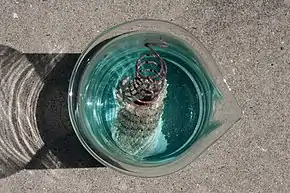
Participation in single-displacement reactions is determined by ionization energies: metals with the least ionization energy (easiest to ionize) tend to displace more electron-affine species. A tabulation of metals' relative propensity to release electrons is called a reactivity series. Traditionally, a reactivity series lists low–ionization-energy metals before high–ionization-energy ones, such as in the following list of common cations:[1]
- (Hydrogen, carbon and ammonium — labeled in gray — are not metals.)

Similarly, the halogens with the highest propensity to acquire electrons are the most reactive. The activity series for halogens is: [1][2][3]

Due to the free state nature of and , single displacement reactions are also redox reactions, involving the transfer of electrons from one reactant to another.[4] When and are metals, is always oxidized and is always reduced. Since halogens prefer to gain electrons, is reduced (from to ) and is oxidized (from to ).


Cation replacement
Here one cation replaces another:
(Element A has replaced B in compound BC to become a new compound AC and the free element B.)
Some examples are:
-
- (Blue vitriol)____(Green vitriol)

-
- (Blue vitriol)___(White vitriol)

-
- (Green vitriol) (White vitriol)

These reactions are exothermic and the rise in temperature is usually in the order of the reactivity of the different metals.[5]
If the reactant in elemental form is not the more reactive metal, then no reaction will occur. Some examples of this would be the reverse.
- No Reaction

| External video | |
|---|---|
 https://www.youtube.com/watch?v=yWcSzvJ6Kcw https://www.youtube.com/watch?v=yWcSzvJ6Kcw | |
| https://www.youtube.com/watch?v=gqSXWbS6gzo | |
| https://www.youtube.com/watch?v=gqGrpd5smtI |
Anion replacement
Here one anion replaces another:

(Element A has replaced B in the compound CB to form a new compound CA and the free element B.)
Some examples are:


Again, the less reactive halogen cannot replace the more reactive halogen:
- no reaction

Common reactions
Metal-acid reaction
Metals react with acids to form salts and hydrogen gas.
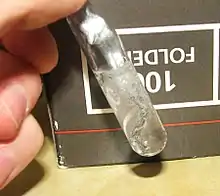

However less reactive metals can not displace the hydrogen from acids.[3] (They may react with oxidizing acids though.)
- No reaction

Reaction between metal and water
Metals react with water to form metal oxides and hydrogen gas. The metal oxides further dissolve in water to form alkalies.


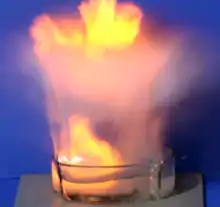
The reaction can be extremely violent with alkali metals as the hydrogen gas catches fire.[2]
Metals like gold and silver, which are below hydrogen in the reactivity series, do not react with water.
| External video | |
|---|---|
| https://www.youtube.com/watch?v=oqMN3y8k9So | |
| https://www.youtube.com/watch?v=u_1uLP30uxY |
Metal extraction
Coke or more reactive metals are used to reduce metals from their metal oxides,[6] such as in the carbothermic reaction of zinc oxide (zincite) to produce zinc metal:

and the use of aluminium to produce manganese from manganese dioxide:

Even for reactions that run in the direction opposite of their intrinsic reactivities, displacement can be driven to occur, as in the Acheson process for displacing silicon from silicon dioxide using carbon:

Thermite reaction
Using highly reactive metals as reducing agents leads to exothermic reactions that melt the metal produced. This is used for welding railway tracks.[6]
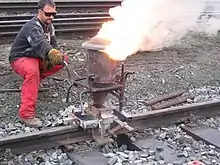

a(Haematite)

Silver tarnish
Silver tarnishes due to the presence of hydrogen sulfide, leading to formation of silver sulfide.[7][2]

Its removal also involves a displacement reaction.[7]

Halogen extraction


See also
References
- "Single replacement reactions". Khan Academy.
- "Single Replacement Reactions". Chemistry LibreTexts. 2016-06-27.
- "Types of Chemical Reactions: Single- and Double-Displacement Reactions". courses.lumenlearning.com.
- Silberberg. Chemistry, the Molecular Nature of Matter and Change, 4th ed. p. 150 McGraw Hill 2006.
- "Exothermic metal displacement reactions". RSC Education. Nuffield Foundation.CS1 maint: others (link)
- "Displacement reactions of metal oxides". BBC Bitesize.
- JCE staff (2000-03-01). "Silver to Black - and Back". Journal of Chemical Education. 77 (3): 328A. doi:10.1021/ed077p328A. ISSN 0021-9584.