Sir John Marsham, 1st Baronet
Sir John Marsham, 1st Baronet (23 August 1602 – 25 May 1685) was an English antiquary known as a writer on chronology. He was also a chancery clerk and politician who sat in the House of Commons from 1660 to 1661.
Sir John Marsham, 1st Baronet | |
|---|---|
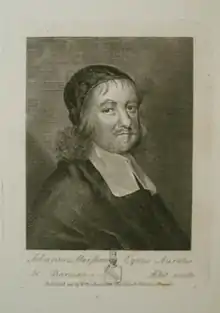 Copper engraving of Marsham, Johannes Marsham Eques Auratus | |
| Born | 23 August 1602 |
| Died | 25 May 1685 (aged 82) |
| Occupation | clerk, Member of Parliament |
| Known for | chronologist |
Life
Marsham was second son of Thomas Marsham, alderman of London, by Magdalen, daughter of Richard Springham, a London merchant. After attending Westminster School he matriculated at St John's College, Oxford, on 22 October 1619; he graduated B.A. on 17 February 1623, M.A. on 5 July 1625. He spent the winter of 1625 in Paris. In 1626 and 1627 he travelled in France, Italy, and Germany, and then returned to London, where he became a member of the Middle Temple in 1627. In 1629 he went through Holland and Gelderland to the siege of 's-Hertogenbosch in Brabant; and then by Flushing to Boulogne and Paris in the retinue of Sir Thomas Edmondes, ambassador extraordinary at the court of Louis XIII.[1]
Marsham was made one of the six clerks in chancery on 15 February 1638. On the outbreak of the First English Civil War he followed the king to Oxford, and was consequently deprived of his place by Parliament. After the surrender of Oxford he returned to London (1646), and having compounded for his estate, he lived in retirement at his seat of Whorn Place, in the parish of Cuxton, Kent. [1]
In April 1660, Marsham was elected a Member of Parliament (MP) for Rochester in the Convention Parliament.[2] At the Restoration, he was restored to his place in chancery, and was knighted. On 12 August 1663 he was created a baronet. He was allowed to hand over his clerkship to his son Robert on 20 October 1680. [1]
Marsham died at Bushey Hall, Hertfordshire, on 25 May 1685, and was buried in Cuxton Church. By Elizabeth (1612–1689), daughter of Sir William Hammond of St. Albans Court in Nonington, Kent, he had two sons, John and Robert, and a daughter Elizabeth. He was succeeded initially by the eldest son John, who purchased the Mote in Maidstone and who died in 1692 when High Sheriff of Kent, but when John's own son John died young the baronetcy and Mote estate reverted to Robert.[1]
Works
Marsham had a reputation in his day for his knowledge of history, chronology, and languages. According to Wotton, Marsham was the first who made Egyptian antiquities intelligible. Hallam also commended his work.[1]
He wrote Diatriba Chronologica, London, 1649, a dissertation in which he examined difficulties in the chronology of the Old Testament. Most of it was afterwards inserted in his more elaborate Chronicus Canon Ægypticus, Ebraicus, Græcus, et disquisitiones, London, 1672, a beautifully printed book (other editions, 4to, Leipzig, 1676, and 4to, Franeker, 1699, but both inaccurate). He wrote also the preface to the first volume of Roger Dodsworth and William Dugdale's Monasticon Anglicanum (1655), which is entitled Propylaion Johannis Marshami; it is a complex survey of English monasticism.[3]
He left unfinished Canonis Chronici liber quintus: sive Imperium Persicum, De Provinciis et Legionibus Romanis, De re nummaria, and other treatises. His nephew Thomas Stanley dedicated to him his History of Philosophy (1655). [1]
| Baronet of Cuckston (1663) | |||||||||||||||||||||||||||||||||||||||||||||||
| Robert Sidney (1595–1677) Earl of Leicester | John Marsham (1602–1685) 1st Baronet of Cuckston | ||||||||||||||||||||||||||||||||||||||||||||||
| Earls of Romney 1st creation (1694) | |||||||||||||||||||||||||||||||||||||||||||||||
| Dorothy Spencer Countess of Sunderland (1617–1684) | Philip Sidney Earl of Leicester (1619–1698) | Algernon Sidney (1623–1683) | Lady Lucy Sidney (1630–1685) | Henry Sydney (1641–1704) 1st Earl of Romney | John Marsham (1637–1692) 2nd Baronet of Cuckston | ||||||||||||||||||||||||||||||||||||||||||
| Thomas Pelham (1653–1712) | Horatio Townshend 1st Viscount Townshend | John Marsham (1679–1696) 3rd Baronet of Cuckston | |||||||||||||||||||||||||||||||||||||||||||||
| Elizabeth Pelham (1681–1711) | Charles Townshend 2nd Viscount Townshend | Robert Marsham (1650–1703) 4th Baronet of Cuckston | |||||||||||||||||||||||||||||||||||||||||||||
| Baron Romney (1716) | |||||||||||||||||||||||||||||||||||||||||||||||
| Thomas Townshend (1701–1780) | Robert Marsham (1685–1724) 5th Baronet of Cuckston 1st Baron Romney from 1716 | ||||||||||||||||||||||||||||||||||||||||||||||
| Thomas Townshend (1733–1800) Viscount Sydney | Robert Marsham (1712–1794) 2nd Baron Romney | ||||||||||||||||||||||||||||||||||||||||||||||
| Earls of Romney 2nd creation (1801) | |||||||||||||||||||||||||||||||||||||||||||||||
| John Townshend (1764–1831) Viscount Sydney | Charles Marsham (1744–1811) 3rd Baron Romney Viscount Marsham from 1801 1st Earl of Romney from 1801 | ||||||||||||||||||||||||||||||||||||||||||||||
| Mary Elizabeth Marsham (1794–1847) | Charles Marsham (1777-1845) 2nd Earl of Romney Viscount Marsham | ||||||||||||||||||||||||||||||||||||||||||||||
| Charles Marsham (1808–1874) 3nd Earl of Romney Viscount Marsham | |||||||||||||||||||||||||||||||||||||||||||||||
| Charles Marsham (1841–1905) 4th Earl of Romney Viscount Marsham | |||||||||||||||||||||||||||||||||||||||||||||||
| Charles Marsham (1864–1933) 5th Earl of Romney Viscount Marsham | Reginald Hastings Marsham (1865–1922) | Sydney Edward Marsham (1879-1952) | |||||||||||||||||||||||||||||||||||||||||||||
| Charles Marsham (1892–1975) 6th Earl of Romney Viscount Marsham | Michael Marsham (1910–2004) 7th Earl of Romney Viscount Marsham | Peter William Marsham | |||||||||||||||||||||||||||||||||||||||||||||
| Julian Marsham (1948–present) 8th Earl of Romney Viscount Marsham | |||||||||||||||||||||||||||||||||||||||||||||||
| David Charles Marsham (1977–present) Viscount Marsham (heir apparent) | |||||||||||||||||||||||||||||||||||||||||||||||
| James Julian Marsham (2014–present) | |||||||||||||||||||||||||||||||||||||||||||||||
References
- Goodwin 1893.
- History of Parliament Online - Marsham John
- David C. Douglas, English Scholars (1939), p. 42.
- Attribution
 This article incorporates text from a publication now in the public domain: Goodwin, Gordon (1893). "Marsham, John". In Lee, Sidney (ed.). Dictionary of National Biography. 36. London: Smith, Elder & Co.
Authority control  | |
|---|---|
| General | |
| National libraries | |
| Other | |