Sir Nigel Gresley, 6th Baronet
Sir Nigel Gresley, 6th Baronet (11 January 1726 – 7 April 1787) was an English land-owner, mine-owner and the builder of Sir Nigel Gresley's Canal.
Sir Nigel Gresley | |
|---|---|
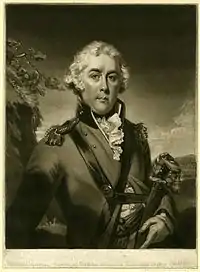
.jpg.webp) Sir Nigel Gresley by Henry Pickering | |
| Born | 11 January 1726 |
| Died | 7 April 1787 |
| Burial place | Bath Abbey |
| Known for | Sir Nigel Gresley's Canal |
Life
Gresley was the son of Sir Thomas Gresley, 4th Baronet, and his first wife Dorothy Bowyer, daughter of Sir William Bowyer, 4th Baronet. He was born on 11 January 1726 at Drakelow Hall and was baptised on 29 January. He joined the Royal Naval Academy as a scholar on 21 February 1740 and stayed there until 1744.[1] At the end of 1746 his ship (posited as HMS Furnace, HMS Bridgewater, or HMS Royal Sovereign) transported the rebel Flora MacDonald to London. Gresley, who was suggested to be a quiet supporter of the Jacobites, was gifted a portrait of herself by MacDonald.[2] He became a lieutenant on 22 April 1748 and served on the 22-gun frigate HMS Inverness until she was paid off on 14 November.[1] He did not serve again in the Royal Navy, probably due to ill health, and declined a position on the 24-gun frigate HMS Mercury in 1749 or 1750.[2]
Gresley then succeeded his elder brother Sir Thomas Gresley, 5th Baronet as baronet on 23 December 1753 when he died of smallpox without issue.[1] As well as Drakelow in Derbyshire, Gresley inherited from his mother's family Knypersley Hall at Biddulph, Staffordshire. Drakelow was inhabited by Dame Wilmot Gresley, and so Gresley lived at Knypersley. He became High Sheriff of Staffordshire in 1759. In 1765 he and his family moved from Knypersley to Worcester both to allow his children better access to education and to help Gresley lessen the weight of some debts.[2] He subsequently sold Knypersley in 1767 in a further effort to combat his debts.[3]
Gresley owned coal mines at Apedale in Staffordshire, and as an early patron of the engineer James Brindley he had him build a water engine for draining the mines there in 1752.[2] In 1773 an Act of Parliament was passed allowing him to build a canal from Apedale to Newcastle-under-Lyme so that he could more easily transport the mine's products of coal and ironstone.[4] The canal opened in 1776 and was named Sir Nigel Gresley's Canal.[5] Having moved at some point to Bath for health-related reasons, he died there on 17 April 1787, possibly of dropsy, and was buried in Bath Abbey on 21 April.[1][6]
Family
Gresley married his cousin Elizabeth Wynn, the daughter of the Reverend Ellis Wynn of Congleton, on 18 May 1752. Together they had a son and seven daughters:[1][7]
- Sir Nigel Bowyer Gresley, 7th Baronet (18 March 1753 – 26 March 1808)
- Dorothy Gresley (12 May 1754 – 1755)
- Anne Heathcote (11 May 1755–September 1797), married industrialist Sir John Edensor Heathcote
- Elizabeth Gresley (18 August 1756 – 10 April 1839)
- Frances Gresley (30 November 1757 – 30 September 1836)
- Louisa Jane Gresley (5 October 1759 – 20 April 1806), married the Reverend William Gresley
- Harriet Jelly (9 February 1761 – 25 May 1832), married the solicitor John Jelly
- Mary Susanna Proby (23 April 1762 – 1 November 1820), married the Reverend Baptist John Proby
References
Sources
- Debrett's Baronetage of England 7th Edition (1839) pp 34/5 (Google Books)
- Harrison, Cy (2019). Royal Navy Officers of the Seven Years War. Warwick, England: Helion. ISBN 978-1-912866-68-7.
- Leigh Rayment's list of baronets
- Madan, Falconer (1899). The Gresleys of Drakelowe. Oxford: Oxford University Press.