Six Ministries of the Nguyễn dynasty
The Six Ministries (Vietnamese: Sáu bộ / 𦒹部; Sino-Vietnamese: Lục bộ / 六部), or the Six Boards, were the major executive parts of the government of the Nguyễn period Vietnamese state (1802–1945). They included ministries of Administration (Bộ Lại), Finance (Bộ Hộ), Rites (Bộ Lễ), Military Affairs (Bộ Binh), Laws (Bộ Hình), and Public works (Bộ Công).[1] Each board had a president ( Thượng thư/ 尚書) , supported by two vice-presidents ( Tham tri/ 參知). In 1826 emperor Minh Mạng added two vice-minister into each board (Thị lang/ 侍郎). By the mid-1840s, the six ministries comprised almost 100 people, included secretaries serving on their boards.[2]
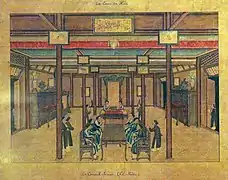 Privy council of Nguyen Dynasty (Cơ Mật Viện: 機密院).
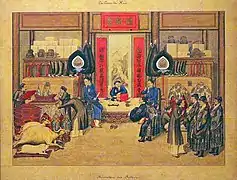 Ministry of Rites of Nguyen Dynasty (Lễ Bộ: 禮部).
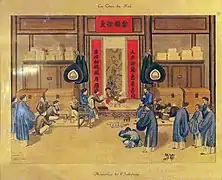 Ministry of administration of Nguyen Dynasty (Lại Bộ: 吏部).
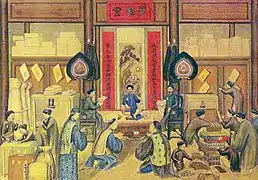 Ministry of Finance of Nguyen Dynasty (Hộ Bộ: 戸部).
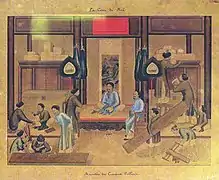 Ministry of Public Works (Công Bộ: 工部).
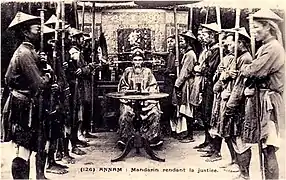 Ministry of Laws (Hình Bộ: 刑部).
 Imperial Academy, Huế under Ministry of Education (Học Bộ: 学部).
 The headquarter of the Privy council.
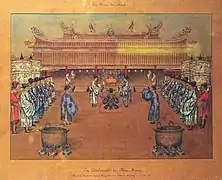 Phục mạng ceremony when mandarin receive the edict from the Emperor.
It was established in 1802 after Gia Long's coronation, however it wasn't fully operational until 1830.[3]
See also
References
- Woodside (1988), p. 68–69.
- Woodside (1988), p. 69.
- Woodside (1988), p. 67.
- Sources
- Woodside, Alexander (1988). Vietnam and the Chinese model: a comparative study of Vietnamese and Chinese government in the first half of the nineteenth century. Cambridge, Massachusetts: Harvard University Press. ISBN 0-674-93721-X.

_colour_scheme_-_%C4%90%E1%BA%A1i_Nam_(%E5%A4%A7%E5%8D%97).svg.png.webp)