Sky Blossom
Sky Blossom: Diaries of the Next Greatest Generation is a 2020 American documentary film directed by Richard Lui which profiles five students across the United States who are caregivers for their disabled military veteran parents or grandparents. Variety magazine named the film as an awards contender for the 2021 Oscars.[2]
| Sky Blossom | |
|---|---|
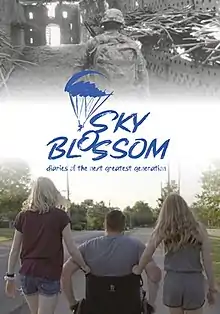 Theatrical release poster | |
| Directed by | Richard Lui |
| Produced by |
|
| Cinematography | Eliana Alvarez Martinez |
| Edited by |
|
| Music by | Maria Lineva |
Production company | Sky Blossom Films |
Release date |
|
Running time | 79 minutes |
| Country | United States |
| Language | English |
The documentary was released in theaters nationwide for one night only through a community partnership of AMC Theaters and Universal Pictures.[3] The film premiered at the John F. Kennedy Center for the Performing Arts with a drive-in theater event on Veterans Day 2020.[4][5]
Synopsis
Five families are profiled in the film, each with a student providing care for a veteran parent or grandparent with disabilities. The film refers to these students as the "Next Greatest Generation."[6]
- Allen Family (McMinnville, Tennessee): High school cheerleader Deryn Allen has been helping her father, Chaz, an Army veteran who lost his legs after stepping on a bomb, put on his prosthetics since she was eight years old.
- Alvarado Family (Long Beach, California): 12-year-old Rhianna Alvarado defends her dad from bullies, who give him "ugly stares" due to his appearance, the result of exposure to burn pits.
- Grier Family (Wexford, Pennsylvania): Air Force veteran Bobby Grier, an aging civil rights icon, is cared for by his granddaughter, Camille, and his son, Rob Jr. Rob opens up about the strain caring for his parents put on his marriage and on his role as a father.
- Kapanui Family (Waimea, Hawaii): Brother and sister Kaleo and Kamaile have put their college studies on hold to look after their grandfather, Bobby, a veteran with dementia. Their grandfather is the only family they have left.
- Ploof Family (Howell, Michigan): 22-year-old Jenna Ploof is the primary breadwinner for her family, balancing her college studies and job with caring for her younger sister and father, Bill, an amputee who has suffered several strokes. While she was in high school, Jenna and her family briefly experienced homelessness when Bill's amputation prevented him from continuing to work as a truck driver.
The film's title is inspired by a World War II era term for paratroopers coming to aid of the wounded on the ground.[7]
Production
The film was shot over four years.[8] The film is inspired by Director Richard Lui's personal experience as a caregiver for his father with Alzheimer's. Lui, an MSNBC news anchor, flew between his work in New York City and his father's home in San Francisco several times a month to help care for his father.[3]
The film is executive produced by television personality Montel Williams, actor David Hyde Pierce, Medal of Honor recipient Colonel Jack Jacobs, Bob & Dolores Hope Foundation CEO Linda Hope, and documentarian Jean Tsien.[9]
Style
The film blends fly-on-the-wall cinema verité with animation, archival video, and interviews conducted by the producers with each of the five families. The animated scenes, drawn by former Disney animator Davy Liu, show scenes of the children's heroism in caring for family members. Composer Maria Lineva wrote original leitmotifs for each of the five families to provide a unique musical sound for each family. The score was performed by a 48-person orchestra made up of students from the Berklee College of Music.[10]
Response
The film is supported by a bipartisan group of Members of the United States Congress, led by Speaker of the House Nancy Pelosi and Senate Majority Leader Mitch McConnell.[3] Other lawmakers supporting the film include Senate Minority Leader Chuck Schumer, Senator Susan Collins, and Senator Tammy Duckworth.[11]
The film was nominated for "Best Documentary" at the AARP The Magazine 2021 Movies for Grownups Awards.[12]
References
- "Sky Blossom". Retrieved June 3, 2021.
- Davis, Clayton (2020-11-19). "Oscars Predictions: Best Documentary Feature – 'Dick Johnson' Is NOT Dead in the Race". Variety. Retrieved 2020-12-02.
- Lejeune, Tristan (2020-11-10). "New doc from MSNBC's Richard Lui examines young Americans who care for disabled family members". TheHill. Retrieved 2020-12-02.
- "New documentary highlights young veteran caregivers of color". NBC News. Retrieved 2020-12-02.
- "A new film honors the young people who care for our nation's heroes who keep our nation safe". wusa9.com. Retrieved 2020-12-03.
- "The Next Greatest Generation". palabra. Retrieved 2020-12-03.
- Gima, Craig. "The Hawaii Herald - Hawaii's Japanese American Journal". The Hawaii Herald. Retrieved 2020-12-02.
- "New documentary shows young people caring for veteran family members". www.kitv.com. Retrieved 2020-12-02.
- Films, Sky Blossom. "The Museum of Tolerance Hosts a Thanksgiving Family Event, An Exclusive Screening for the Film SKY BLOSSOM: Diaries of the Next Greatest Generation". WFMZ.com. Retrieved 2020-12-02.
- Sky Blossom (2020) - IMDb, retrieved 2020-12-02
- "Congressional Honorary Co-Chairs – Sky Blossom". skyblossom.com. Retrieved 2020-12-02.
- "2021 AARP Movies for Grownups Awards Nominations List". The Hollywood Reporter. 2021-02-08. Retrieved 2021-02-08.