Slavianski Bazaar in Vitebsk
The International Festival of Arts “Slavianski Bazaar in Vitebsk”[1] (Belarusian: Міжнародны фестываль мастацтваў «Славянскі базар у Віцебску», Ukrainian: Міжнародний фестиваль мистецтв «Слов'янський базар у Вітебську», Russian: Международный фестиваль искусств "Славянский базар в Витебске"), also known as Slavic Bazaar, is an annual festival held in Vitebsk, Belarus under the auspices of the Belarusian Government since 1992. Its main program is devoted to Slavic music. The main participants are artists from Russia, Belarus, Ukraine, countries of the former Yugoslavia, Poland, and Bulgaria with guests from many other countries, both Slavic and non-Slavic.
| Slavic Bazaar in Vitebsk | |
|---|---|
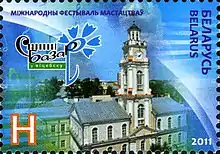 2011 Stamp of Belarus | |
| Genre | Folk, pop, folk-rock |
| Location(s) | Vitebsk, Belarus |
| Years active | 1992-present |
| Founded by | Belarusian Government |
| Website | fest-sbv |
History
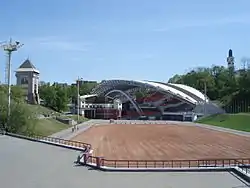
The predecessor of the festival was "Polish Song Festival in Vitebsk" (Polish: pl:Festiwal Piosenki Polskiej w Witebsku) that was held in Vitebsk. Vitebsk was chosen to host the festival according to the agreements with Polish city Zielona Góra where "Soviet Song Festival" (Polish: Festiwal Piosenki Radzieckiej) was held since 1965. The main venue of the present-day festival, the Amphitheatre, was constructed especially for such occasion in 1988. Except from scenic area there were tennis courts, aerobic gyms, restaurant, and a coffee bar.
Only two editions of the "Polish Song Festival in Vitebsk" were held: in 1988 and 1990. After the Dissolution of the Soviet Union the cultural ties between the former Soviet bloc countries have broken. So there emerged an idea to organize a cultural arrangement in order to show the cultural diversity of Slavic nations. The first Slavianski Bazaar was opened in 1992. It was organized by the Belarusian Government with the financial support from Russia and Ukraine. The main goal of the very first festival was an attempt to acquaint the Belarusian audience with pop and folk trends from Slavic countries.
In 1993 the festival became a member of the International Federation of Festival Organizations (FIDOF). Cultural variety has grown as the representatives from non-Slavic countries expressed their interest in participating in the festival. Since 1995 Slavianski Bazaar has acquired the new concept and changed its name to the International Festival of Arts "Slavianski Bazaar".Cinematographic presentations and folk art fairs have become the recurrent events in the festival’s calendar. In 1998 the festival has become an inter-state cultural project of Belarus and Russia and suffered another name change that fixed the festival’s affiliation to the city of Vitebsk: International Festival of Arts "Slavianski Bazaar in Vitebsk".
The festival was awarded the diploma 'FIDOF Festival of the Year 2000' "for impeccable quality of organization, professionalism, hospitality, and promotion of noble humanistic aims on the international level",[2] 'FIDOF Festival of the Year 2004' and other awards.
The contest

During the festival, a contest for young singers is held. It has two stages, each held on a separate day. On the first day the contestants should perform the song in a national language of the country the contestant represents. All vocals are sung live using backing track. On the second day the contestants perform the song written by a composer from any Slavic country in any of the Slavic languages. On this stage all vocals must be sung live with the National Concert Orchestra of Belarus under Mikhail Finberg's conduction.
The final decision is made by the international jury usually consisting of 10 people who are usually former winners of the contest, former contestants, or other celebrities. After the performance each jury gives points from 0 to 10 (although the nil has never actually been given). At the end of the second day all the points are summed up and the Grand Prix winner and other places holders are defined.
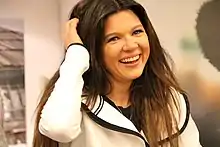
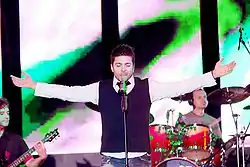
The festival has been the starting point in the careers of several singers such as: Ruslana, Taisia Povaliy, Toše Proeski, Bobi Mojsovski, Pyotr Elfimov, Željko Joksimović and Dimash Kudaibergen.

| Year | Country | Performer |
|---|---|---|
| 1992 |  Ukraine Ukraine | Oleksa Berest |
| 1993 | Ukraine | Taisia Povaliy |
| 1994 | %253B_Flag_of_Serbia_and_Montenegro_(2003%E2%80%932006).svg.png.webp) FR Yugoslavia FR Yugoslavia | Milan Šćepović - Šćepa |
| 1995 | FR Yugoslavia | Filip Žmaher |
| 1996 | Ukraine | Ruslana |
| 1997 | FR Yugoslavia | Svetlana Slavković |
| 1998 |  Israel Israel | Rafael Dahan |
| 1999 | FR Yugoslavia | Željko Joksimović |
| 2000 |  Macedonia Macedonia | Toše Proeski |
| 2001 |  Russia Russia | Theona Dolnikova |
| 2002 | FR Yugoslavia | Milovan Zimonjić |
| 2003 | .svg.png.webp) Belarus Belarus | Maxim Sapatskov |
| 2004 | Belarus | Pyotr Elfimov |
| 2005 | Belarus | Polina Smolova |
| 2006 | Russia | Oksana Bogoslovskaya |
| 2007 | Ukraine | Natalya Krasnyanskaya |
| 2008 |  Lithuania Lithuania | Donny Montell |
| 2009 | Russia | Dmitry Danilenko |
| 2010 |  Croatia Croatia | Damir Kedžo |
| 2011 | Belarus | Alyona Lanskaya |
| 2012 | Macedonia | Bobi Mojsoski |
| 2013 |  Poland Poland | Michał Kaczmarek |
| 2014 |  Mexico Mexico | Rodrigo de la Cadena |
| 2015 |  Kazakhstan Kazakhstan | Dimash Kudaibergen |
| 2016 |  Belarus Belarus | Alexey Gross |
| 2017 | Ukraine | Vlad Sytnik |
| 2018 |  Romania Romania | Marcel Roșca |
| 2019 | Kazakhstan | Ädilxan Makïn |
| 2020 | Belarus | Raman Volazneu |
| 2021 | Kazakhstan | Rukhiya Baydukenova |
Children's contest winners
The children's contest during the festival in Vitebsk was first held in 2003, an expansion of the cultural and artistic diversity of the event. It has become one of the main events in the East European countries for children performers who are making their way to Junior Eurovision Song Contest.
.jpg.webp)
.jpg.webp)
| Year | Country | Performer |
|---|---|---|
| 2003 | Romania | Noni Răzvan Ene |
| 2004 | Russia | Roman Grechushnikov |
| 2005 | Belarus | Ksenia Sitnik |
| 2006 | Poland | Katarzyna Miednik |
| 2007 | Belarus | Andrey Kunets |
| 2008 | Russia | Luara Hayrapetyan |
| 2009 | Romania | Maria Cristina Crăciun |
| 2010 | Romania | Mario Galatanu |
| 2011 | Romania | Raluca-Elena Ursu |
| 2012 |  Georgia Georgia | Mariam Bichoshvili |
| 2013 |  Bulgaria Bulgaria | Presijana Dimitrova |
| 2014 | Ukraine | Anastasiya Baginska |
| 2015 | Kazakhstan | Luisa Nurkuatova |
| 2016 | Russia | Anastasiya Gladilina |
| 2017 | Belarus | Maria Magilnaya |
| 2018 | Ukraine | Oleksandr Balabanov |
| 2019 | Belarus | Ksenija Haletskaja |
| 2020 | Belarus | Anhelina Lamaka |
| 2021 |  Montenegro Montenegro | Komnen Vuković |
- — Although Luara Hayrapetyan is an Armenian, she represented Russia in the 2008 contest under the nickname Lara.
See also
- Through Art – to Peace and Understanding: an award given each year at the Slavic Bazaar
- History of marketing
- Market (place)
- Retail
References
- https://fest-sbv.by/en/about
- "International Federation of Festival Organizations Praised Slavonic Bazaar in Vitebsk". Mfa.gov.by. Retrieved 2012-03-17.
External links
 |
Wikimedia Commons has media related to Category:Slavianski bazar. |