Slavic Charity Organization
The Slavic Charity Organization is a public organization in the Russian Empire, established in early 1858 by a circle of Moscow Slavophiles in Moscow.
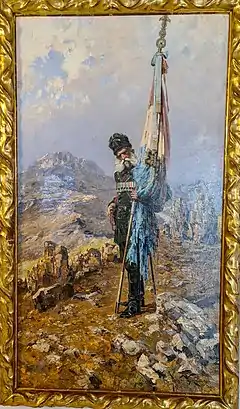
The society officially distributes free books, establishes awards for scientific works, helps students in Russia, organizes readings of essays on Slavism and its history, finances the opening of schools and Eastern Orthodox Churches. [1]
There are several reasons for the creation of the organization. The first is geopolitical, because after the Crimean War, with the withdrawal of the Russian Empire from the pedestal of the first violin of the Congress of Vienna, Russia's influence among the Slavs was limited. The second reason is the continuing search for the historical roots of Holy Rus in response to Normanism and during Anti-Normanism. The third reason was the counterattack of Westernizer.
The greatest achievement of the society was the Treaty of San Stefano with the liberation of Bulgaria. The society disintegrated after an extremely sharp public protest of its members and in particular of its chairman Ivan Aksakov against the Russian policy of the Berlin Congress in the person of Foreign Minister Alexander Gorchakov.
The activity of the society lasted even until the time of the USSR, but it was limited only to the publishing activity of its several committees in places, and in particular in St. Petersburg. [2]
The society organized the first solemn celebration in 1863 in Russia of the work of Cyril and Methodius and their students better known as the Seven Apostles of the Bulgarian Orthodox Church. Ardent supporters of society are the Russian writers Ivan Turgenev with the novel ″On the Eve″ and Fyodor Dostoevsky with the novel ″The Karamazov Brothers″.
References
 History portal
 Russia portal
.svg.png.webp) Europe portal
Europe portal
See also
- Tsar
- Golden Age of Bulgaria
- The way to Sofia