Sleeping Beauty problem
The Sleeping Beauty problem is a puzzle in decision theory in which whenever an ideally rational epistemic agent is awoken from sleep, she has no memory of whether she has been awoken before. Upon being told that she has been woken once or twice according to the toss of a coin, once if heads and twice if tails, she is asked her degree of belief for the coin having come up heads.
History
The problem was originally formulated in unpublished work in the mid 1980s by Arnold Zuboff (the work was later published as "One Self: The Logic of Experience")[1] followed by a paper by Adam Elga.[2] A formal analysis of the problem of belief formation in decision problems with imperfect recall was provided first by Michele Piccione and Ariel Rubinstein in their paper: "On the Interpretation of Decision Problems with Imperfect Recall" where the "paradox of the absent minded driver" was first introduced and the Sleeping Beauty problem discussed as Example 5.[3][4] The name "Sleeping Beauty" was given to the problem by Robert Stalnaker and was first used in extensive discussion in the Usenet newsgroup rec.puzzles in 1999.[5]
The problem
Sleeping Beauty volunteers to undergo the following experiment and is told all of the following details: On Sunday she will be put to sleep. Once or twice, during the experiment, Sleeping Beauty will be awakened, interviewed, and put back to sleep with an amnesia-inducing drug that makes her forget that awakening. A fair coin will be tossed to determine which experimental procedure to undertake:
- If the coin comes up heads, Sleeping Beauty will be awakened and interviewed on Monday only.
- If the coin comes up tails, she will be awakened and interviewed on Monday and Tuesday.
In either case, she will be awakened on Wednesday without interview and the experiment ends.
Any time Sleeping Beauty is awakened and interviewed she will not be able to tell which day it is or whether she has been awakened before. During the interview Sleeping Beauty is asked: "What is your credence now for the proposition that the coin landed heads?"
Solutions
This problem continues to produce ongoing debate.
To resolve the paradox it is unavoidable that we must first define and interpret what probability means. The frequentist interpretation is that probability measures the emergent pattern of many samples; the Bayesian interpretation is that probability measures the subjective belief of the experimenter or in this case the subject.
Let be the random variable governing the fair coin toss, where (heads) with a long-run limiting proportion . If we adopt a frequentist interpretation, then the long-run limiting proportion of heads for the fair coin in this investigation, , is the probability of heads regardless of who is perceiving the flip and when. If we adopt a Bayesian interpretation then "probability of heads" initially references the prior predictive distribution for the coin landing heads,


- ,

based on perfect knowledge that the limiting proportion of heads is with belief probability . To the Bayesian the limiting proportion of heads, , is not a probability. Sleeping Beauty's belief, , is the probability which can later change. If Sleeping Beauty had imperfect knowledge of then would not be a degenerate distribution and would represent her belief in with imperfect knowledge of .



Using Bayes' theorem, Sleeping Beauty's prior predictive distribution for heads is updated based on the information available to her about the number of possible awakenings (1 or 2), forming a posterior predictive distribution. This results in a predictive belief probability of that the coin landed heads,

- .


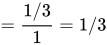
Analogous to Bayesian predictive probabilities, Sleeping Beauty could calculate frequentist predictive p-values and prediction confidence levels which describe the long-run performance of the prediction based on observed data without conditioning on parameter values. The predictive p-value is the probability of the discrepancy between the estimated result (prediction) and the hypothesized result or something more extreme. In this setting Sleeping Beauty's knowledge of the coin being fair is equivalent to having already flipped the coin a near infinite number of times (the estimate has no sampling variability). Therefore, the predictive p-value testing the hypothesis that the coin landed heads is equivalent to the limiting proportion of heads over repeated experiments where Sleeping Beauty is woken twice on tails and once on heads, . We are considering each prediction opportunity as an experiment and an opportunity to make a type I error, not each coin flip. Upon every awakening Sleeping Beauty will predict the coin landed tails, incorrectly rejecting the null hypothesis 33% of the time in repeated testing. Every time she is woken and tests the hypothesis that the coin landed heads she is confident in the alternative, which is tails.


If asked for the limiting proportion of heads, the correct answer is regardless of paradigm. If asked for the frequentist predictive p-value testing the hypothesis that the coin landed heads, the answer is . If asked for the updated Bayesian belief of the subject whether the coin landed heads, the answer is .

Other positions
Thirder position
The thirder position argues that the probability of heads is 1/3. Adam Elga argued for this position originally[2] as follows: Suppose Sleeping Beauty is told and she comes to fully believe that the coin landed tails. By even a highly restricted principle of indifference, given that the coin lands tails, her credence that it is Monday should equal her credence that it is Tuesday, since being in one situation would be subjectively indistinguishable from the other. In other words, P(Monday | Tails) = P(Tuesday | Tails), and thus
- P(Tails and Tuesday) = P(Tails and Monday).
Suppose now that Sleeping Beauty is told upon awakening and comes to fully believe that it is Monday. Guided by the objective chance of heads landing being equal to the chance of tails landing, it should hold that P(Tails | Monday) = P(Heads | Monday), and thus
- P(Tails and Tuesday) = P(Tails and Monday) = P(Heads and Monday).
Since these three outcomes are exhaustive and exclusive for one trial, the probability of each is one-third by the previous two steps in the argument.
Halfer position
David Lewis responded to Elga's paper with the position that Sleeping Beauty's credence that the coin landed heads should be 1/2.[6] Sleeping Beauty receives no new non-self-locating information throughout the experiment because she is told the details of the experiment. Since her credence before the experiment is P(Heads) = 1/2, she ought to continue to have a credence of P(Heads) = 1/2 since she gains no new relevant evidence when she wakes up during the experiment. This directly contradicts one of the thirder's premises, since it means P(Tails | Monday) = 1/3 and P(Heads | Monday) = 2/3.
Nick Bostrom argues that Sleeping Beauty does have new evidence about her future from Sunday: "that she is now in it," but does not know whether it is Monday or Tuesday, so the halfer argument fails.[7] In particular, she gains the information that it is not both Tuesday and the case that Heads was flipped.
Double halfer position
The double halfer position[8] argues that both P(Heads) and P(Heads | Monday) equal 1/2. Mikaël Cozic,[9] in particular, argues that context-sensitive propositions like "it is Monday" are in general problematic for conditionalization and proposes the use of an imaging rule instead, which supports the double halfer position.
Connections to other problems
Nick Bostrom argues that the thirder position is implied by the Self-Indication Assumption.
Credence about what precedes awakenings is a core question in connection with the anthropic principle.
Variations
Extreme Sleeping Beauty
This differs from the original in that there are one million and one wakings if tails comes up. It was formulated by Nick Bostrom, and is used to argue for the thirder position.
Sailor's Child problem
The Sailor's Child problem, introduced by Radford M. Neal, is somewhat similar. It involves a sailor who regularly sails between ports. In one port there is a woman who wants to have a child with him, across the sea there is another woman who also wants to have a child with him. The sailor cannot decide if he will have one or two children, so he will leave it up to a coin toss. If Heads, he will have one child, and if Tails, two children. But if the coin lands on Heads, which woman would have his child? He would decide this by looking at The Sailors Guide to Ports and the woman in the port that appears first would be the woman that he has a child with. You are his child. You do not have a copy of The Sailors Guide to Ports. What is the probability that you are his only child, thus the coin landed on Heads (assume a fair coin)?[10]
References
- Arnold Zuboff (1990). "One Self: The Logic of Experience". Inquiry: An Interdisciplinary Journal of Philosophy. 33 (1): 39–68. doi:10.1080/00201749008602210.(subscription required)
- Elga, A. (2000). "Self-locating Belief and the Sleeping Beauty Problem". Analysis. 60 (2): 143–147. CiteSeerX 10.1.1.32.3107. doi:10.1093/analys/60.2.143. JSTOR 3329167.
- Michele Piccione and Ariel Rubinstein (1997) “On the Interpretation of Decision Problems with Imperfect Recall,” Games and Economic Behavior 20, 3-24.
- Michele Piccione and Ariel Rubinstein (1997) “The Absent Minded Driver's Paradox: Synthesis and Responses,” Games and Economic Behavior 20, 121-130.
- Nick Wedd (June 14, 2006). "Some "Sleeping Beauty" postings". Retrieved November 7, 2014.
- Lewis, D. (2001). "Sleeping Beauty: reply to Elga" (PDF). Analysis. 61 (3): 171–76. doi:10.1093/analys/61.3.171. JSTOR 3329230.
- Bostrom, Nick (July 2007). "Sleeping beauty and self-location: A hybrid model" (PDF). Synthese. 157 (1): 59–78. doi:10.1007/s11229-006-9010-7. JSTOR 27653543. S2CID 12215640.
- Meacham, C. J. (2008). "Sleeping beauty and the dynamics of de se beliefs". Philosophical Studies. 138 (2): 245–269. CiteSeerX 10.1.1.517.4904. doi:10.1007/s11098-006-9036-1. JSTOR 40208872. S2CID 26902640.
- Mikaël Cozic (February 2011). "Imaging and Sleeping Beauty: A case for double-halfers". International Journal of Approximate Reasoning. 52 (2): 137–143. doi:10.1016/j.ijar.2009.06.010.
- Neal, Radford M. (2006). "Puzzles of Anthropic Reasoning Resolved Using Full Non-indexical Conditioning". arXiv:math/0608592.
Other works discussing the Sleeping Beauty problem
- Arntzenius, F (2002). "Reflections on Sleeping Beauty". Analysis. 62 (1): 53–62. doi:10.1093/analys/62.1.53. JSTOR 3329069.
- Bostrom, Nick (2002-07-12). Anthropic Bias. Routledge (UK). pp. 195–96. ISBN 978-0-415-93858-7.
- Bradley, D (2003). "Sleeping Beauty: a note on Dorr's argument for 1/3". Analysis. 63 (3): 266–268. doi:10.1093/analys/63.3.266. JSTOR 3329324.
- Bruce, Colin (2004-12-21). Schrodinger's Rabbits: Entering the Many Worlds of Quantum. Joseph Henry Press. pp. 193–96. ISBN 978-0-309-09051-3.
- Dorr, C (2002). "Sleeping Beauty: in Defence of Elga". Analysis. 62 (4): 292–296. doi:10.1093/analys/62.4.292. JSTOR 3328920.
- Elga, A. (2000). "Self-locating Belief and the Sleeping Beauty Problem". Analysis. 60 (2): 143–147. doi:10.1093/analys/60.2.143. JSTOR 3329167.
- Lewis, D. (2001). "Sleeping Beauty: reply to Elga" (PDF). Analysis. 61 (3): 171–76. doi:10.1093/analys/61.3.171. JSTOR 3329230.
- Meacham, C. J. (2008). "Sleeping beauty and the dynamics of de se beliefs". Philosophical Studies. 138 (2): 245–269. CiteSeerX 10.1.1.517.4904. doi:10.1007/s11098-006-9036-1. JSTOR 40208872. S2CID 26902640.
- Monton, B. (2002). "Sleeping Beauty and the Forgetful Bayesian". Analysis. 62 (1): 47–53. doi:10.1093/analys/62.1.47. JSTOR 3329068.
- Neal, R. (2006). Puzzles of Anthropic Reasoning Resolved Using Full Non-indexical Conditioning, preprint
- Rosenthal, J.S. (2009). "A mathematical analysis of the Sleeping Beauty problem". The Mathematical Intelligencer. 31 (3): 32–37. CiteSeerX 10.1.1.151.2326. doi:10.1007/s00283-009-9060-z. S2CID 14152244.
- Titelbaum, M. (2013). Quitting Certainties, 210–229, 233–237, 241–249, 250, 276–277
- Zuboff, A. (1990). "One Self: The Logic of Experience". Inquiry. 33 (1): 39–68. doi:10.1080/00201749008602210.
External links
- Terry Horgan: Sleeping Beauty Awakened: New Odds at the Dawn of the New Day (review paper with references)
- Franceschi, Paul. "A Two-Sided Ontological Solution to the Sleeping Beauty Problem" (PDF).
- Anthropic Preprint Archive: The Sleeping Beauty Problem: An archive of papers on this problem
- Phil Papers Entry on Sleeping Beauty (a complete bibliography of papers on the problem)
- Twoplustwo thread discussing the sleeping beauty problem in depth