Urtica urens
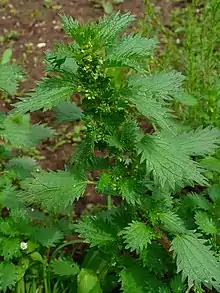
Urtica urens, commonly known as annual nettle, dwarf nettle, small nettle, dog nettle, or burning nettle, is a herbaceous annual flowering plant species in the nettle family Urticaceae. It is native to Eurasia, including the Himalayan regions of Kalimpong, Darjeeling and Sikkim in India and can be found in North America, New Zealand and South Africa as an introduced species. It is reputed to sting more strongly than common nettle.[1]
| Urtica urens | |
|---|---|
 | |
Scientific classification  | |
| Kingdom: | Plantae |
| Clade: | Tracheophytes |
| Clade: | Angiosperms |
| Clade: | Eudicots |
| Clade: | Rosids |
| Order: | Rosales |
| Family: | Urticaceae |
| Genus: | Urtica |
| Species: | U. urens |
| Binomial name | |
| Urtica urens | |
Organism interactions
In Europe, Urtica urens is one of the food plants of the small tortoiseshell butterfly (Aglais urticae). In New Zealand it is also a food plant for the New Zealand red admiral butterfly (Bassaris gonerilla, syn. Vanessa gonerilla, syn. Papilio gonerilla), and the Australian / New Zealand yellow admiral butterfly (Vanessa itea).[2]
References
External links
 Media related to Urtica urens at Wikimedia Commons
Authority control  | |
|---|---|
| General | |
| National libraries | |