Soga clan (Sagami Province)
The Soga clan (Japanese: 曾我氏, Soga-shi) was a samurai family in Sagami Province descending from the Taira clan. The clan is not related to the Soga clan (蘇我氏) of the Yamato period.
| Soga 曾我 | |
|---|---|
| Home province | Sagami Province |
| Parent house | Chiba clan |
| Founder | Soga Sukeie |
| Founding year | 12th century |
| Cadet branches | Tsugaru-Soga clan |
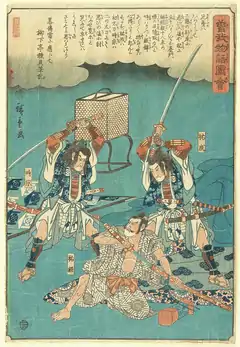
Known for the Revenge of the Soga Brothers incident of the early Kamakura period, they later became high-ranking military officials under the Ashikaga shogunate during the Muromachi period. During the Edo period, they continued their military service and served the Tokugawa shogunate.
Origins
The Soga clan's origins are in Soga Manor in Sagami Province. They descended from the Kanmu Heishi line of the Taira clan through the Chiba clan, making them direct descendants of the 8th century Emperor Kanmu.[1][2] The founder of the Soga clan, Soga Sukeie is Taira no Yoshifumi's eighth generation descendant.[2]
History
Although the clan claims descent from the Chiba clan, considering that the descendants inherited the territory in Izu Province, the clan was more closely related to the Itō clan than the Chiba clan based in Shimosa Province.[1]
The wife of Soga Sukeie's son Sukenobu, is the mother of the Soga brothers, Soga Sukenari and Tokimune, who are known for their revenge known as the Revenge of the Soga Brothers against Kudō Suketsune, the killer of their biological father.[1][3] Although the biological father of the Soga brothers is Kawazu Sukeyasu of the Itō clan, the brothers took the family name Soga after their mother remarried to Soga Sukenobu following Kawazu Sukeyasu's death, thus making Sukenobu the stepfather of the brothers.[1]
The Revenge of the Soga Brothers incident occurred in May 1193, when the Soga brothers participated in the grand hunting event Fuji no Makigari held by shogun Minamoto no Yoritomo. On May 28 of the same year, the Soga brothers took their revenge and killed Kudō Suketsune on the last night of Fuji no Makigari. After the brothers killed ten other participants, the elder brother Soga Sukenari was shot by Suketsune's subordinate Nitta Tadatsune. The younger brother Soga Tokimune killed all the samurai one by one who attempted to stop him, and broke into Yoritomo's living quarters. However, Gosho no Gorōmaru took Tokimune down before he could attack the shogun. The next day, Tokimune was executed for the assassination attempt on the shogun.[4] This incident is recorded in Azuma Kagami and in Soga Monogatari, a dramatized epic tale of the Soga brothers' revenge.[3]
During the Muromachi period, several members of the Soga clan, descending from the Kanmu Heishi lineage, served the Ashikaga shogunate as hōkōshū military officials. Soga Shōjirō served as the ichibanshū (first guard of the shogun) during the Bun'an era. In 1563, Soga Harusuke served as the suke kokushi official of Kōzuke Province and Soga Saemon-jō as ashigarushū (ashigaru officer). This line of the Soga clan also served the Tokugawa shogunate in the Edo period.[2]
References
- Sekai Daihyakkajiten 2 (世界大百科事典 第2版). Heibonsha. 1998. Soga-uji (曾我氏).
- Ota, Akira (1942). Seishi Kakei Daijiten, Volume 3 (姓氏家系大辞典、第3巻) (in Japanese). Kokuminsha. pp. 3198–3199, 曾我.
- Ichiko, Teiji (1966). Soga Monogatari - Iwanami Koten Bungakutaikei 88 (曽我物語 岩波古典文学大系88). Iwanami Shoten.
- Sakai, Koichi (2000). Soga monogatari no shijitsu to kyokō (曾我物語の史実と虚構) (in Japanese). Japan: Yoshikawa Kobunkan.