Solange Hertz
Nellie Solange Strong Hertz (née Strong; January 1, 1920 – October 3, 2015) was an American traditionalist Catholic author, who published almost two dozen books on Catholicism and spiritualism. She received national attention during the Vietnam War when her husband, Gustav Crane Hertz, was kidnapped by Viet Cong guerrillas in Saigon. Gustav's kidnapping spurred several failed government negotiations to rescue him, including one led by Robert F. Kennedy; but Gustav ultimately perished after more than two years in captivity.[1]
Solange Hertz | |
|---|---|
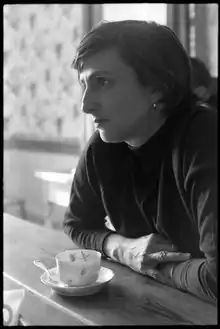 Solange Hertz in 1965 | |
| Born | Nellie Solange Strong January 1, 1920 Washington D.C., U.S. |
| Died | October 3, 2015 (aged 95) Leesburg, Virginia, U.S. |
| Alma mater | American University (BA) |
| Occupation |
|
| Known for | Traditionalist Catholicism |
| Spouse(s) | Gustav Crane Hertz
(m. 1938; died 1967) |
| Children | 5 |
Early life and education
Nellie Solange Strong was born in Washington D.C. on January 1, 1920, the only child to John Logan Strong and Andree Laurans Strong. At age 15, Solange graduated from Western High School in Washington D.C. as the class valedictorian. She was the first female recipient of the school’s scholarship to the (at that time) all-male Georgetown University. Solange instead attended American University where she graduated summa cum laude[2] with a BA in Classical Language on June 5, 1939, at the age of 19.
Life and career
Family
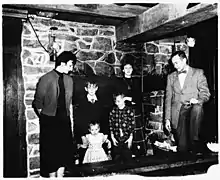
Solange married her classmate, Gustav Crane Hertz, in 1938. The couple settled in Leesburg, Virginia, where they bought their home, an old historic farmhouse (which would serve as the motivation for her first book, Old Stone Houses of Loudoun County, Virginia).[2] Solange & Gustav went on to have a total of five children together: Lydia Logan Hertz, Gustav Jr., Stephen, Christina (Tina), & Crane.[3] At the time of her death in 2015, she was survived by four of her five children (with Lydia having died in 1997), as well as 19 grandchildren, and 50 great-grandchildren.
Vietnam war
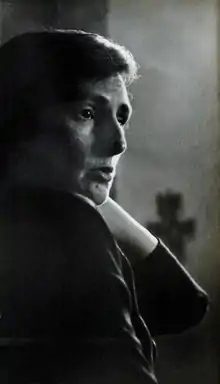
Solange Hertz's husband, Gustav, was the chief public administrator for the U.S. Agency for International Development’s mission in Vietnam. Having been assigned the position in 1963, he traveled all over South Vietnam, teaching civil administration across the war-torn country.[4] The Hertz family resided for some time in Vietnam, enjoying the local Vietnamese way of life. Solange initially preferred living among the Vietnamese to American life, despite occasional Viet Cong terrorism. On this, she explained that "I'm not the nervous type."[4]
On the afternoon of Tuesday, Feb. 2, 1965, at about 2:30 P.M., Gustav went out for a leisurely motorcycle in Saigon and disappeared.[2][5] At the time of his kidnapping, Gustav was the highest-ranking prisoner to be taken captive by the Vietcong.[4] By that early evening, Solange Hertz reported her husband missing, but any attempt to search for him was initially delayed. With it being the Lunar New Year, the Viet Cong had previously observed a truce over the holidays. Additionally, no other U.S. civilian advisor had been kidnapped by the Viet Cong before Gustav, leading authorities to doubt that he had actually been captured.[4] Hertz's frantic calls to U.S. military authorities eventually lead to the opening of an investigation. It took two days after his disappearance before U.S. authorities had even bothered to travel up the street to look for him.[4] The pace of the search for Gustav was forcibly sped up 40 hours after his disappearance, when Presidential Assistant McGeorge Bundy had arrived in Saigon for an inspection visit. Bundy was informed that "our Public Administration guy has been kidnapped", which accelerated the search for Gustav. State Department Officials had acknowledged at the time that any further investigation into Gustav's disappearance would likely be a waste, as too much time had passed before they started searching for him. One official stated that "Within four minutes after the V.C. got Hertz, they had hidden him where we never could have found him."[4]
10 days after his disappearance, on February 12, Hertz received an envelope in the mail, containing two letters. The first was a handwritten letter from Gustav, stating he would be returning home within a week. The handwriting matched her husband's, but the letter addressed her "Solange", rather than "Nellie", which he had always called her. The second letter was written in Vietnamese, and was signed by a man who revealed himself as a representative of the Viet Cong in the village of Thu Duc, which was located five miles north of Saigon.[4] The letter gave Hertz instructions on what to do to discuss the conditions of her husband's release, but gave a date set for a meeting four days before she received the letter in the mail. With the letter having taken too long to reach her, Hertz was unable to follow the Viet Cong's instructions, with the first letter marking the last time Hertz ever heard from her husband.
Given that kidnapping of a civilian prisoner by the Viet Cong was unprecedented, the U.S. government had no real conduct to follow. Hertz also tried enlisting the help of Catholic clergy (which held contacts in the Vietnamese countryside) as well as the French (having been informed that the French mission in Hanoi could possibly get word to the Viet Cong).[4] Ultimately though, all attempts at negotiation failed. Hertz returned to Leesburg, Virginia with her children in March, so that closer proximity to Washington D.C. would allow her to apply pressure to the State Department and White House for Gustav's release. Soon after, the Saigon government arrested and condemned a terrorist, Nguyen Van Thai, to death for the March 30 bombing of the U.S. embassy. The Viet Cong then used Gutav's life as a threat of retaliatory execution if Thai was killed.[6] Thai's execution was post-posted to spare Gustav's life, though this ran counter to the South Vietnamese desire to see Thai executed for his crimes. In 1965, Prime Minister Nguyễn Cao Kỳ came into office and vowed to carry out all death sentences against those on death row, including Thai. U.S. administrative officials managed to convince Ky to exempt Thai, for the sake of Gustav.[4] Meanwhile, several U.S. government attempts were made for the release of her husband, and an unsuccessful prisoner exchange led by then-Senator Robert F. Kennedy. Kennedy attempted to help the Hertz family after members of Congress were approached by Solange for help. Kennedy, through an Algerian ambassador, came into contact with a one time guerilla fighter named Huynh Van Tam. Tam informed the Algerian ambassador, who informed Kennedy in turn, that the Viet Cong would agree to a prisoner swap: Gustav Hertz for Nguyen Van Thai. Kennedy referred the prisoner swap proposal to the White House, who rejected it on the grounds that a civilian was not of equal value as a convicted terrorist and that the U.S. should not negotiate with the Viet Cong in such a fashion, among other reasons. The Hertz family was bewildered and angered at the White House's rejection of the deal, with Solange stating that her husband was being sacrificed to "maintain the fake image that the U.S. had absolutely nothing to do with the politics and government of South Vietnam."[4] Later unsuccessful attempts were made, including a rejected ransom of about $20,000 (U.S. money at that time) in 1966, though all efforts ultimately fell through.
Initially, Gustav's kidnapping drew only a small amount of media attention.[4] However, In June 1967, the Viet Cong Liberation Radio announced Gustav had been executed; drawing far more attention to the case. The Hertz family clutched at hope for a short time after this radio message, as the surname 'Hertz' had been incorrectly pronounced, leading them to believe he may still be alive.[4] Shortly after the radio broadcast, Hertz was informed through intermediaries that Gustav had not been executed, but actually had died of malaria in a North Vietnamese prison.[1] In 1973, Gustav's name appeared on a list delivered to the U.S. government of Americans who had perished in Vietnamese captivity. Hertz later buried her husband in 2002, after a long search for his remains by the State Department concluded after a successful DNA match.[3]
Writer
Hertz was a prolific writer, supporting her five children in part with the publication of almost two dozen books on Catholicism and spiritualism. Her work was featured in several local publications, including the Loudoun Times-Mirror, the Washington Evening Star, Antiques magazine and others. She also wrote for numerous Catholic periodicals and magazines such as America, Immaculata, The Remnant, Triumph, and others.[7]
Views
Hertz's work defended traditional Catholic views on family and the Tridentine mass; often attacking Feminism, Americanism, & Scientism.[8] Hertz described herself as a "counter-revolutionary."[9]
Capital punishment
In 2001, Hertz argued in favor of capital punishment, writing that to argue against it was "to contend with constituted reality. Ever since Adam and Eve committed the Original Sin, every living creature is subject to it. Every one of us is born on Death Row and lives out his allotted lifespan in its shadow without hope of reprieve...there has always been a death penalty. God instituted it, and He was the first to impose it, embedding it in the very fabric of natural law."[10]
Contraception
Hertz was opposed to both artificial contraception, which the Catholic Church considers "intrinsically evil",[11] and Natural Family Planning, which it deems permissible in limited circumstances.[12] Hertz wrote that
"the abomination of desolation is contraception … particularly as practiced by His own people in the guise of so-called "natural family planning" … Standing poised in the holy place to destroy souls and bodies at the very source of life in the Christian family, contraception is proving to be the apex and consummation of that old Master heresy from which all Christian heresies have derived. By its means Lucifer hopes to terminate the Church as we know her."[13]
Hertz also asserted that Jesus and the Virgin Mary did not ever possess nocturnal emissions or menstruation, respectively. In her work Sin Revisited, she writes
"Wet dreams and menstruation are universal in mankind today only because sin is universal in mankind, its effects actualized in our very bodies. Properly ordered human beings operating in perfect harmony with God's designs would not require the physical relief of periodic discharges to correct imbalances. All bodily processes and secretions would be self-regulating. Unless released for reproduction by an express command of the human will, sperm and ova would remain in the body, where they belong as due components. We would, in other words, be integrated. Such was the bodily state of our Lord and the Blessed Virgin on earth, and to say otherwise is both heretical and blasphemous."[14]
Feminism
Hertz was a critic of Feminism, often writing that gender distinction was divinely ordered.[15] Hertz's view was that a woman's role as a housewife and mother did not make her inferior to men, but significant and equal in her own unique right. In her article The Housewife as Guerilla, she wrote about Feminists and gender roles
“The cowardice of women’s liberationists is shocking; they don’t seem to possess the most elementary female courage. At this crucial juncture they are proclaiming out loud that women are no good at all, that to qualify as human beings they must be like men...before all creation that they have been wrong from the beginning...that men are more excellent in all departments of life and have been right all along about how to do things. . . . A real woman wants man’s role in society as she wants hair on her face. Never would she admit for a moment that man’s way of doing things is better than hers, or that he’s any smarter. She will only acknowledge, quite happily, that he’s different and that she needs him. She will be tireless, on the other hand, in demonstrating how much he needs her. Without me, dear, she tells Adam, you can do nothing!...Not the least of woman’s guerrilla activities is the care and training of future guerrillas, not to mention all the professional soldiers who must issue from her womb. These are her 'seed,' destined to battle the Adversary—and win. The quality of their fighting spirit is her first responsibility. She must use every natural means at her command to this supernatural end. If she deserts her post, what men can man theirs?"[16]
Hertz also wrote that there was no "confusion about woman’s role in the world. God clearly defined it when He created mankind male and female, and it has never changed. Declaring that 'it is not good for man to be alone,' the Creator made for Adam 'a help like unto himself' (Gen. 2: 18). The whole vocation of woman rests in being God’s help to man, to whom she is united indissolubly in one human nature."[17]
Gluttony
Hertz discussed the sin of gluttony in her work Sin Revisited. Writing that the "control of gluttony is therefore the key to the whole spiritual life",[18] she emphasized the importance of moderation in eating and fasting. Hertz, following the advice of the early Christian Fathers, recommended conquering gluttony by "anchoring the mind in the contemplation of divine things" and following three rules:
"1. Eat only at designated times.
2. Eat what is set before you.
3. Always leave the table with room for more."[19]
Monarchy
Herz wrote that monarchy was "the only form of government formally and positively sanctioned in Scripture and Tradition” and consonant with the “very order of Persons in the Most Blessed Trinity, where God the Father is Source of both the Son and the Holy Spirit.”[20][21]
Hertz was critical towards the French Revolution, stating its effect must not be minimized. She described King Louis XVI as "Christ's constituted vicar in the temporal order"[22] and that had "his throne endured, the collapse of Christian law and order which eventually left the Church everywhere at the mercy of the State would not have been possible."[23] She wrote that the King of France was "Constituted a quasi-bishop in the temporal order" & defended the practice of the royal touch as "miraculously effective, provided only that the monarch was in the state of grace", citing Charles X's miraculous healing of eleven victims of scrofula who presented themselves before him.[24] Hertz likewise considered Charles X to be the last true King of France, on the basis that the other French monarchs after Louis XVI's execution (that is Louis XVIII & Louis Philippe I) were never "anointed or consecrated by any prelate of the Holy Catholic Church". She also distinguished Napoleon I's ceremonial coronation from that of an anointed one, and stated that Napoleon came to power due to the French people's "natural craving for monarchy".[25]
Sexual intercourse
Hertz held that "Sex, like God, is Sacred".[26] In her work Women, Words, and Wisdom, she writes in great detail the relationship between sexual intercourse between spouses and Catholicism. In one chapter, Hertz wrote
"Physical details of human love are not often discussed in pious literature for the simple reasoning that discussing sex is excruciatingly embarrassing to modest people. St. Augustine suffered from this impediment and speculated on why exactly this should be, if sex is good and ordained by God, as we know it is...
The problem remains, however, and it's as much the housewife's as the theologian's. Sex lies at the bottom of her entire career, and her perfection is inextricably bound up in it, whether she likes it or not...
Sex began with Eve's creation...
Thus it seems that in some mysterious way marriage reintegrates the Adam and Eve in every couple and makes them one again as they were originally...Marriage is a love affair. It has to be, because God's union with a human soul, which marriage is meant to reflect, is a love affair...
The collection of Hebrew love poems we call Canticle of Canticles is full of embarrassing details. Beginning, 'Let him kiss me with the kiss of his mouth,' it goes on from there through a riot of extravagant Oriental imagery that leaves prudes gasping...
...Man's first and basic occupation, it would seem, is that of a gardener. It's his function to planet the earth and make it produce...
Man is also a gardener in the marriage-bed, because his union with his wife represents the union of God and the soul, a relationship of gardener with garden. He is given his garden "to till and to keep" when he promises to love, cherish, and protect his wife.
In all literatures and mythologies the earth is the figure of a woman. Under countless names, Ceres, the earth goddess, is a universal symbol of fertility...
Women's role in the marriage act is passive, but not inert, any more than the human soul before God. She is meant to be aroused to response as a garden would to the gardener. Oh, if only modern men in our secular world could be made to pore over gardening manuals and seed catalogues when tempted to read those ghastly sex books purveying mutual masturbation. If only they would pray and read Scripture! What they wouldn't learn about sexual 'compatibility'! Unfortunately, the people most qualified to write sex books could never bring themselves to do so. Modesty shuts theirs mouths, but rarely shuts the mouths of fools. As long as there is religion without theology, there can be sex without love...
Small wonder sex is sacred. Sex and prayer go together to mutually reveal each other. No one fascinated by God could fail to be fascinated by sex...
...Sex, like prayer, must be engaged in secretly and humbly, for by divine decree it is now shielded from earthly view."[27]
In Sin Revisited, Hertz identified sexual lust as closely related to gluttony, writing that
"Like eating, sex has a specific, intense pleasure attached to it which is ordered to the preservation of life—in this case the life of the species rather than the individual. As with gluttony, lust therefore consists in seeking, either mentally or physically, the pleasure apart from the purpose God ordained it to serve, or seeking it primarily.[28]
Hertz also writes in this work that
"Sex and prayer are in fact rather close traveling companions, due to the fact that by their very nature both are ordered to a union with persons, carnal in one instance and divine in the other. Human nature, fallen and befuddled by sin as it is, therefore easily confuses the two."[29]
Public Reception
Hertz was primarily known in the public sphere due to her husband's kidnapping. Within the Catholic community, she received both praise and criticism for her theological views. Dr. Marian T. Hovart gave her work Beyond Politics a positive review, describing it as a "synthesis of a ripe and experienced Catholic consideration of History".[30] Journalist Stefanie Nicholas gave a positive review to Hertz's work Women, Words, and Wisdom.[31] Historian Charles A. Coulombe has spoken positively of Hertz's work.[32] Supreme Court Justice Antonin Scalia defended Hertz's views on capital punishment.[33]
Catholic apologist Karl Keating criticized Hertz for her geocentrist beliefs.[34] Father Johnathan Loop, SSPX, wrote a work in 1991 criticizing Hertz's negative views towards the United States, entitled The Strange Spirit of Solange Hertz: A Study in Disinformation.
Death
Hertz died at age 95 on October 3, 2015, at a nursing home in Leesburg, Virgina. She had previously been admitted to hospice in 2014 due to severe respiratory distress, which she faced with her "sense of humor" intact.[35] The cause of death was cancer and complication from strokes, according to her granddaughter, Elizabeth Puglise.[1]
Selected bibliography
Books
- Old Stone Houses of Loudoun County, Virginia, (1950) [as Solange Strong]
- Women, Words, & Wisdom, (1959) [as Solange Hertz]
- Come Down, Zacchaeus, (1961)
- Searcher of Majesty, (1963)
- Feast for a Week, (1964)
- The Occult Franklin, (1983)
- The Star-Spangled Heresy: Americanism, (1992)
- Utopia Nowhere, (1993)
- The Thought of Their Heart, (1994)
- Beyond Politics, (1995)
- Sin Revisited, (1996)
- On the Contrary, (1997)
- Apostasy in America, (1998)
- The Battle for Amerindia, (2000)
- The Sixth Trumpet, (2002)
- The Passion of the Church, (2005)
Articles
- Among Women, (April 1972)
- The Woman and Her Home: 1. The Home as Divine Mystery, (May 1972)
- The Woman and her Home: 2. The Housewife's Vocation According to Saint Paul, (June 1972)
- The Crack in the Board, (July 1972)
- Thoughts on the Working Mother: Housewife as Martyr, (October 1972)
- Walls, Roof and Door: The Home as Sanctuary, (January, 1973)
- The Housewife as Guerrilla, (April, 1973)
- D'abord, The Home: Mama's Manifesto, (July, 1973)
- Discovering the Real Christopher Columbus, (October, 1992)
- Will He Find Faith...in the third millennium?, (November, 1993)
- Horses and Mules, (January, 1997)
- Out of the Murk, (January, 1998)
- Quo Vadis, Petre?, (July, 1999)
- The Death Penalty, Instituted by God Himself (The Biblical Basis for Catholic Teaching on Capital Punishment), (March, 2001)
- The Real World, (February, 2002)
- A Revelation for America and for Our Times, (March, 2002)
- The Scientific Illusion, (April, 2003)
- Is the Black Mass Valid, (2006)
- Joan of Arc: Scourge of Modern Feminists, (July, 2008)
- The Housewife as Martyr, (August, 2011)
- The Home as Divine Mystery, (January, 2012)
- Russia and the Mother of God, (April, 2014)
- Will Rome Lose the Faith? (La Salette Revisited), (August, 2014)
References
- Barnes, Bart (25 October 2015). "Nellie Hertz, whose husband was a civilian captive in Vietnam, dies at 95". The Washington Post.
- Barnes, Bart (30 October 2015). "Nellie Hertz: Writer on theology whose husband was kidnapped in Vietnam". The Independent.
- Obituary for Nellie Solange Strong Hertz
- Stolley, Richard B. (21 July 1967). "The Fight to Make the Vietcong Let Him Go". Life Magazine Vol 63, No. 3. p. 22-29.
- Pho, Helen N. (February 2015). Cold War Kidnapping: The Gustav Hertz Case and the Failure of Secret Negotiations in Vietnam, 1965-1967. Pacific Historical Views, Vol 84, No. 1. 84. University of California Press. pp. 19–47. doi:10.1525/phr.2015.84.1.19. JSTOR 10.1525/phr.2015.84.1.19.
- International Herald Tribune (29 June 2015). 1965: Life Insurance on Hostage.
- "Books by Solange Hertz".
- Matt, Michael J. (3 October 2015). "Solange Hertz, RIP". The Remnant.
- Hertz, Solange (1 June 2011). On the Contrary. Tumblar House. p. 1.
- Hertz, Solange (March 2001). "The Death Penalty, Instituted by God Himself (The Biblical Basis for Catholic Teaching on Capital Punishment)". The Remnant.
- Catechism of the Catholic Church, Second Edition. Paragraph 2370
- Pope Paul VI (25 July 1968). "Humanae Vitae".
- Hertz, Solange. Beyond Politics. p. 200.
- Hertz, Solange (2015). Sin Revisited. Tumblar House. pp. 20–21.
- Popowski, Mark David. Roman Catholic Crusading in Ten Years of TRIUMPH, 1966-1976: A History of a Lay-Directed, Radical Catholic Journal (PDF). p. 440.
- Hertz, Solange (April 1973). "The Housewife as Guerilla". Triumph 8 No. 4. p. 26-27. Archived from the original on 7 September 2016.
- Hertz, Solange (July 2008). "The Virgin Joan, Mother of the Christian State". Archived from the original on 10 April 2021.
- Hertz. Sin Revisited. p. 10.
- Hertz. Sin Revisited. p. 14.
- Hertz, Solange (July 1973). "D'abord, The Home: Mama's Manifesto". Triumph 8 no. 7. p. 20.
- Popowski. p. 281
- Hertz, Solange (2012). Apostasy in America. Tumblar House. p. 1.
- Ibid, p. 1
- Hertz, Solange. Democracy, Monarchy and the Fourth Commandment
- Ibid
- Hertz, Solange (1959). "Chapter XXI". Women, Words, and Wisdom. The Newman Press. p. 153.
- Hertz (1959). Women, Words, and Wisdom. Westminster, Md., Newman Press. pp. 154–162.
- Hertz. Sin Revisited. p. 23.
- Hertz. Sin Revisited. p. 106.
- Hovart, Marian T. "A Catholic Meta-History". TraditioninAction.org. Archived from the original on 30 March 2021.
- Nicholas, Stephanie (1 August 2019). "A Review of Women, Words, & Wisdom".
- Solange Hertz (Youtube Video). Tumblar House. 6 May 2018.
- "Tower of Trent Tribute to Solange Strong Hertz". Daily Catholic Vol. 16, no. 152. 1 June 2005. Archived from the original on 24 January 2021.
- Keating, Karl (1 May 2015). "Bad Religion, Bad Science". Catholic.com.
- Matt, Michael J. (11 August 2014). "A Grand Catholic Lady Needs Our Prayers". The Remnant.
Further reading
- Stolley, Richard B. The Fight to Make the Vietcong Let Him Go, pp 22–29. Life Magazine Vol. 63, No. 3 (21 July 1967) Text