Active region
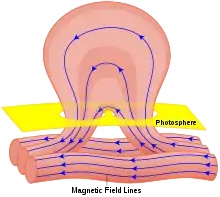
An active region is a temporary region in the Sun's atmosphere characterized by a strong and complex magnetic field. They are often associated with sunspots and are commonly the source of violent eruptions such as coronal mass ejections and solar flares.[1] The number and location of active regions on the solar disk at any given time is dependent on the solar cycle.[2][3][4][5][6]
Region numbers
Newly observed active regions on the solar disk are assigned 4-digit region numbers by the Space Weather Prediction Center (SWPC) on the day following the initial observation. The region number assigned to a particular active region is one added to the previously assigned number. For example, the first observation of active region 8090, or AR8090, was followed by AR8091.
The region numbers reached 10,000 in July 2002. However, the SWPC continued using 4-digits, with the inclusion of leading zeros.[7]
Sunspots

The strong magnetic flux found in active regions is often strong enough to inhibit convection. Without convection transporting energy from the Sun's interior to the photosphere, surface temperature decreases along with the intensity of emitted black body radiation. These areas of cooler plasma are known as sunspots, and often appear in groups.[8] However, not all active regions possess sunspots.[7]
See also
- List of solar cycles
- List of solar storms
- Hyder flare
- Magnetic cloud
- Orbiting Solar Observatory
- Phoebus group, international scientists aiming at detecting solar g modes
- Solar and Heliospheric Observatory
References
- Zell, Holly (20 April 2015). "Active Regions on the Sun". NASA. Retrieved 18 July 2021.
- Warren, Harry P.; Winebarger, Amy R.; Brooks, David H. (10 November 2012). "A SYSTEMATIC SURVEY OF HIGH-TEMPERATURE EMISSION IN SOLAR ACTIVE REGIONS". The Astrophysical Journal. 759 (2): 141. arXiv:1204.3220. doi:10.1088/0004-637X/759/2/141.
- Del Zanna, G. (October 2013). "The multi-thermal emission in solar active regions". Astronomy & Astrophysics. 558: A73. doi:10.1051/0004-6361/201321653.
- Basu, Sarbani; Antia, H. M.; Bogart, Richard S. (August 2004). "Ring‐Diagram Analysis of the Structure of Solar Active Regions". The Astrophysical Journal. 610 (2): 1157–1168. doi:10.1086/421843.
- Hagino, Masaoki; Sakurai, Takashi (25 October 2004). "Latitude Variation of Helicity in Solar Active Regions". Publications of the Astronomical Society of Japan. 56 (5): 831–843. doi:10.1093/pasj/56.5.831.
- Zhang, Jie; Wang, Yuming; Liu, Yang (10 November 2010). "STATISTICAL PROPERTIES OF SOLAR ACTIVE REGIONS OBTAINED FROM AN AUTOMATIC DETECTION SYSTEM AND THE COMPUTATIONAL BIASES". The Astrophysical Journal. 723 (2): 1006–1018. doi:10.1088/0004-637X/723/2/1006.
- "Solar Region Summary | NOAA / NWS Space Weather Prediction Center". www.swpc.noaa.gov. Retrieved 4 November 2021.
- "SECEF Sunspot Resource". image.gsfc.nasa.gov.
