Sonar 2031
Sonar 2031 is a family of passive towed array sonar formerly used by the Royal Navy on Leander-class, Type 22 and Type 23 frigates. [1]
_underway_in_1991.jpg.webp)
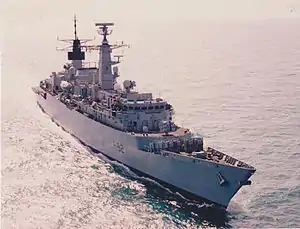
Sonar 2031 consisted of a 663-metre (2,175 ft), 89 mm (3.5 in) diameter, five-octave hydrophone array, on the end of a 1,830 m (6,000 ft), 40 mm (1.6 in) tow cable, and was a Critical Angle Towed Array (in which the depth of the non-buoyant array is determined by towing speed and tow cable length) as opposed to a Depressed Towed Array (a directly controllable variable depth sonar featuring a hydrodynamic body on the far end of the array) as in US systems of the time.
Developed based on experience shared with the United States Navy in submarine-based towed arrays, Sonar 2031 was the first surface ship towed array developed and used by the Royal Navy. Naval Staff Requirement (NSR) 7638 set out the requirement for a passive towed array, and between 1978 and 1985 a prototype (2031X) was trialled in the frigate HMS Lowestoft. The first production model, designated 2031I, was fitted to four Leander-class frigates (HMS Cleopatra, Phoebe, Sirius and Minerva) as part of the Batch 2A (Exocet/Sea Cat) conversion. After modification, the prototype set was fitted to HMS Arethusa as 2031Y.
By the mid 1980s, electronic technology had improved to the point that the four racks of hard-wired special-purpose signal processors used in Sonar 2031I could be replaced by a single rack of digital microchips giving much higher computing power. This modification, utilising "Curtis Architecture" developed by the Admiralty Underwater Weapons Establishment, was introduced into a modified and improved Sonar 2031Z. In addition to this change in computing hardware, 2031Z introduced waterfall displays generated by computing the Fourier transform of incoming signals, displayed on raster screens. The winch and handling arrangements were also improved, a wider and lower winch allowing the sonar to be moved down from the upper deck to the quarterdeck, keeping it clear of helicopter operations. Sonar 2031Z was fitted to Batch 2 and 3 Type 22 frigates, and the eight ASW-specialist (Batch 2 and 3) Type 23 frigates, where it was replaced in the 2010s by Sonar 2087. From 2001, further improvements were introduced in the form of Sonar 2031E, retaining the same towed array hardware but replacing the computers and displays to improve performance.
References
- Marland, Peter. "Postwar Sonar Systems in the Royal Navy". Warship 2021: 150–164.